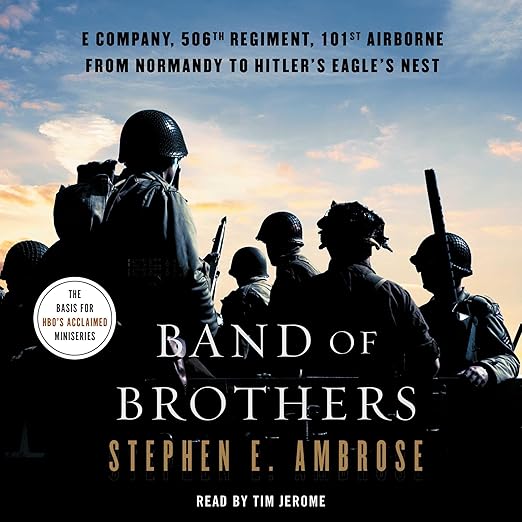
The Short Version
- Performance: Tim Jerome's measured, respectful delivery suits this act of remembrance; he tracks a large cast without overcharacterizing any voice.
- What it covers: Brotherhood under fire, the paradox of transformative hardship, the gap between training and combat.
- Feel: Sombre, reverent, and at moments quietly devastating.
- Our call: Ambrose's account of Easy Company holds its emotional truth intact across twelve hours, and Tim Jerome's narration honors that weight.
What Ambrose understood, and what distinguishes this audiobook from dozens of other World War II histories, is that the story of Easy Company only makes sense as a human story first and a military history second. Band of Brothers is built from hundreds of interviews, diaries, and letters, and Ambrose stitches that material into something with the texture of lived memory rather than the smooth certainty of official record. The men of E Company took 150 percent casualties. They were at Bastogne, at the Arnhem campaign, at Berchtesgaden at the end. The book does not let any of that become abstract.
I came to this one having already seen the HBO series several times, which is an unusual way into a source text. What surprised me about listening to the audiobook through Tim Jerome's narration was how much the written account fills in the silences that television, even very good television, cannot accommodate. The characters on the page are rougher, more tired, more contradictory than their screen counterparts, and the account of what it actually meant to hold Bastogne while surrounded in winter is more harrowing in print than anything the series managed to put on screen.
Ambrose's approach is sometimes criticized by military historians for its emotional directness and its willingness to let veterans' recollections shape the historical record without aggressive corroboration. That criticism has merit at the methodological level. At the level of the reader's experience, however, the effect is that you are hearing what it felt like to be in Easy Company from the men who were there, mediated by a writer who took their testimony seriously. The book's relationship to memory as a historical source is part of what it is doing, and the result is richer than a more formally rigorous history would have been.
The section on Herbert Sobel, the commanding officer the men loathed and the one who trained them better than any loved CO could have, is one of the most psychologically interesting passages in American military writing. Ambrose does not excuse Sobel, but he is clear that Easy Company's battlefield excellence in 1944 and 1945 was partly Sobel's creation. The men knew it. The book knows it. That kind of moral complexity, held without resolution, is what lifts Band of Brothers above its genre.
Jerome Lets the Names Carry the Weight
Tim Jerome's narration is a good fit for the material. This is a book with a large cast of named individuals, and Jerome maintains enough vocal differentiation to track the major figures through the text without resorting to exaggerated characterization. His register is measured and respectful, which suits a book that is, at its core, an act of remembrance. When the prose becomes quietly devastating, as it does in the accounts of soldiers killed in Holland or in the final counting of the dead, Jerome does not oversell the emotion. He lets the names and the facts carry the weight.
One reviewer described watching the HBO series and then reading the book as filling in gaps on events and context the series omitted, and that observation maps closely to my own experience. The audiobook and the television adaptation serve genuinely different functions. The series is a visual and dramatic compression. The audiobook is the human record on which that compression was built. Both are worth your time, but they are not interchangeable, and the book has things to offer that the series cannot.
The foreword by Tom Hanks, who co-produced the HBO series alongside Steven Spielberg, provides a brief orientation to why this particular company and this particular book caught enough attention to become a cultural touchstone. It is short and adds something, which is all a foreword needs to do.
The liberation of Berchtesgaden, Hitler's Bavarian retreat, which Easy Company reached at the war's end, functions as the book's emotional conclusion rather than simply its chronological one. After everything the company endured at Bastogne and in Holland, the moment of occupying the Eagle's Nest has an almost surreal quality in Ambrose's telling. The men who arrived there were not the same men who had trained in Georgia in 1942, and Ambrose is careful to acknowledge both the victory and the cost. The chapter is quiet where you might expect it to be triumphant, and that restraint is among the book's best decisions.
Over a Hundred Names to Keep Straight
Ambrose's narrative moves chronologically from training in Georgia in 1942 through disbanding in 1945, and the middle portion, the Holland and Ardennes campaigns, is considerably more intense than the earlier training sections. Listeners who come in expecting consistent pacing across the twelve-hour runtime may find the early sections slower. Ambrose is building toward something, and the training material matters for understanding what Easy Company became, but patience is required before the book fully catches fire.
The scale of the cast is also a real challenge for first-time listeners. Easy Company had more than a hundred men across its history, and while Ambrose focuses on a core group of officers and NCOs, the names accumulate quickly. Listeners who have not seen the HBO series may want to keep a simple mental shorthand for the key figures: Winters, Lipton, Guarnere, Toye, Blithe. The television series, whatever its limitations, gives each of these men a face and a voice that makes the book easier to follow. First-time listeners may actually benefit from watching some of the series before or alongside listening to the audiobook.
Essential Listening for Ground-Level WWII History
This audiobook is essential for anyone seriously interested in World War II at the ground level, in the culture of the American airborne, or in the history of the Ardennes campaign and the liberation of Europe. Fans of the HBO series who have never read the source text will find the audiobook fills in considerable detail and emotional texture the adaptation compressed or omitted. Tim Jerome's narration makes the twelve-hour runtime a steady, absorbing experience. Listeners looking for a critical or revisionist military history will find Ambrose's methodology more sympathetic to oral testimony than to archival rigor, but as a work of memory and tribute, Band of Brothers remains one of the essential American books about the Second World War.