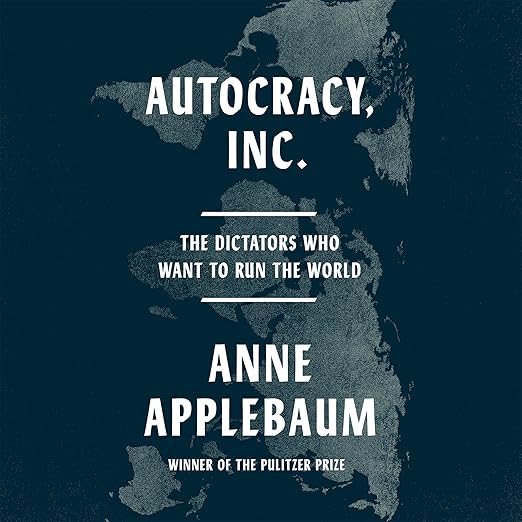
At a Glance
- Narrator: Anne Applebaum reads her own argument across four hours and forty-eight minutes, and an author's emphasis counts for a great deal in a book built as polemic.
- Subjects: Networked autocracy, kleptocracy and surveillance, the failure of sanctions, what democracies should do instead.
- Tone: Brisk, alarmed, argumentative.
- Bottom line: A compact and forceful case rather than a balanced survey, and stronger for being read by the person making it.
Four hours and forty-eight minutes is a short book, and Anne Applebaum meant it that way. Autocracy, Inc. is an argument rather than a history, closer in shape to a long essay than to the archival volumes that earned its author a Pulitzer, and the audiobook comes in shorter than most single-volume histories manage. Applebaum reads it herself, which for a polemic is the difference between hearing a case and hearing somebody make one.
What Anne Applebaum Delivers
Applebaum narrating her own argument changes what the recording does. A hired reader delivers a text; an author delivers an intention, and the emphases land where the writer wanted them. That matters most in the passages where the book is being deliberately provocative, and it turns provocative early. The opening move is to sketch the autocracy everyone pictures, an all-powerful leader at the top, a police force threatening the population, evil collaborators and a few brave dissidents, and then to insist that the image bears little resemblance to how power actually works now.
Kleptocratic financial structures, surveillance technologies and professional propagandists are the three pillars the book puts in that image's place. The claim is that they operate across regimes rather than inside any single one: corrupt companies in one country trading with corrupt companies in another, police forces arming and training police forces elsewhere, propagandists sharing resources and hammering home identical messages about the weakness of democracy. The members of the network, in this framing, share no ideology whatsoever. What binds them is an appetite for power, wealth and impunity. Stated that baldly it sounds cynical, and the book spends most of its length demonstrating that the cynicism is descriptive rather than rhetorical.
George Kennan's containment essay is the acknowledged model, and the comparison explains the length. That essay worked because it was short, argumentative and aimed at policymakers rather than specialists, and Applebaum is writing in the same register: a treatise meant to change what governments do rather than a study meant to settle a scholarly question. Anyone expecting the density of a full archival history will find this leaner and considerably more insistent, and the under-five-hour runtime is a property of the form rather than a shortfall.
What Anne Applebaum Gets Right
Howard Schulman's five-star response supplies the most useful comparison anywhere on the page, having arrived here after Iron Curtain, the earlier book on how the Soviet Union took over Eastern Europe in the years after WW II. The verdict is that this one is different in kind: where the earlier book reconstructed a period from the vantage of the ordinary person living through it, Autocracy, Inc. examines how autocrats around the globe currently work together to stay in power, so that when one leader gets into trouble another regime steps in with help.
William de Rham's four-star review, headlined "Paints some frightening pictures", is the most careful summary in the column, and it lists the countries the book puts in frame: Russia, China, Iran, Syria, Cuba, Venezuela and many others with no interest in protecting human rights and every interest in their own sovereignty. That list is the real subject of the book. De Rham's grade, a four where every other voice on the page gave five, is also the only reservation registered in the column, and no explanation for the withheld star appears anywhere in the text of the review.
Sanctions do not work in this account, and neither does condemnation. The book states plainly that international pressure and economic penalties cannot move the autocrats, and that popular opposition movements from Venezuela to Hong Kong to Moscow do not stand a chance on their own. It is a bleak middle stretch, and hearing it in the author's own measured delivery keeps it from tipping into either despair or lecture. The closing call, that democracies must fundamentally reorient their policies, then arrives as a proposal rather than as consolation.
Where Anne Applebaum Loses Some Ground
Rich Swain's five-star entry is not a review of this book. It is a political statement in capital letters about a sitting president, ending in exclamation marks, with a single clause of praise for the author folded into it. Nothing in it describes the argument, the structure or the evidence. Anyone scanning the column for guidance should recognize that a title like this one attracts responses to the subject rather than to the work, and weigh the star average accordingly.
Corey S contributes two sentences under a five-star grade, and half of them concern how quickly the delivery arrived. The other half calls the book a quick read for understanding a topic relevant to today, which is at least on subject. Yoseph Hadar's entry runs to eight words of praise. Taken together, the written responses here are enthusiastic, brief, and almost entirely about the politics of the argument rather than about how it is built.
The blurbs stacked at the top of the description do a great deal of work and should be read as what they are. Best-of-the-year selections from four publications, a bestseller line, and a quotation from John Simpson in The Guardian calling it a masterful guide to the new age of authoritarianism, clear-sighted and fearless. All of that is real, and none of it tells you whether the argument holds. The central claim, that ideology no longer binds these regimes together, is precisely the sort of thesis specialists will contest, and a listener should hold it as a position rather than a finding.
Who Should Pick Up Autocracy, Inc.
Students of contemporary politics, readers who followed the author's earlier work, and anyone wanting a compact framework for reading the news will get real value out of under five hours. The self-narration suits that audience particularly well: the delivery is a historian's, unhurried and specific, and the compression means nothing here is padded. It also functions as a first book on the subject, since the argument is laid out plainly and assumes no prior reading.
Pass if you want an even-handed survey of comparative authoritarianism, or a documented case study rather than a case. This book takes a position and argues it hard, and the response column is dominated by people who arrived already agreeing. Readers who came looking for archival texture will find far less of it here than the earlier work supplied. Applebaum wrote a short book on purpose, and reading it herself keeps the urgency exactly where she put it.
Common Questions
Does Anne Applebaum narrate the Autocracy, Inc. audiobook herself?
She does, across four hours and forty-eight minutes. For a book conceived as a treatise rather than a history, that counts: the emphases fall where the writer intended them, and the provocative early passages about what an autocratic state actually looks like carry the author's own timing instead of a performer's guess.
Is this audiobook long enough to cover the subject properly?
Under five hours sounds thin for global authoritarianism until you notice the model. The book invokes George Kennan's containment essay, which worked precisely because it was short and aimed at policymakers. Expect a framework, three or four sustained claims and a policy proposal, not a country-by-country survey of regimes.
What is the central claim of the book?
That autocracies are no longer held together by ideology the way communism once held them, but by kleptocratic finance, surveillance technology and shared propaganda operating across borders. Corrupt companies trade with corrupt companies, police forces arm and train police forces. What binds the network is appetite for power, wealth and impunity.
Why are the reviews on this page so political?
Because the subject invites it. One five-star response is a capitalized statement about a sitting president with a single clause about the author. Another devotes half its length to how fast delivery arrived. Only the four-star entry actually summarizes the argument, listing the regimes the book puts in frame.