
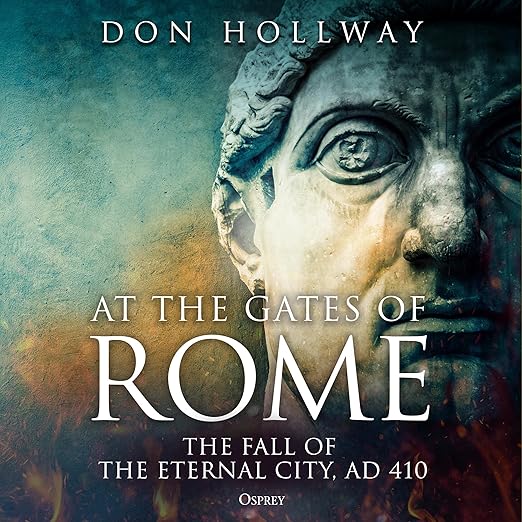
Bloomsbury's copy names the narrator in its opening line, before it names either of the two men this audiobook is about. That is a small courtesy and a rare one, and it sets the tone for a record that is unusually clear about what it is selling: fourteen hours and twenty minutes on the generation in which the Western Roman Empire came apart, read by Mark Meadows, told through a Roman general and a Gothic king who had once fought on the same side.
Two Soldiers Split by One Generation's Collapse
Two soldiers who knew each other well end up on opposite sides of the same collapse. Flavius Stilicho is the man behind the Roman throne, a general who dedicates himself to restoring imperial glory and then spends his energy fighting political enemies at home instead. Alaric wants to be a friend of Rome, is betrayed by it, and becomes its enemy because nothing else is left to him. They fight each other to a standstill, cooperate against threats worse than each other, and when one of them falls the survivor takes a revenge the book says had no precedent. Christians against pagans, legions against barbarians, generals against politicians, all of it happening while the thing they are fighting over shrinks. The book's opening claim is that little more than a single generation was needed to end a centuries-old empire, and the pleasure of the telling is watching how ordinary each fatal decision looks at the moment it gets made.
Among the five-stars, the one filed March 12, 2024 identifies exactly why this works when so much late antiquity writing does not. The period is usually dry because the sources are thin, and this book fills the gaps with vivid detail drawn from many chroniclers so the narrative avoids dead spots and repetition. That reader credits the author with always producing an interesting anecdote, an unusual fact, or a quote from ancient literature at the moment the story might otherwise sag. Both halves of the empire get covered, eastern and western, which matters because the story makes no sense with only one of them in view.
Mark Meadows Goes Unmentioned in Every Review
Calibration arrives in one sentence, from the five-star filed July 28, 2022: deep enough to satisfy what you have always wanted to know about the era of Alaric's sack, light enough to move quickly. That is a difficult balance in ancient history, where books tend to be either popular retellings with the evidence hidden or academic accounts that assume you already know who everyone is. Hollway, whose previous book followed a Viking king, writes narrative history with the chronicler's voice audible in it rather than paraphrased away. The method is stated openly in the description, which promises the ancient accounts of both men combined into a single story of betrayal, politics, intrigue and war, and the seams between sources are left visible rather than smoothed over.
Not one response addresses the recording itself, which is worth flagging because at first glance it looks otherwise. The five-star filed on March 12, 2026 is headed with praise for the narrative and reports having read this author before with consistent pleasure, but the word there refers to the writing rather than the reading, and Mark Meadows goes unmentioned across the whole sample. On a fourteen hour history that gap matters, since a narrator's handling of Roman names and quoted sources determines how much of the detail actually reaches you.
Maps and a Cast List That Never Made the Recording
Oddly, the most useful warning comes from a five-star, which makes it more credible rather than less. Filed on September 8, 2022 by someone who taught high school history for thirty-three years, it says plainly that one has to work to read this book, that a reader cannot breeze through turning pages whimsically, and that this is a good thing. It then lists what the author supplies to make the task easier: maps, a chronology, illustrations and a cast of characters. Every one of those is a print asset. None of them travels into audio, and nothing on this record mentions a supplementary download, so the apparatus built specifically to keep you oriented is exactly what the format removes.
Weigh that seriously before buying. This is a story with two protagonists, a divided empire, competing emperors, shifting alliances and a supporting cast drawn from several chroniclers, spread across fourteen hours and twenty minutes. A cast list you cannot consult is a real handicap, and the same reader praises the low-key humor and suspense in the writing, which suggests the prose will carry you even when the names blur. Anyone who wants both should consider running the audio with a print or digital copy nearby for the maps. It is also worth knowing that the empire in this story is split east and west with a frontier that will not hold still, so the geography does real narrative work and losing it costs more here than in most military history.
Choose This for a Single Generation, Not the Full Arc
Dissent in the sample amounts to a single three-star from January 2, 2025, which calls the book well researched and the reading slow, in five words total. That is not much to go on, but it lines up with the warning above rather than contradicting it: this is history that asks for attention, and a listener wanting momentum above all will feel the drag. Set your expectations toward absorption rather than propulsion and the same quality reads as depth.
Choose it if the fall of Rome has always been a phrase rather than a sequence of events you could describe, or if you like military history where the politics get equal weight. It will also suit anyone who enjoyed The Last Viking, since the method is the same. Newcomers to the period will manage, though they should expect to look things up. Anyone who wants a brisk survey of Roman history end to end is in the wrong book: this one zooms in hard on a single generation and stays there. That narrowness is the reason it succeeds, and the reason it will frustrate a listener who wanted the whole arc of the empire in one sitting.







