Key Details
- Narration: Michael Kramer takes on a book that moves two separate expeditions along two separate routes over three years, which puts unusual pressure on a listener's ability to hold names and geography without a map.
- Themes: westward expansion, commercial empire building, survival and attrition, the founding of the Oregon Trail
- Mood: Grim, propulsive, occasionally horrifying
- Verdict: A first-rate disaster narrative for anyone who likes their history hard-edged, with the caveat that the geography arrives faster than the ear can map it.
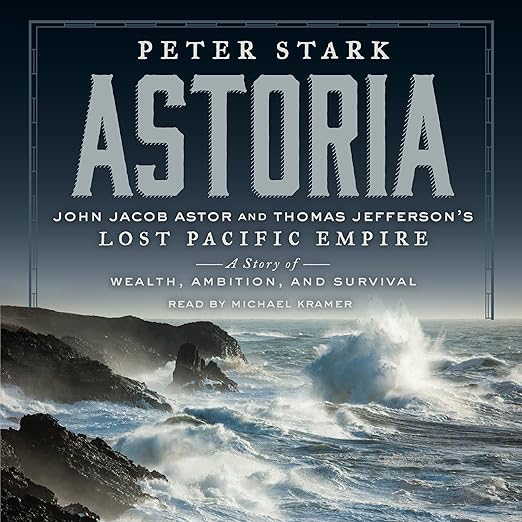
Fort Astoria lasted barely long enough to matter, and this audiobook spends nearly eleven hours explaining why it mattered anyway. Peter Stark's account of the 1810 Astor expedition runs ten hours and fifty-four minutes in Michael Kramer's reading, and the story it covers is compressed into three years: two advance parties dispatched toward the Pacific Northwest, one crossing the Rockies overland and the other rounding Cape Horn by sea, both aimed at planting an American commercial colony on a coast the young republic had not yet secured.
Numbers do most of the persuading in the opening stretch. Of the more than one hundred and forty people in the two advance parties that reached the West Coast, the publisher's own summary says nearly half died by violence, and others went mad. Within a year the survivors had put up a trading post on the Columbia River. The colony did not last. What it did was open provincial American eyes to what the western coast might be worth, and its founders helped blaze the route that became the Oregon Trail, which is a strange kind of legacy for a venture that failed on its own terms.
Astor himself is the hook, and a February 2015 report, at four stars, frames him better than the marketing copy does. It starts from a question almost anyone can answer, about the hotel in New York that bears his name, and then works backward: John Jacob Astor, born in Waldorf in Germany, was the richest man in America in the early nineteenth century, and he got there by way of butchering, selling violins and buying fur. The same account tracks the ascent from that beginning to presumptive lord of the northwestern coast of North America, working in concert with Thomas Jefferson and against the Northwest Company operating out of Canada. That arc is the book's actual subject, and it is a commercial story before it is an adventure one.
The Strengths
Publishers name comparison titles for a reason, and the two invoked here are precise rather than aspirational: this is pitched alongside The Lost City of Z and Skeletons in the Zahara, which tells you the register immediately. Expect attrition, weather, bad decisions made confidently, and a strong authorial interest in exactly how a body fails when it runs out of food. Stark writes for Outside magazine, and that background shows in the passages about physical breakdown, which are reported with the specificity of someone who has thought carefully about cold and hunger as technical problems.
Enthusiasm in the response column runs to the same qualities. The June 2018 report, five stars, lists what it liked in a single breath: grand global schemes, fascinating individuals, unspoiled country and massive hardship, with a particular affection for the French Canadian Voyageurs. That entry also supplies the kind of detail that makes a history feel suddenly close, noting that the overland party crossed paths with Sacajawea, who by then was already part of the Lewis and Clark story the whole country was still talking about. Six years separate the two expeditions in the publisher's framing, and hearing that overlap makes 1810 feel less like a date and more like a moment with people still in it.
Ten hours and fifty-four minutes is also generous enough to let the two-party structure breathe. Cutting between an overland column and a ship working its way around Cape Horn is a device that would feel contrived in fiction and is simply what happened here, and the alternation gives the book a rhythm that sustains a long listen better than a single chronological march would.
What to Watch For in Astoria
Accuracy comes up, and pointedly. A four-star report from July 2017 carries a headline announcing a fascinating story with a major historical error in it, then spends its available space on a careful and admiring summary of Astor's fur ambitions and Jefferson's strategic interest before running out mid-sentence. The error is never named in the visible text. Anyone who wants to know what it was will have to look elsewhere, which is frustrating precisely because the rest of that entry reads as informed and fair-minded rather than reflexively critical.
Difficulty is the other recurring note, and the briefest report here puts it most economically. Left at four stars in March 2017 with no headline attached to it at all, it calls the book a complex tale but very readable, which is a compliment carrying a warning inside it. Complexity here means two parties, three years, a shifting cast of traders, sailors and financial backers, and a geography running from New York to Cape Horn to the mouth of the Columbia. In print you can flip back. Listening, you cannot, and the material never pauses to reorient anyone who lost the thread twenty minutes ago.
Worth noting too: the listing's own description contains a garbled clause about when Lewis and Clark began their journey, the sort of slip that survives on retail pages for years. It has no bearing on the book, but if you are judging a title by its product copy, that copy has not been proofread.
Recommended For
Survival narrative fans who want one set on their own continent are the obvious audience here. Anyone interested in the commercial machinery of expansion will be served just as well, since the fur trade, the competition with Canadian firms and Jefferson's strategic calculations get real attention rather than serving as background to the suffering. Histories of ventures that failed have their own following too, and the collapse is where this book is sharpest.
A single protagonist to follow is what this book will not give you, since the cast splits early and the two halves stay apart for a long stretch. Maps, portraits and appendices do not travel into an audio edition either, which will frustrate anyone who reads history with a finger on an atlas. Newcomers to the period face the steepest climb: the book assumes you arrive knowing roughly who Lewis and Clark were and why anyone cared about the mouth of the Columbia River, and it stops to explain neither.