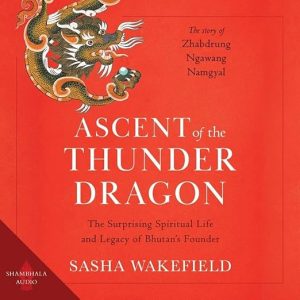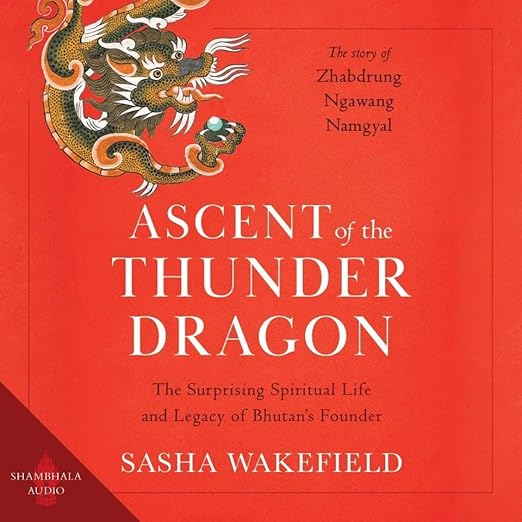
Bhutan in the seventeenth century is the stage for Ascent of the Thunder Dragon, and Sasha Wakefield built this audiobook by braiding two timelines together, the life of Zhabdrung Ngawang Namgyal, the political and spiritual leader who unified the kingdom between 1594 and 1651, and Wakefield's own more recent spiritual journey from Australia to Bhutan tracing that history firsthand. Erin Humphrey Konuma narrates just over nine hours covering reincarnation, karma, and the specific Buddhist lineage Zhabdrung established, material that according to reviewer Mary was not even Wakefield's own idea to write, but a task assigned by her Buddhist teacher.
Braided Timelines Build Bhutan's Founding Story
The book's dual structure is its most distinctive choice. Rather than writing straight biography or straight memoir, Wakefield interweaves Zhabdrung's seventeenth-century story with her own travels retracing it, using her personal journey as the frame for explaining Buddhist concepts a general audience might not already know, reincarnation, karma, bodhisattvas, buddhas, and enlightenment. The synopsis singles out Zhabdrung reaching what it calls the tenth bhumi, a specific level of spiritual accomplishment for a bodhisattva, and his deliberate choice of his own rebirth, framing him as an unusually advanced spiritual figure rather than only a political one.
Politically, the book covers Zhabdrung's role as an early nation-builder facing adversaries and attacks, responding, per the synopsis, with meditation and diplomacy rather than force alone, and it details the ritual and ceremonial life of the Bhutanese state, including verse liturgies and consecration ceremonies tied to establishing the Drukpa Kargyu Buddhist lineage. That combination, statecraft alongside religious practice, is presented as inseparable in Bhutan's founding rather than as two separate storylines running in parallel through the book.
Zhabdrung's remarkable past lives, a phrase the synopsis uses directly, are treated as part of the same throughline rather than a single supernatural claim isolated to one chapter, connecting his political authority to his spiritual standing across the whole account. By the end of the period the book covers, Zhabdrung had established Bhutan as what the synopsis calls a sovereign land, tying religious lineage and national founding together as one achievement rather than two separate legacies competing for space.
Konuma's Narration Alongside a PDF Assist
Both written reviews are enthusiastic, and both emphasize Wakefield's personal presence in the material as a strength rather than a distraction. Mary calls the book the result of several years of arduous research, praising clear writing and what the review describes as spell binding passages, while noting the book was not originally Wakefield's own idea, her Buddhist teacher assigned the task, which the review treats as evidence of a kind of accountability to the material rather than a purely personal project. Mary also mentions living in Bhutan personally for many years, framed as part of what qualified Wakefield for a project she did not originally choose for herself. Pacific9 goes further, calling the book far more than a dry founding-of-Bhutan history, full of intrigue, devotion, and perseverance, and specifically praises how present the author remains throughout as she relates her own experiences uncovering the history.
A companion element matters here too. The listing notes that a PDF accompanies the audio in your Audible Library, which for a book this dense with named historical figures, Buddhist terminology, and Bhutanese place names is a practical addition rather than a marketing extra. Anyone planning to absorb the specific lineage details, the Drukpa Kargyu succession or the verse liturgies described in the ceremonies, may want that document open alongside Konuma's narration rather than relying on audio alone for names this unfamiliar to a general Western audience. The synopsis does not specify what the PDF actually contains beyond calling it accompanying material, so treat it as a bonus reference rather than a guaranteed glossary or map, and check the product page directly if a specific kind of supplement is what you are counting on.
Thin Two-Review Sample, No Textbook Framing
Mary's review breaks off right as it turns to discuss even the drier parts of Zhabdrung's life, which suggests the fuller thought was headed toward pacing or density somewhere in the book, a point that never gets to land. Both written reviews are five stars, and together they account for the full ten-point total behind the listing's 5.0 average, a rating that is at least mathematically clean, though two reviews is still a thin sample for a book covering this much specialized ground. Both reviews are dated well after the book's January 2026 release, Pacific9's in mid-February and Mary's in early March, so unlike listings elsewhere where feedback predates the edition being sold, nothing here suggests these accounts describe a different version of the book.
Anyone expecting a conventional, third-person political history of Bhutan should recalibrate before starting. Wakefield's own spiritual journey is not background color here, it is structurally load-bearing, and the synopsis is explicit that reincarnation, karma, and Zhabdrung's specific spiritual attainments get treated as historically real developments in his story rather than as folklore reported at arm's length. Listeners who want their Bhutanese history kept separate from Buddhist cosmology should know upfront that this book does not separate them. The combination of the tenth-bhumi spiritual claim, the political nation-building, and the ceremonial detail means listeners get very little conventional textbook framing, dates and successions stated flatly, and instead get material presented through Wakefield's own sense of its significance throughout.
Suited to Readers Who Want Faith Woven In
Readers drawn to Bhutan specifically, to Buddhist history and practice, or to memoir-driven history where the author's own search shapes the narrative will find all three well served here, and Pacific9's description of intrigue, devotion, and perseverance suggests the book earns its length rather than padding out nine hours with repetition. The PDF companion is worth downloading before starting, especially for listeners unfamiliar with Bhutanese names and Buddhist terminology that appear throughout the narration. Listeners who enjoy history carried by one dedicated researcher's years of accumulated firsthand knowledge, rather than a detached academic survey assembled from a distance, will likely find the nine hours move faster than the subject matter might suggest on paper.
Readers wanting Zhabdrung's political history isolated from Wakefield's own spiritual framework will not get that separation, since the two are woven together by design. A rigorously secular academic history, written entirely at arm's length from its subject, this is not either. This book's whole approach depends on the author's closeness to the material rather than distance from it, and the nine-hour runtime reflects that closeness rather than padding.
How long is the Ascent of the Thunder Dragon audiobook?
Erin Humphrey Konuma narrates nine hours and nine minutes, covering both Zhabdrung Ngawang Namgyal's seventeenth-century story and Sasha Wakefield's own travels retracing it from Australia to Bhutan. No abridgment is flagged anywhere on the listing, and the runtime folds the historical, ceremonial, and personal-journey material into one continuous account rather than separated sections.
Is this audiobook a memoir or a history of Bhutan?
Both, deliberately combined. Wakefield interweaves her own spiritual journey with Zhabdrung Ngawang Namgyal's seventeenth-century life and legacy, and reviewer Pacific9 specifically praises how present the author remains throughout as a personal guide rather than a detached narrator. Listeners wanting one without the other should know the two are not separated.
Do listeners need prior knowledge of Buddhism to follow this audiobook?
Not necessarily, since the synopsis presents Wakefield's own journey as a frame for introducing concepts like reincarnation, karma, and bodhisattvas to listeners who may not already know them. Basic familiarity still helps, and the companion PDF may assist with names and terms that move quickly in audio form.