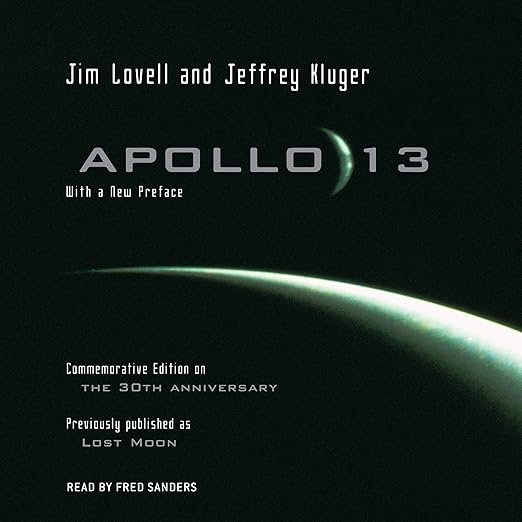
Fifty-five hours into a routine trip to the moon, an explosion turned Apollo 13 from a mission most of the country was barely watching into the story this audiobook exists to tell. Jim Lovell wrote the account with coauthor Jeffrey Kluger decades after he lived through it, and the listing describes this particular recording as an all-new production of a number one bestseller that a lot of people still know under its original name, Lost Moon. Simon and Schuster released this reading in December of 2019, narrated by Fred Sanders, and it runs sixteen hours and fifteen minutes, long enough to cover far more ground than the film built around Tom Hanks ever had room for. Anyone who knows the crisis only from the screen is in for a longer, more technical ride here.
One Book Covers Three Different Apollo Missions
Navy Captain Jim Lovell and two crewmates are fifty-five hours into America's fifth trip to the moon when an explosion drains their ship of oxygen and power, forcing all three men into a lunar module designed to keep two people alive for two days, not three people for four, exactly as the synopsis lays it out. What the audiobook adds to that outline is everything the movie compresses, the engineers at Mission Control working the problem in real time, and Lovell's own wife and children waiting at home for word of his safe return. Book Gnome's review makes a point worth passing on to anyone comparing editions: this is the same text originally published as Lost Moon, The Perilous Voyage of Apollo 13, later reprinted under the Apollo 13 title, and the same review notes that the book also folds in Lovell's earlier Apollo 8 flight and what the reviewer calls the best written account of the Apollo 1 fire available anywhere. That is a wider scope than the splashdown-to-safety arc most people expect walking in, and it means the sixteen-plus hours are not padding, they cover three missions worth of Lovell's career, not one. The synopsis also closes on a detail that never makes it into dramatizations: decades after the mission, Lovell and Kluger reflect on America's waxing and waning enthusiasm for space exploration over the following three decades, right up to the point where the actual Apollo 13 spacecraft, long kept in an aviation museum outside Paris, was finally returned to the United States. That closing framing turns the book into something more than a disaster narrative, it is also Lovell's own accounting of what the mission came to mean once the adrenaline wore off.
Structurally, the audiobook does not rush toward the explosion the way a two-hour film has to. The synopsis spends real time establishing the "glory days of the Apollo space program" before the crisis even begins, following Lovell and two crewmates as they set out on what the copy calls America's fifth mission to the moon. Only once that context is in place does the narrative shift into the crisis itself, from the ship to Mission Control to Lovell's family waiting at home, which is the structure that makes the eventual splashdown feel earned rather than just relieving.
Thomas Erickson Flags the Near-Fatal Carrier Landing
Personal history dominates this set of five reviews far more than a typical space-program title, and that says something about who this book reaches. Erl Gould Purnell, a former Naval Aviator who flew the UH-2 Seasprite off the USS Lexington, frames a review around attending a National Naval Aviation Museum symposium at NAS Pensacola, which suggests this account resonates especially hard with people who served. Thomas Erickson's review describes watching Lovell move from Navy flight testing into a near-deadly night carrier landing before the Apollo years even begin, which is the kind of biographical runway a two-hour film has no time for. Dan's shorter review calls the book a deeper dive into the technical aspects than the film allows, and, in a memorably odd turn of phrase, praises it for delivering what the review calls the "TikTok of the flight" and the "TikTok" of Lovell's family waiting at home, an unusual word choice that reads like autocorrect got there before the reviewer did, but the point underneath it lands: this version gives you the minute-by-minute detail the movie had to cut. Wellington's review, written in Portuguese from Brazil, makes a similar claim in different words, arguing the book delivers a far richer story than even a well-regarded film adaptation could hold.
Erickson's Review Is About a Different Edition
Two things are worth flagging before you press play. First, the rating math does not add up as printed: the listing counts only two ratings behind the 4.8 average, while five full written reviews sit in plain view underneath it, so whatever generated that count undercounted from the start and the figure itself deserves little weight. Second, at least one review in this column is clearly written about a different edition entirely. Thomas Erickson's title references an "Apollo Thirteen Commemorative" anniversary edition and specifically praises the "nice pictures" inside it, which is a print-book feature this audio recording cannot offer no matter how good Fred Sanders' narration turns out to be. Sanders' voice, pacing, and general delivery go completely unmentioned across all five reviews, so the recording itself stays untested even though the book underneath it clearly has an enthusiastic, detail-hungry readership. It also helps to know going in that the listing calls this an all-new recording, language that implies at least one earlier audio edition existed before this one, though who read that previous version or how it compared is not something this listing spells out anywhere.
Sixteen Hours Trades Screen Time for Real Time
This is a strong pick for readers who already sat through the film and wanted the fuller technical and personal record behind it, especially the material on Lovell's earlier Apollo 8 mission and the Apollo 1 fire that the movie skips past entirely. Military and aviation audiences, going by the reviewers who show up here, seem to find something extra in it, a level of procedural and personal detail that reads as authentic rather than dramatized. Steer clear if pictures and captions matter to how you experience this story, since that commemorative print material is not part of what you are hearing, or if a tight retelling suits you better than a career-spanning account that starts well before the famous explosion. For everyone else willing to trade screen time for real time, sixteen hours and fifteen minutes is a fair exchange.
Before You Press Play
- Performance: Fred Sanders is the solo voice behind this all-new sixteen-hour recording; whether it improves on any earlier edition is not something the five reviews here get into.
- What it covers: survival under pressure, engineering ingenuity, America's shifting love affair with space exploration
- Feel: tense, procedural, and quietly patriotic
- Our call: a technically rich, career-spanning account for readers who want more than the movie gave them, not a quick retelling of the crisis alone.
A Few Questions About Apollo 13
Does the Apollo 13 audiobook cover more than the famous rescue mission?
Yes, considerably more. Alongside the explosion and rescue, the book covers Lovell's earlier Apollo 8 flight, an account of the Apollo 1 fire that one reviewer praises very highly, and his Navy flight-testing years before he ever reached NASA.
Who narrates the Apollo 13 audiobook, and how long is the recording?
Fred Sanders narrates the full sixteen-hour-and-fifteen-minute recording, released by Simon and Schuster in December 2019. The five reviews on hand are full of praise for the book itself but stay quiet on how Sanders actually sounds across that runtime.