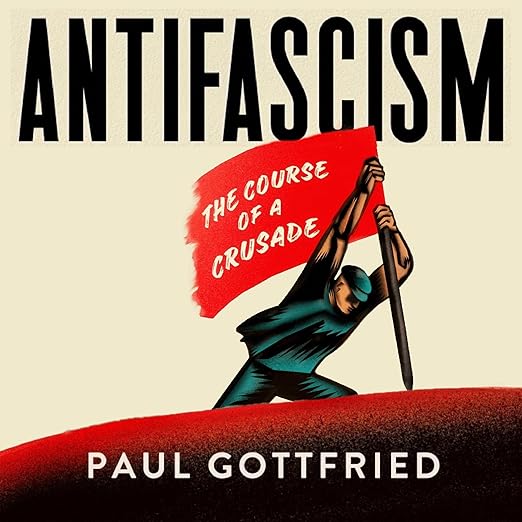
Lundeen Narrates a Word Stretched From Marxism to Cudgel
Paul Gottfried has spent decades in the scholarly margins, watching political vocabulary mutate in ways that most mainstream commentators either celebrate or ignore. This audiobook, published by University Press Audiobooks and narrated by Tim Lundeen across seven hours and four minutes, distills that lifetime of observation into a compressed academic monograph that reads simultaneously as intellectual history and pointed contemporary polemic. Gottfried is a paleoconservative scholar, and listeners should enter with full awareness of that standpoint: his analysis is rigorous, but his sympathies are not hidden, and the conclusions he reaches are designed to unsettle readers across the political spectrum.
What Gottfried accomplishes here that is genuinely useful regardless of your politics is a careful genealogy. Antifascism, in his account, is not a stable idea with a fixed referent. It has been stretched, repurposed, and emptied of its original Marxist content over the course of a century, until today it functions primarily as a rhetorical cudgel rather than a coherent ideology. Lundeen narrates with academic composure, hitting the complex proper nouns cleanly and maintaining a tone that suits the material's density without becoming robotic.
How an Intersectional Pivot Reordered the Left
The intellectual architecture here is more interesting than the partisan conclusions. Gottfried traces antifascist thought from its origins in early twentieth-century European communist opposition to fascism, through the postwar period when it was institutionalized in East Germany and parts of Western European academia, and into its American mutations from the New Left of the 1960s onward. The pivot he identifies as decisive is the replacement of a recognizably Marxist left organized around class and material conditions with what he calls an intersectional left, organized around identity categories. That shift, he argues, fundamentally reordered Western political life and allowed antifascism to be detached from any economic critique and reattached to a broader culture war.
The chapter on antifascism within American conservatism is one of the more surprising sections. Gottfried argues that the conservative establishment, neoconservatives in particular, adopted an antifascist framing of their own, positioning themselves as heirs to the Allied cause and using the fascist label against opponents both foreign and domestic. The Washington Examiner blurb frames this approvingly as arguing that those who invoke antifascism are proposing new tyranny, but Gottfried's actual analysis is more layered than that marketing line suggests. Alexander Riley, author of Toward a Biosocial Science, called it a methodical demolition of the myths propagated about Antifa in the halls of politics, media, and universities, which captures the book's polemical ambition accurately.
Gottfried also devotes substantial space to Antifa as an American street-level movement, situating it within the longer European history rather than treating it as a purely contemporary phenomenon. His conclusion that promoting a fear of fascism serves the interests of those who hold institutional power in media, education, and politics is a restatement of a classic Nietzschean point about resentment and the use of moral language for social dominance. Readers of Nietzsche, Carl Schmitt, or even Shelby Steele will recognize the argumentative mode.
Tracking the Word Rather Than the Thing
One reviewer described it as useful for everyone interested in recent political debate and noted Gottfried's careful attention to the movement's shifting meanings across history. That is accurate as far as it goes. The book's significant omission is a sustained engagement with what fascism actually was, historically, before it became an accusation. Gottfried largely assumes his reader knows the history and is more interested in tracking the word than the thing. That is a reasonable scholarly choice, but it means the book works best as a complement to histories of actual fascist movements rather than a standalone introduction. Listeners who come to this without prior reading in twentieth-century European political history may find themselves needing to pause the recording and fill in context.
The section on the working-class shift in Europe, including former communist party members drifting toward the populist right, is analytically interesting and underexplored in American media. Gottfried treats this as evidence of a political dynamic that has broken free of the older Marxist versus anti-Marxist dialectic. The prose is formed by decades of academic publishing, and Lundeen's narration does not soften the density. Paragraphs run long and transitions can be abrupt, which is the honest price of the material's depth and the format it was originally written in.
The final chapter, in which Gottfried turns his analysis toward what he sees as the future trajectory of antifascist politics in America, is the book's most openly speculative section and the least satisfying intellectually. He projects trends forward from 2020 political events, and some of those projections have already been complicated by subsequent history. Lundeen reads these sections with the same measured authority as the historical chapters, which means the listener gets no tonal signal that the mode has shifted from documented history to informed speculation. Readers who track politics closely will want to hold these concluding arguments at arm's length while giving the historical sections the serious engagement they deserve.
Background Reading Recommended Before These Seven Hours
This audiobook rewards listeners with some background in twentieth-century political thought. Readers of Hannah Arendt, Roger Griffin, or Umberto Eco on fascism will find Gottfried's polemic most useful as a counterpoint. Those who want to understand why the concept of antifascism provokes such fierce disagreement in contemporary American politics will find the historical scaffolding genuinely clarifying. Listeners expecting balance or a dispassionate survey should look elsewhere: Gottfried has a thesis, he pursues it single-mindedly, and his conservative priors shape which evidence he foregrounds. For seven hours, however, it is a bracing and intellectually serious performance, and Lundeen's narration keeps it moving at a pace that respects the listener's time and investment in the subject.
- Narrator: Tim Lundeen delivers Gottfried's dense academic prose with measured clarity; the pacing suits the argumentative structure but won't win over listeners who prefer expressive performance.
- Subjects: ideological genealogy, the replacement of Marxist left by intersectional left, political language as power
- Tone: Analytical and combative, like a seminar where the professor intends to upset everyone
- Bottom line: Essential for readers who want a historically grounded account of how antifascism became a floating political weapon rather than a fixed ideology.
A Few Questions About Antifascism
Is this audiobook a balanced academic treatment of antifascism or does it have a clear political argument?
It has a clear argument. Gottfried is a paleoconservative scholar, and the book concludes that antifascism today primarily serves as ideological cover for institutional power rather than genuine resistance to fascism. Listeners who want a neutral survey should supplement it with other works.
Does the audiobook cover Antifa as a contemporary movement or mostly the historical roots?
Both. Gottfried situates Antifa within the longer European history of antifascist movements and then brings the analysis forward to the American context, examining who funds and supports the movement and what political functions it serves in the current moment.