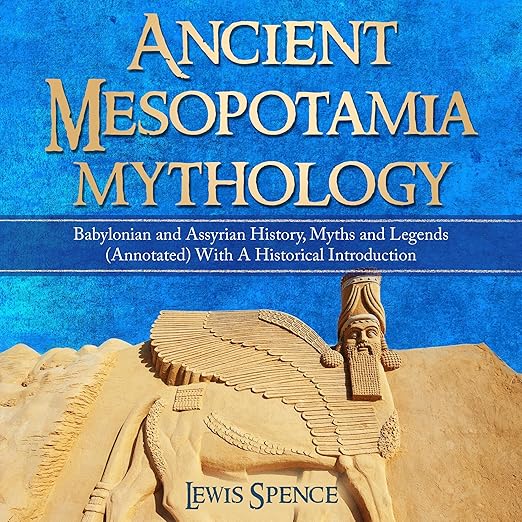
Gilgamesh was already on my mind the week I picked up this audiobook. I had been revisiting a translation of the Epic for a reading group, and the question that kept surfacing was simple: where do all these stories actually come from? The myths, the flood narrative, the descent to the underworld. Lewis Spence, the distinguished Scottish anthropologist and folklorist who published the original text in the early twentieth century, had been working through exactly that question decades before modern archaeology filled in many of the gaps. Listening to Jim D. Johnston narrate Ancient Mesopotamia Mythology felt like sitting in on a very learned lecture from someone who still finds the material genuinely astonishing, even after years of study.
Chaldea's Monsters Alone Justify the Listening Time
Spence wrote this as a scholarly guide but, as one reviewer noted, the text carries a poetic feel that makes it far more listenable than a dry academic survey. The audiobook covers Babylonian cosmogony, the early pantheon, the Gilgamesh epic in serious depth, the star-worship traditions, the priesthood and temple systems, and the magic and demonology that ran alongside official religion. The chapter on Mythological Monsters and Animals of Chaldea alone is worth the listening time. Spence was working with material that even now remains fragmentary. He handles that uncertainty honestly, distinguishing between what excavation had confirmed and what remained scholarly inference. That intellectual honesty is one of the distinguishing qualities of this work, and one that distinguishes it from popular mythology surveys that smooth over the gaps.
The scope of the book is genuinely impressive. Spence moves from Babylonian cosmogony through to the Comparative Value of the Babylonian and Assyrian Religions, and wraps with a chapter on Modern Excavation that grounds the mythological material in the physical landscape of the ancient world. Chapters on the Ishtar Gate, the Marduk Temple, and the stelae on which Hammurabi's Code was inscribed situate the mythology inside the political and architectural history of Babylon and Assyria rather than treating it as free-floating legend. That integration is genuinely useful, and it is part of what makes the book more than a simple mythology dictionary.
Johnston Handles Akkadian and Sumerian Names with Care
Jim D. Johnston narrates with the kind of steady authority that suits a text of this register. He does not dramatize unnecessarily, which is the right call: the material is not underdramatic on its own. The Gilgamesh chapters, in particular, benefit from his measured pace, which gives listeners time to absorb the layered cosmological significance without losing the narrative thread. Johnston handles the transliterated Akkadian and Sumerian terms with care, which matters in a text this dense with proper names. He does not stumble or skim over difficult terminology, a failure mode that derails a lot of mythology audiobooks. The listen runs nearly eleven hours, and the pacing sustains attention across that runtime.
Listeners who find academic prose difficult in audio will have more success here than they might expect, partly because of Johnston's delivery and partly because Spence's prose genuinely has that poetic undertow the reviewers have mentioned. One reviewer described spending significantly more time with this book than expected because the material pulled them deeper into the history of Babylon and Assyria. That is an accurate description of what can happen. The chapters on the Later Pantheon and the Pantheon of Assyria are particularly immersive, and the later section on the Twilight of the Gods closes the book with the kind of elegiac reflection that suits the subject.
Scholarship Has Moved On Since 1916
The text was originally published in 1916. That context shapes both its strengths and its limits. Spence had access to significant excavation data from Assyria and Babylon, and he synthesized it rigorously for his era. But scholarship has moved substantially since then, particularly regarding the relationship between Sumerian, Babylonian, and Assyrian religious traditions. Modern listeners will benefit from approaching this as an important historical document in the study of Mesopotamian religion rather than as a current state-of-the-field text. For anyone who has read more recent work by scholars like Jeremy Black or Thorkild Jacobsen, Spence will read as foundational but not final.
The chapter on Tales of the Babylonian and Assyrian Kings is one of the most narrative sections, and listeners who came in expecting scholarly density may be surprised by how readable it is. The penultimate chapter on comparative religious value invites the listener to step back from individual myths and consider the broader significance of the Babylonian and Assyrian traditions alongside Greek, Egyptian, and Semitic religious thought. For a text from 1916, the comparative instinct is sophisticated, even if modern comparative religion has substantially refined its methods. The final chapter on excavation grounds everything in the archaeological record in a way that emphasizes how recent our knowledge of this ancient world actually is.
Eleven Patient Hours Beyond Pop History Treatment
This audiobook suits listeners who already have some familiarity with Greek or Egyptian mythology and want to trace the deeper roots of Western mythological traditions. Students of comparative religion, archaeology enthusiasts, and anyone following modern scholarship on the Ancient Near East will find Spence's foundational survey valuable as a historical baseline. The eleven-hour runtime asks for patience, but the material rewards it. Listeners expecting a pop-history treatment may find the scholarly density a challenge. Those who want a leisurely but erudite companion to the Gilgamesh Epic or to the broader history of Babylon and Assyria will find exactly that here. Casual listeners new to the subject may prefer to start with a more accessible modern introduction and then return to Spence with more context in hand.
- Narrator: Jim D. Johnston's steady, unhurried delivery suits the scholarly register precisely; he handles dense Akkadian and Sumerian terminology without flinching.
- Subjects: Mesopotamian mythology and cosmogony, the Gilgamesh epic, Babylonian and Assyrian religious practice
- Tone: Dense, erudite, and surprisingly absorbing
- Bottom line: A foundational survey of Babylonian and Assyrian mythology that rewards patient listeners with genuine depth, though its early-twentieth-century origins mean it works best alongside more current scholarship.
Questions Listeners Ask
Is the audiobook narrated or is it a straight reading of the original text?
Jim D. Johnston performs a straightforward narration of Lewis Spence's original text. The production does not include dramatization, music, or supplementary commentary from modern scholars. It is an unabridged reading of Spence's scholarly work.
How does this audiobook compare to newer books about Mesopotamian mythology?
As a text from 1916, it reflects the archaeological knowledge of its era. Modern scholarship has refined many of Spence's interpretations, particularly on Sumerian-Babylonian distinctions. Listeners interested in the current state of the field should treat this as an important historical baseline rather than a definitive account.