Before You Press Play
- Read by: Jay Herbert's brisk, engaged delivery suits the episodic structure well, resetting tone cleanly between chapters without losing overall momentum.
- At its heart: Hidden historical figures, gender and power, the gap between legend and evidence
- Vibe: Brisk and curious, with occasional flashes of genuine historical strangeness
- Short version: An episodic counter-narrative to standard Chinese history, best as an accessible entry point rather than comprehensive coverage.
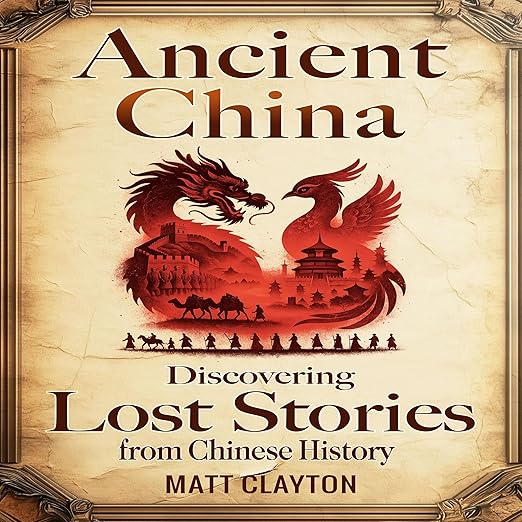
When archaeologists unsealed Lady Fu Hao's tomb in 1976, they found weapons alongside jewelry, military tallies alongside ritual bronzes. The audiobook Ancient China: Discovering Lost Stories from Chinese History, narrated by Jay Herbert, opens with her story, and it immediately signals what Matt Clayton is doing throughout this collection: recovering the people that conventional dynastic history left out. This audiobook functions as a counter-narrative to the emperor-and-battles framework that dominates most popular accounts of Chinese history.
Lady Fu Hao's Tomb Rewrites Shang Assumptions
Clayton's structure is deliberately episodic. Rather than tracing a single chronological arc, the audiobook moves through categories of forgotten figures: vanished kingdoms, unsung men, women who defied the constraints of their era, political victims, intimate relationships that influenced imperial decisions, and the tragic figure of the alchemist in endless pursuit of immortality. That last category, the alchemist's deadly experiments with mercury and elixirs, is among the most compelling in the collection, partly because it illustrates something genuinely paradoxical about ancient Chinese intellectual culture: the same civilization that pioneered astronomy, papermaking, and advanced agriculture was simultaneously poisoning its emperors with longevity treatments.
Lady Fu Hao, the general and high priestess whose story opens the collection, stands as the book's strongest chapter. Her rediscovery through archaeology is recent enough to feel like an active historical revision rather than settled fact. Clayton communicates the significance of this without overstating it: Fu Hao's existence rewrites assumptions about gender and military command in the Shang dynasty, and the physical evidence of her tomb makes the argument undeniable. Reviewer Nancy Reynolds describes the book as 'a remarkable journey into the lesser-known corners of Chinese history,' and the Fu Hao chapter is the clearest example of why that framing works. Her story also sets the template for the collection's approach: Clayton shows you what the physical evidence reveals, then traces the silence that surrounded it for centuries.
Herbert Resets the Tone with Every Chapter
Jay Herbert brings a quality to popular history narration that is harder to achieve than it sounds: he sounds genuinely interested in the material. The audiobook's episodic structure means the narrator needs to reset the emotional tone with each new chapter, moving from the grandeur of Lady Fu Hao to the vanished Xia dynasty question to the quieter stories of exiled poets and court favorites. Herbert manages those transitions cleanly. His pace is brisk enough to maintain momentum without flattening the individual episodes into a single undifferentiated stream.
The format rewards listening over reading in a specific way. Clayton's prose has a direct, conversational quality that translates well to audio delivery. The chapters are short enough that each feels self-contained, which makes the audiobook useful in fragmented listening sessions, a chapter during a commute, two during an afternoon walk, without losing the accumulative effect of the whole. At three hours and forty-five minutes, the full collection is also manageable as a single extended listen for those who prefer that approach.
Reviewer ColoMich94 notes that the stories 'bring fresh perspectives to ancient history,' and that freshness is the book's core value proposition. Clayton is not competing with academic sinology. He is opening doors for listeners who might then seek out more specialized scholarship. The audiobook works as an invitation rather than a destination, and Herbert's narration delivers that invitation with consistent energy. The chapter on the star-crossed lovers whose story echoed through subsequent dynasties is a particular highlight, illustrating how personal tragedy could leave institutional traces across generations of imperial culture.
Fu Hao Was Never Really Lost to Scholars
Listeners with existing knowledge of Chinese history should calibrate expectations. The book covers recognized historical figures including Lady Qi, Lady Fu Hao, and various emperors and exiled poets, but in an accessible format that deliberately sets aside the scholarly debates. The Xia dynasty question, which Clayton raises as a chapter focus, is genuinely contested among archaeologists and historians. The audiobook presents it accessibly but cannot and does not resolve it. That is appropriate for the format and audience, but specialists may find the treatment insufficient.
The title's promise of 'lost' and 'hidden' history overstates things slightly. Several of the figures covered, including Lady Fu Hao, have received serious scholarly and popular attention in recent years. Lost here means 'not in the standard popular narrative' rather than 'unknown to historians,' which is a meaningful but more modest claim. Clayton's contribution is curation and accessibility rather than original discovery.
The chapter on the rise and fall of Lady Qi, once the emperor's favorite, is among the collection's most unsettling entries. Clayton traces how proximity to imperial power without independent institutional standing could make a figure's position absolutely contingent on a single relationship, and what happened when that relationship dissolved. Lady Qi's story functions as a corrective to romanticized versions of imperial court life, illustrating how the same systems that elevated certain figures could annihilate them with equal efficiency. Jay Herbert's delivery of this material gives it the weight it deserves without melodrama.
Chinese History Fans Coming from Cuisine or Travel
Listeners curious about Chinese history who find standard dynastic surveys too dry or too dense will find this an accessible entry point. Anyone who has been drawn to Chinese history through other media, travel, cuisine, martial arts, or popular culture, and who wants a structured historical foundation, will benefit from the collection's organized approach to forgotten figures. Book clubs looking for a short, discussion-generating listen will find the individual chapters useful as launching points for broader conversation. Listeners who want comprehensive scholarly coverage should look to more specialized resources.
Good to Know
Who is Lady Fu Hao, and why does this audiobook open with her story?
Lady Fu Hao was a military general, high priestess, and consort of the Shang dynasty emperor who lived roughly 3,000 years ago. Her tomb, discovered in 1976, contained weapons and military insignia that established her as a field commander. Clayton opens with her because her story exemplifies the book's central project: recovering figures that dynastic history overlooked.
How does this audiobook differ from standard histories of ancient China?
Rather than tracing dynastic succession and military campaigns, Ancient China: Discovering Lost Stories focuses on forgotten or marginalized figures: unsung women, exiled poets, court favorites, vanished kingdoms, and failed alchemists. The organizing principle is human story rather than political chronology.
Is this audiobook appropriate for classroom use with secondary school students?
Yes, with caveats. The accessible format and short chapter structure make it useful for sparking interest and discussion. The Xia dynasty chapter and the Lady Fu Hao chapter both touch on genuinely debated historical questions, which are good discussion starting points.
How long is this audiobook, and is it suited to fragmented listening?
The total runtime is three hours and forty-five minutes. The episodic chapter structure makes it particularly well-suited to fragmented listening because each chapter resolves its own story. You can listen to one chapter during a commute and return to the next without losing the thread.