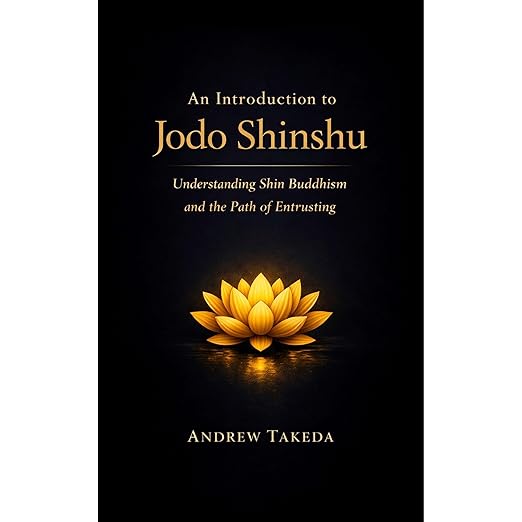
Andrew Takeda opens by drawing a line that books on Buddhism rarely draw, between improvement and relief, and then places the whole audiobook on the far side of it. What gets promised is not a technique, a discipline or a practice to get better at, but permission to stop trying to get better. Three hours and fifty-one minutes is short for a religious introduction, and the brevity turns out to be consistent with the argument: a tradition built on entrusting rather than on effort has less to teach and rather more to explain.
Virtual Voice and Four Hours of Unfamiliar Terms
Shin Buddhism is the shorter name for what is being introduced, and the description is admirably specific about the ground it intends to cover. Why entrusting sits at the center of the path. How Amida Buddha stands for boundless compassion rather than distant perfection. What the Primal Vow changes about the rules of salvation. Why the nembutsu is a response of gratitude and not a technique. How Shinran reshaped a tradition for people living ordinary, imperfect lives. One response, written the day the book arrived and after only a partial read of the sections that reader wanted first, calls the language relational and says it feels written from the heart. That is a first impression rather than a verdict, and a page this thin gives a first impression more weight than it should have to carry.
Amida, Shinran, nembutsu, Jodo Shinshu. This is a book whose central terms are proper nouns in a language most of its intended readers do not speak, and the narrator field on this listing reads Virtual Voice. That is a synthetic credit rather than a person, which means nobody is accountable for how those words sound across nearly four hours of repetition. On most subjects that would be a minor irritation. On an introduction whose entire purpose is to hand a newcomer a working vocabulary, it matters a great deal, because a listener will learn whatever pronunciation they are given and will carry it straight into the first conversation they ever have about the tradition.
Aimed at Readers Exhausted by Self-Improvement
Nothing here asks you to master your mind or escape the world, and on a shelf crowded with spiritual self-improvement that is a genuinely different proposition. The description addresses itself to readers who have tried self-improvement and found it exhausting, and to people who sense that the pressure to become better has quietly turned spiritual life into one more performance to be judged on. Whether or not you end up accepting the doctrine, the diagnosis lands, and it tells you precisely who the book believes it is talking to. That audience is larger than the shelf label suggests. A great deal of contemporary spiritual writing sells effort as the product, and a book selling the end of effort is competing with all of it while refusing to borrow any of its language.
Listeners with no background at all are explicitly welcome, and the description says so outright: no prior knowledge is required, the core ideas are explained without jargon, and the tradition is placed in historical context before its claims are argued. That last element is what separates an introduction from a devotional book. Filed under history as well as under religion and spirituality, the listing is signaling that you will get the account of how this came about alongside the account of what it holds, which is the right order for anybody approaching from outside.
Trust Has No Exercises to Hand You
Trust is a difficult thing to introduce in the abstract, and that is the structural risk the book runs. A tradition whose central move is entrusting rather than practicing has, by definition, no exercises to hand you, no morning routine, no measurable progress to chart. What remains is explanation, and explanation at this length can begin to feel like one point restated in fresh vocabulary. A reader who came looking for something to do will find the absence of instructions disorienting, and no amount of clarity in the writing repairs that, because the absence is the doctrine rather than an oversight.
Scroll up and order the book today, says the description, near the end, in the imperative. That sentence was written for a text storefront and carried across to an audio listing, where scrolling up gets you a runtime and a reader credit rather than a purchase button. It is a small thing, and it tells you something about how carefully the edition was assembled. The single response on this page that mentions the audio at all reports buying it on top of the original and a hard copy as well, then says nothing whatever about how it sounds, which leaves the recording undescribed by anybody who has actually heard it.
For Listeners Who Have Run Out of Methods
Anyone worn out by the demand to improve is who this is aimed at, and the description says nearly that in its opening lines. It is aimed as well at a reader who has met other Buddhist schools first and wants to understand why a faith-centered path exists inside the same tradition rather than in opposition to it. And it is aimed at people who would rather receive the history and the argument together, in one short sitting, than work through a practice manual that assumes a commitment they have not made yet. The length works in the same direction. A short recording asks for a small decision, which is a fitting way to meet a tradition whose opening claim is that nothing large is being demanded of anybody.
Steer past it when what you want is a method, because the book is arguing against methods and will read as evasive to anybody who needs one. Steer past it too when a synthetic reading would spoil the material for you, which on a text this dependent on unfamiliar names is a reasonable position rather than a fussy one. A listener after scholarly apparatus should also note that the description promises accessibility rather than citation, and delivers on that promise precisely. Shinran built a path for people who had run out of strength, and an introduction faithful to that has to be gentle rather than demanding, which is exactly the register this one keeps.
A Few Questions About An Introduction to Jodo Shinshu
Who reads the An Introduction to Jodo Shinshu audiobook?
Nobody, in the human sense. The reader slot carries the label Virtual Voice instead of a name, which marks a synthetic reading. Andrew Takeda holds the author slot, and this is an author-published title rather than one from a press. On a book whose key terms are Japanese proper nouns, that credit is worth weighing before you buy.
Do I need any background in Buddhism for this audiobook?
None at all. The description states that no prior knowledge is required, puts the tradition in historical context before explaining its core ideas, and promises those ideas without jargon. History sits alongside religion and spirituality in the shelving here, which suits a book that explains where a school came from before it explains what it holds.
When was it released, and by whom?
December 2025, through Independently Published, which marks an author-published title rather than one from a Buddhist press or an academic house. That is worth weighing on a subject where institutional affiliation often carries real information, since nothing on the page states the author's own connection to the tradition.
Is a print edition mentioned on this audiobook listing?
No. The record gives no ISBN and no page count, so it carries no information about a text version at all. If you want to read alongside the audio you will have to look for it separately, because the page names no companion edition and no accompanying PDF of any kind.