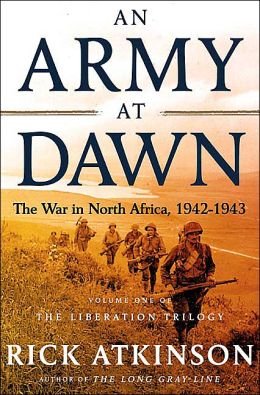
Rick Atkinson's title is doing all the work on this listing, because the description field underneath it prints that same title back at you and then stops. That is the entire synopsis attached to an audiobook running four hours and forty-eight minutes: a name, a theater, and a bracketed pair of years. No summary, no framing, no indication of what register of history this is. Listings this bare turn up a few times in every thousand, and they change what a review can honestly do. Everything verifiable before you press play sits in the metadata strip: a publisher, one credited reader, a date, a runtime, and an average assembled from three votes. So that strip is what I am going to read closely.
Guidall Narrates With No Reviews to Guide You
History bought blind carries a specific risk, and this page asks you to take it with almost nothing offered in return. The title is the most informative object available: it fixes a continent, a campaign window running 1942 to 1943, and an army arriving somewhere at first light. Atkinson gets no jacket copy, no editorial pitch, not even the single orienting paragraph most publishers supply out of habit. What occupies the description slot is the book's own name with the years punctuated differently, a comma standing where the display title uses parentheses. That small discrepancy is the tell. A person writing a blurb does not retype the title with altered punctuation; a script reaching for a fallback value does exactly that.
Guidall is the one name attached to the reading, and the page says nothing further about what the recording is like. Not one written response has been posted, so any verdict on pacing, accent work or clarity would be manufactured rather than observed. What can be stated is structural. One voice, no supporting cast, and a subject whose working vocabulary is place names, unit designations and dates, which is the hardest kind of text to keep legible without an eye to fall back on. Listeners who already do well with single-reader campaign history understand that risk and price it in. Everyone else is buying a reading style unheard, and the listing supplies nothing that would narrow the range of what it might turn out to be.
Three Ratings Can't Prove Much Either Way
Three ratings sit behind the five-star average, and that number belongs in the open before anyone treats the score as endorsement. A perfect average assembled from three votes carries close to zero predictive weight; it establishes that three people were pleased and nothing whatsoever about the ninety-seventh listener. The case for pressing play is not the score. It rests on the shape the title declares: a bounded campaign in a bounded place across a bounded pair of years, rather than a sweeping survey of everything that happened. Bounded history is the variety that survives the audio format best, because a listener who drifts for ninety seconds can rejoin at the next date and lose very little in the process.
Campaign narrative holds one real advantage over thematic history when you are listening rather than reading: it moves in a single direction. A front advances or it stalls, months arrive in order, and the spine of the thing is chronological rather than argumentative. The years printed in the title promise exactly that spine. Henry Holt & Co appears as the imprint, with 2003 attached, and together those two entries make up the whole provenance this page is willing to offer. Whether the pages behind that imprint deliver scenes and people or tables and historiography, the listing declines to say. At four hours and forty-eight minutes, the gap between those two books matters more than it usually would.
The Listing Never Says Abridged or Complete
January 1, 2003 is what the date field prints, and a value falling on New Year's Day is almost always a year stamp rather than a genuine release day. Read it as the year and no finer than that. The same caution extends across the format fields as a set. No series name, no series number, no volume note of any kind, which on a book covering one campaign inside a far larger war is worth registering rather than shrugging at. If this recording belongs to a sequence, the page keeps that entirely to itself, and a listener who finishes it wanting the next installment will have to go hunting with no assistance from here.
Runtime is the field I would check twice before buying. Four hours and forty-eight minutes is a short sitting for two years of a continental campaign, and the listing carries no abridged or unabridged marker in either direction. That absence is the most consequential gap on the whole page. An abridgement is a perfectly legitimate product and a fair number of listeners actively prefer one; buying an abridgement while believing you hold the complete text is a different and worse experience. Nothing on this page resolves the question, and no response column exists to resolve it informally either. Anyone who cares about completeness should confirm the edition elsewhere before committing to it.
Skip It If You Need Context First
Anyone who already reads military history and recognizes the byline will be fine here, because they are not depending on the page to tell them what they hold. The same applies to listeners who prefer one steady voice over a full cast, and who are comfortable with a book that assumes a working familiarity with the period rather than building it from scratch. Under five hours, this also suits someone who wants a campaign delivered across two or three sittings instead of stretched over two weeks. If your listening diet already runs to narrative history and you trust the author, the thinness of the listing is an annoyance rather than an obstacle.
Skip it when knowing what you are buying matters more than taking a chance. A newcomer to the period gets no orientation from this page, no summary against which to judge the level, and no confirmation that the recording is complete. The same applies if you like to sample a reader by reputation first, since the response column is empty and offers nobody else's ears to borrow. The book behind this listing may well be first-rate, and nothing here argues otherwise. The listing itself is the weakest component of the transaction, and buying it means trusting a title over a page that has declined to describe its own contents.
Frequently Asked Questions
How long is the An Army at Dawn audiobook?
The runtime field says four hours and forty-eight minutes. That is brisk for a book covering a two-year campaign, and the page never states whether the recording is abridged or unabridged, so confirm the edition elsewhere before buying if a complete text matters to you.
Who is credited with reading the An Army at Dawn audiobook?
George Guidall appears alone in the reader slot. No supporting cast is listed and no sample commentary appears at any point on this page, so the delivery style is something you discover after purchase rather than before it. Nothing else in the metadata describes the recording at all.
Why does the description field contain only the title?
Because the slot was filled with a fallback value instead of publisher copy. The years even carry different punctuation from the display title, a comma where the heading uses parentheses, which is the signature of an automated fill rather than a person writing a blurb.
Is An Army at Dawn presented as part of a series?
The listing gives no answer either way. Series name and series number are both blank, and no volume note appears anywhere in the metadata. On a book covering a single campaign inside a much larger war, that silence is worth noticing before you assume the title stands alone.