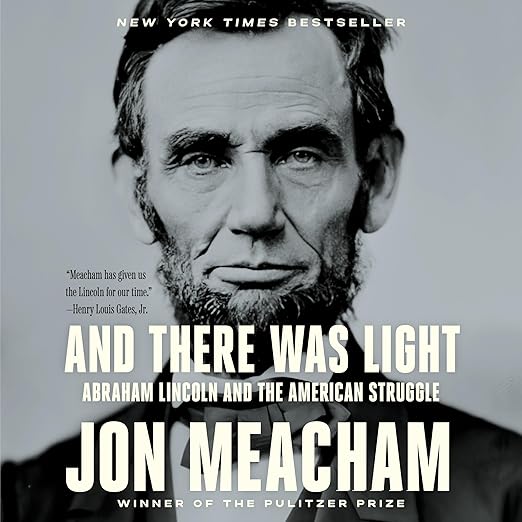
Seventeen hours and forty-nine minutes of Random House Audio's Lincoln biography, and the first thing worth settling is what this audiobook is actually called. The listing says American Struggle. Two of the five people writing underneath it discuss a book titled And There Was Light, quoting that title directly, and everything else about the record matches: same author, same subject, same Pulitzer-winning biographer working across a single life. Whatever produced the discrepancy, a buyer searching under either name should understand that both lead to this page.
Sanders Narrates Frontier Cabin to War Presidency
Meacham's approach is set out cleanly in the copy: Lincoln as a very human figure rather than a remote icon, an imperfect man whose antislavery conviction began inside the Baptist community he grew up in, who insisted that slavery was a moral evil and who tried, in his own words, to do right as God gave him to see the right. That framing pushes back against two familiar caricatures at once, the marble saint and the pure calculator. One reader, filing five stars in February 2023, came to the book as an admirer of both Lincoln and this biographer, called the result truthful and unbiased history, then noted in the same breath that it was the hardback being read, reading glasses and all.
Kentucky frontier, 1809, through to the assassination in 1865 is the full sweep, and one volume covering all of it has to choose what to slow down for. The description signals those choices openly: the self-education, the loves, the bouts of depression, the political failures, the deepening faith. That list is the argument in miniature. A biography giving depression and failure equal billing with the presidency is making a claim about where the character came from, and the credentials are there to sustain the reading without belaboring it. Whether the book turns up anything genuinely new is a fairer question than whether it tells the story well. The arc from a frontier cabin to the war presidency also gives the whole thing its shape as a story about self-making, and the copy leans on that exact word, self-education, rather than reaching for genius.
No New Ground, but an Eloquent Retelling
Lincoln biographies arrive constantly, so the useful question is what this one does that the shelf does not already hold. A four-star assessment dated November 2022 puts it as squarely as anyone could: no new ground appears to have been broken, and what arrives instead is an eloquent retelling that declines to overlook its subject's faults. I would take that as a recommendation rather than a complaint. Synthesis has real value, particularly at this scale, and a listener coming to Lincoln for the first time does not need novelty. What they need is one coherent account with the scholarship absorbed into the prose rather than displayed on top of it.
Slavery is where the argument concentrates, and the copy is unusually direct about the fact. Lincoln's moral commitment is traced back to an antislavery Baptist community rather than presented as a calculation arrived at later under pressure, and the description places the courage of the enslaved and the witness of Black Americans inside the same frame rather than behind it as scenery. A February 2025 endorsement, also five stars, calls this an excellent single-volume biography focused on the presidency, crediting characteristic verve and narrative skill. Those two qualities together, a moral through-line and a readable surface, are why a general listener finishes a political history of this size at all.
Credited to Mitchun, a Name from Nowhere
Attribution is where the written column produces its strangest item. A March 2023 commendation praises the meticulous research and the way the president is situated within a larger context, then credits every bit of it to somebody called Mitchun, twice over, in a review of a book written by Jon Meacham. That name appears in no field anywhere on the page. It is far likelier to be a slip of memory than a sign of anything sinister, and it still belongs on the record beside the title question, because both are failures of naming on one listing and both point at metadata nobody has checked. A shopper choosing between editions has to do that checking instead.
Praise attached to a different title is the deeper issue, and it deserves stating plainly. The page displays one name while part of the column underneath works from another. The shortest thing in the column, five stars in December 2025, sidesteps the whole problem by naming no title at all and simply reporting that it taught things about Lincoln's personal values and beliefs the reader had not known before. Nothing in any of this suggests the wrong book was recorded. It does suggest that the display title here and the title under which this work reached its readers are not the same string, which is worth a check before purchase.
Students Wanting a Single Authoritative Lincoln
Students and general listeners who want one authoritative Lincoln, and have no intention of reading six, are the clear audience. The copy's framing of a president governing a divided country during a moment of polarization and political crisis is an open invitation to read the nineteenth century for present purposes, and anyone who wants that parallel will find it offered rather than merely implied. The awards listed on the page, the Gilder Lehrman Lincoln Prize among them, suggest the scholarship holds, and a Pulitzer-winning biographer working in a single volume is a sensible place to begin a subject this large. Anyone wanting to hand a single title to a teenager working through a civics unit will find this the obvious candidate, given the scope and the moral clarity of the framing.
Look elsewhere if you want fresh archival findings, because a single-volume synthesis is not where those tend to live. Specialists who have already read widely on the Civil War presidency will recognize most of what is here. Anyone hoping for a military history will get a moral and political biography instead, with the war present as context rather than as subject, and the battlefield chapters will feel thin by comparison. Listeners who dislike present-day parallels drawn out of historical material should also note that the description makes that connection explicit in its opening paragraph. Verify which title you are actually buying before committing, because the name printed on this page and the name this biography is known by are not the same string.
Before You Listen
Is the American Struggle audiobook the same book as And There Was Light?
Everything on the record points that way. The description matches Jon Meacham's single-volume life of Lincoln in author, subject, scope and listed awards, while the displayed title does not match the name that biography is known by. If a Lincoln book by this author is already on your shelf, compare the ASIN against what you own before paying, so you do not buy the same thing twice.
Which edition is this audiobook, and how many hours does it fill?
Random House Audio issued it on October 18, 2022, at seventeen hours and forty-nine minutes, with Fred Sanders named as narrator. Eighteen hours or so is unremarkable for a full-life presidential biography, and it works out to roughly two weeks of ordinary evening sessions.
Does the book cover all of Lincoln's life or only the presidency?
All of it. The description traces the story from his birth on the Kentucky frontier in 1809 through his self-education, political failures and deepening faith, into the Civil War leadership and the assassination in 1865. The presidency is the center of gravity, not the entire scope.