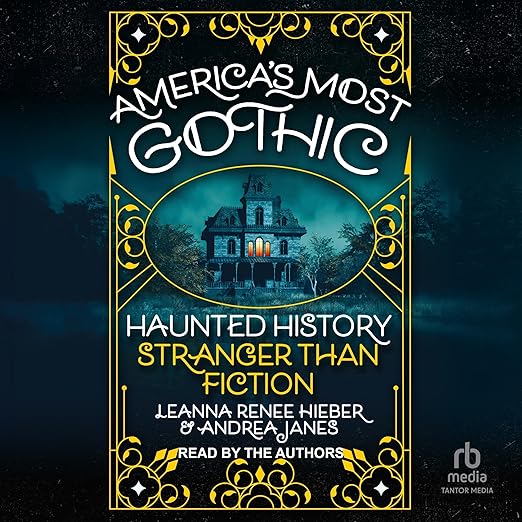
Somebody is missing from the byline on this audiobook. The author field carries Leanna Renee Hieber alone, while Andrea Janes appears one line down as the reader. Two of the five written responses on the page describe an author duo and name them both. Twelve hours and forty minutes of true gothic Americana, published by Tantor Media in October 2025, and the credit block accounts for roughly half of who made it.
Janes Reads, but Two Reviews Say Co-Author
The response making that case most fully carries five stars and a late February date. It credits Hieber and Janes together with a scholarly and insightful account of hauntings, folklore, history, phantom ships, family curses and dangerous lovers, sets the book beside another title it names as Haunted History of Invisible Women, and picks out Ghost Brides as its favorite chapter. That entry treats the pair as a known quantity. The listing declines to acknowledge that a second author exists at all.
Byline gaps cost real discovery. A reader who knows the Janes name and goes looking finds it filed as the narrator of somebody else's book, and a reader who arrives through Hieber never learns a collaborator was involved. The gap also leaves a question hanging over the recording, since the single credited reader is the same name two responses treat as a writer. Whether that reflects a production decision or a filing error, the page never says.
Dates on this page are worth lining up before you read the grades. Tantor Media released the recording on October 14, 2025, and three of the five written responses were filed before it: October 1, October 9 and October 13. Those three are grading the book in another form, and one of them signs off by disclosing a complimentary copy. The February and March 2026 entries are the only two written when this file was available to buy.
Mercy Brown to the Hoosac Tunnel's Dead
What the warmest endorsement praises is a balance rather than a subject. A March five-star describes the pairing of research and feeling as the thing it values most, calls the result a tour of gothic Americana both famous and obscure, and credits the contextual commentary with leaving it haunted in the best possible way. That is a fair account of the ambition. This is not a book of campfire stories; it is an argument about why these particular deaths keep getting retold.
Roster alone will tell you whether the material appeals. Mercy Brown, the teenager at the center of Rhode Island's vampire hysteria in the 1890s, framed by the description as victim or possibly predator. Marguerite de la Roque, condemned by a French court for what the copy calls sexual crimes and abandoned on Canada's long-lost Isle of Demons. Mad Lucy Ludwell, prowling a Virginia estate to this day. President Helen Peabody, watching over the women's college now folded into Miami University in Ohio. Workers lost building the Hoosac Tunnel, still warning of danger.
Twelve hours and forty minutes of that is a great many dead people, and the length is doing deliberate work. An anthology of ghost stories would move faster and mean less; the essay form lets each case carry its documentary record, its afterlife in local legend, and the reason the legend took the shape it did. Taken a chapter or two at a sitting, it behaves like a history series that has done its own reading rather than repackaged somebody else's.
Essays by Location That Still Need Tightening
Structure is where the column splits, and the four-star names the split precisely. That reader came in loving haunted history books and all things gothic, and found the book organized location by location in the manner of short essays rather than as ghost stories. Learning the history of those places was the compensation. If you wanted dread delivered in scenes, this arrangement will feel like a reference work read aloud, and no amount of good material fixes that.
Editing draws the sharpest objection on the page. The two-star allows that the passion for the subject is obvious and argues the pieces need tightening, which is the standing risk of an essay collection assembled around a theme rather than a through line. The badge tracks that split rather than any failure of research: the five visible grades run 5, 4, 3, 5 and 2, and they average exactly the 3.8 displayed at the top, though the counter behind it reads 29.
Casting is the question this record refuses to answer. One reader is credited on a book that two of its own responses describe as the work of two writers, and nothing on the page indicates whether the material is divided, alternated, or read straight through in a single voice. Twelve hours of case histories in one consistent register is a different experience from twelve hours split between two authors, and a buyer has no way to tell which is on offer.
No content note appears anywhere on the record. The copy promises material sure to get under your skin, then lists panics, condemnations, madness and men killed in horrific working conditions, without a word of guidance for a listener who wants to know what is coming. For a title this cheerfully macabre in its marketing, the omission is odd.
A Stocking Stuffer for the Right Reader
Format is the whole question here, and the three-star answers it from an unexpected direction. That reader found the book rather interesting, a little too heavy at times, not a personal fit, and concluded it would make a perfect stocking stuffer for a son-in-law who lives and breathes this kind of material. Gift buying is a legitimate use for a book like this one. Anyone who already keeps three shelves of haunted Americana is the recipient the column keeps describing.
Hold back if you want fright rather than history, or if you need one narrative to carry you across twelve hours. The same applies if an unverifiable byline is going to nag at you, since the second writer on this book appears only in the reader field and in the responses beneath it. Everyone else, and particularly listeners who read gothic history for the documentary record underneath the legend, is squarely the audience.