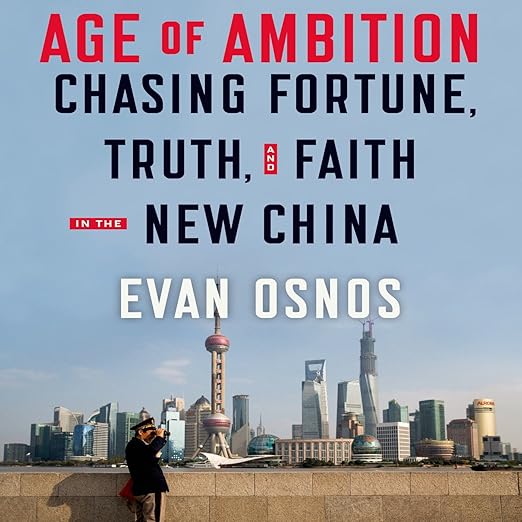
I listened to Age of Ambition during a period when I was reading everything I could find about contemporary China, and I came to it with the slight wariness you develop when any single book promises to explain a civilization of 1.4 billion people. Evan Osnos does not make that promise. What he offers instead is something more honest and considerably more valuable: a series of sustained portraits of individuals living through a moment of extraordinary transformation, each portrait chosen to illuminate a tension that statistics alone cannot capture. I was two hours in before I realized I had stopped eating the lunch I had intended to eat while listening.
Osnos spent years as The New Yorker's Beijing correspondent. He speaks Chinese, he lived in the country through a period of rapidly accelerating change, and he knows how to write about people in the way that magazine journalism at its best demands: with specificity, empathy, and the structural intelligence to understand what a single life reveals about a larger system. Age of Ambition won the National Book Award for Nonfiction in 2014 and has held up as one of the essential books on modern China for listeners approaching the subject from outside.
What Evan Osnos Delivers
The book's organizing tension is between the explosion of individual aspiration in China and the Communist Party's continued insistence on controlling the terms of that aspiration. Osnos is rigorous about the genuine achievements of China's growth, the lifting of hundreds of millions of people from poverty, the infrastructure transformation, the emergence of a new middle class with genuine expectations, while being equally unflinching about what the Party's constraints have meant for dissidents, journalists, lawyers, and ordinary citizens who have come into conflict with the system.
The portraits are the book's real engine. Reviewer A. Menon noted that none of the perspectives in the book are necessarily new from a macro standpoint, but that the way individual people give their opinions makes the analysis feel lived rather than theoretical. That is exactly right. Osnos does not argue abstractly about Chinese nationalism; he shows you the people who define themselves as angry youth and explains the specific historical and cultural experience that produced that identity. He does not lecture about corruption; he takes you into the lives of lawyers who have tried to use the legal system and run into its limits.
What Evan Osnos Gets Right
Osnos's narration is one of the audiobook's most significant assets. He pronounces Chinese names and places correctly, which matters more than it might seem; errors in this area, common when professional narrators encounter unfamiliar language, pull listeners out of the material and signal a remove from the culture being described. His delivery has the quality of a reporter speaking from authority rather than performing for an audience, and the sixteen-hour length feels earned because the pacing is consistently controlled. He knows which stories need space and which can be told quickly.
Reviewer dr johnson, who described himself as a regular reader of Osnos's New Yorker work, called the book as good as his magazine writing but noted some unevenness in the second half where certain portraits feel slightly less sharp than in the opening sections. That critique has some merit; the book's final chapters are less surprising than what comes before them, and the synthesis Osnos reaches at the end is more subdued than a reader who has followed the individual stories might hope for.
Where Evan Osnos Loses Some Ground
The book covers China in the years up to its 2014 publication, and readers in 2026 should approach it with awareness of how significantly the political and cultural landscape has shifted since then. The Xi Jinping era has hardened many of the constraints Osnos describes, and some of the cautious optimism that runs through certain sections has not been borne out by subsequent events. This does not diminish the book's value as a portrait of a specific historical moment; it is precisely the kind of document that becomes more interesting to read in retrospect. But listeners seeking a current account of Chinese society will need to supplement this with more recent sources.
The book is also unapologetically focused on certain segments of Chinese society: urban, educated, aspirational citizens who are in dialogue with or in conflict with the system. Rural China, internal migrant communities, and minority populations are present in the book but less central, and the picture that emerges reflects the limits of any correspondent's access and emphasis.
Who Should Pick Up Age of Ambition
This audiobook is essential for anyone who wants to understand contemporary China beyond the headlines of economic statistics and geopolitical maneuvering. It is particularly valuable for listeners who have consumed a lot of policy-focused China analysis and want to understand what that policy landscape means for actual human lives. International listeners note that it provides a window into aspects of Chinese life that outside coverage rarely reaches. Anyone approaching China studies for the first time should start here before moving to more specialized or more recent works.
In Brief
- Voice: Evan Osnos self-narrates with the measured authority of a veteran foreign correspondent; his Chinese pronunciation and his familiarity with the people he is describing give the audio a credibility that a professional narrator could not replicate.
- Big ideas: The collision between individual aspiration and state authority, Chinese identity in a globalizing economy, the politics of information control
- Atmosphere: Thoughtful and immersive, with the texture of long-form journalism at its most engaged
- Worth it?: One of the most illuminating accounts of contemporary China written for Western audiences, and Osnos's narration gives it the weight of firsthand testimony.
How much has Age of Ambition dated since its 2014 publication?
Significantly in some respects, less in others. The individual portraits and the structural analysis of the tension between aspiration and state control remain illuminating. Specific political conditions, including the degree of internet openness and the trajectory of civil society, have shifted considerably under Xi Jinping. Treat it as essential historical context that requires supplementing with more recent reporting for a current picture.
Is Age of Ambition accessible to listeners with no prior background in Chinese history or politics?
Yes. Osnos grounds each portrait in enough historical and political context that readers without background can follow the significance of what they are hearing. The book is more readable than most China-focused academic or policy texts, and the narrative form makes the context feel earned rather than assigned.
Does Osnos's self-narration add meaningfully to the experience over a professional narrator?
It adds considerably. Correct pronunciation of Chinese names and places signals genuine familiarity with the culture being described and prevents the kind of jarring error that pulls listeners out of the material. For a book that is fundamentally about taking China seriously on its own terms, the narration reinforces that commitment.