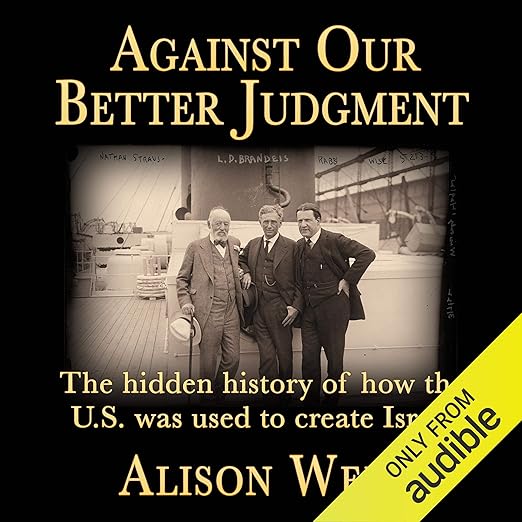
McGowan's Crisp Delivery Lets Sourced Claims Register
Alison Weir's audiobook Against Our Better Judgment enters a crowded field of historical treatments of US-Israel relations and distinguishes itself primarily through its source discipline. Where much writing on this topic operates from secondary analysis or contemporary journalism, Weir builds from archival primary sources and contemporaneous political documentation. The opening claim is direct: Dean Acheson, one of the architects of postwar American foreign policy, warned explicitly that supporting the creation of Israel on land already inhabited by Palestinians would compromise both American and broader Western interests in the region. That warning was overridden, and Against Our Better Judgment is an attempt to explain precisely how and why.
Daniel McGowan narrates the three-hour production with crisp, unornamented delivery that suits the text well. This is primarily an argumentative work rather than a narrative one, and McGowan's measured pace allows Weir's sourced claims to register without editorial inflection. At just over three hours, the audiobook is short enough to be consumed in a single session.
Brandeis's Role in an Elitist Secret Society
The audiobook's primary contribution is empirical rather than interpretive. Weir documents the mechanisms by which Zionist lobbying influenced the Truman administration's 1948 decision in concrete detail: the organizations involved, the individuals who served as conduits between lobbying networks and the White House, and the nature of the organized opposition from the State Department and Defense establishment that was overridden. The inclusion of figures like Supreme Court Justice Louis Brandeis in what Weir describes as an 'elitist secret society' of pro-Zionist advocacy gives the account historical specificity that distinguishes it from more polemical treatments.
One reviewer noted that the book was refused a paid advertisement by the American Historical Association, a detail that generated its own controversy around editorial independence in academic venues. That context is worth knowing: Against Our Better Judgment has been treated as politically sensitive by institutional channels, which has itself become part of how readers receive and evaluate it. The book's reception history is, in a sense, a data point about the very dynamics it documents.
Weir Founded the Organization Behind This Argument
At three hours and five minutes, this audiobook cannot deliver the sustained evidentiary argument that a topic of this complexity requires. It functions as an introduction and an orientation to the historical record rather than a comprehensive treatment. Listeners expecting the depth of a Rashid Khalidi or Walter Russell Mead will find the scope more modest than the framing implies. The sourcing is meticulous within its scope, but the coverage is necessarily selective.
The political valence of the material is significant and should be named. Weir founded If Americans Knew, an organization with a specific policy position on Palestinian rights and US-Israel relations. That position does not automatically invalidate the historical sources she cites, but listeners should approach the framing and selection of evidence with awareness of that context. The book has drawn both strong praise from those who find the documented record clarifying and sharp criticism from those who argue that the selection of sources and framing constitute a one-sided presentation. Engaging with the counterarguments alongside this audiobook will produce a more complete picture.
The organizational question the book raises, how a lobbying infrastructure operating across public advocacy organizations and private networks simultaneously can produce policy outcomes that override the professional consensus of the State Department and Defense establishment, is not unique to the Israel question. The mechanism Weir documents is recognizable from other episodes in the history of US foreign policy where domestic political constituencies successfully pushed against expert recommendation. That broader pattern gives the book an analytical relevance that extends beyond its specific historical case.
At three hours, the audiobook's most productive use may be as a catalyst for deeper reading rather than as a self-contained account. The sources Weir cites, the State Department cables, the Truman administration internal correspondence, the records of the organizations she describes, represent a documentary foundation that listeners who find the argument compelling can pursue into the primary record. McGowan's narration makes the three-hour session feel efficient rather than insufficient; the pace is measured enough to absorb the specifics without dawdling. For a short documentary audiobook, that balance is its own achievement.
McGowan Makes Three Hours Feel Like Enough
Listeners interested in the specific question of how US domestic politics shaped the 1948 recognition decision will find the sourcing here more focused and accessible than many longer treatments. The three-hour format makes it practical as an introduction to the archival record before moving to more comprehensive historical accounts. Those seeking a single definitive treatment of US-Israel relations should look at longer, more contextually comprehensive works alongside this one. The audiobook works best for listeners who understand that a three-hour document is an entry point, not an endpoint, in a historically contested area. For listeners specifically interested in the mechanics of how domestic political lobbying shapes foreign policy decisions against expert recommendation, this audiobook is a clear and specific case study in a form compact enough to function as a documented primer rather than a full scholarly treatment. McGowan's narration makes the three-hour session feel like efficient use of time rather than a compressed abbreviation of something that needed more room. Approached as an evidence-oriented starting point rather than a comprehensive conclusion, Against Our Better Judgment performs that specific function with notable discipline given the politically charged territory it covers and the compressed format within which it operates. Weir's documented approach provides that entry point clearly.
Good to Know
How does the audiobook's three-hour runtime affect its depth of coverage?
The short runtime means this is an introduction to the documented record rather than a comprehensive historical treatment. Weir covers the Truman-era decision and the lobbying context with archival specificity, but the broader historical, demographic, and geopolitical context that longer works address is necessarily compressed. Think of it as a documented primer rather than a full account.
What primary sources does Weir draw on in this audiobook?
The book draws on diplomatic cables, White House records, contemporary political correspondence, and institutional records from organizations involved in the lobbying effort. Weir also cites contemporaneous statements from US diplomatic and military officials who opposed the policy, including the Dean Acheson warning that opens the book.