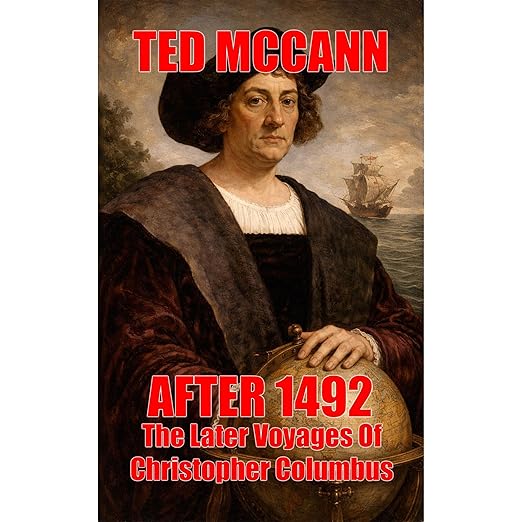
Ask most people what happened after 1492 and the answer stops at the landfall, which is exactly where this audiobook starts. Ted McCann's subject is the three Atlantic crossings that came after the famous one: four hours and two minutes spent on the stretch of the story that the school version abandons the moment the ships are safely ashore. It is a good instinct for a book, and the description knows it.
Seventeen Ships Marked a Shift From Exploring to Occupying
Everyone knows Columbus sailed the ocean blue in 1492, the copy opens, and almost no one knows what happened next. Behind the hook sits a genuinely underused shape: not the discovery but the administration that followed it. The second voyage, the description says, looked nothing like the first. Seventeen ships, more than a thousand men, livestock, seeds, soldiers and priests, a fleet that had stopped exploring anything and started occupying it.
Seventeen ships is the detail doing the real work. The copy uses it to mark the moment the enterprise changed category, and everything after follows the consequences: a return across the water as Admiral, Viceroy and Governor General, carrying sweeping authority and royal expectations of gold, walking into something in the Caribbean that would, in the description's phrasing, shatter every assumption about how the whole thing was supposed to unfold. That is a book, and a short one can carry it.
Columbus was perhaps the finest navigator of his age, the copy argues, a man who could read winds and stars with uncanny precision, and governing a colony of resentful Europeans in hostile tropical terrain demanded an entirely different set of skills. The gap between those two things is the actual thesis. He ended one voyage in chains and began the next already forbidden from setting foot in the colony he had founded, and he died believing himself a failure. As a spine for four hours, it holds without strain. The copy also lands one line worth keeping, because it tells you the register you are buying: he touched coastlines he could not recognize for what they were, and he made decisions that turned allies into enemies. That is trade narrative history, written to be heard rather than annotated.
No Rating, No Reviews, No Author Background
Four hours and two minutes counts as an argument in the book's favor. This is a period most listeners have met only as a date and a rhyme, and a compact narrative that begins where the classroom account ends is a sensible route in. The material supplies its own drama without help: mutiny, rebellion, royal displeasure, a return in irons. The description does not have to oversell any of it, and for the most part it resists the temptation. Three crossings inside four hours does force the book to choose, and the copy makes its choices visible enough: the second voyage takes the longest paragraph, the last one supplies the ending.
Where the page thins out is everywhere outside that description. No rating has been posted. No written response exists. The publisher line reads Independently Published, and nothing on the record identifies Ted McCann, names a single source, or hints at whether the book works from primary documents or from a synthesis of existing accounts. For narrative history that question is not a nicety, and this listing declines to answer it. Nothing stops a self-published history from being good, and a great many are. What is missing here is any way at all to find out in advance.
History audiobooks live or die on exactly that distinction, and a browser choosing between this and a university press production has nothing here to weigh. You are being asked to spend an afternoon on the strength of the blurb alone, which is a fair enough ask for a novel and a considerably heavier one for a book making factual claims. The copy even states the size of its own claim outright: the full story, it says, has been waiting five centuries to be told.
Virtual Voice Never Vetted the Caribbean Names
Nothing about that sentence can be checked from this page, and it is the kind of promise to hold loosely. Five centuries of waiting is a large thing to assert about a figure whose first voyage the description itself says everyone already knows, and the listing offers no bibliography, no author note, and no reviewer prepared to vouch for any of it. Read the framing as marketing and take the narrative on its own terms.
Independently Published is the second thing to weigh, and not because self-publishing is a defect in itself. What it means in practice is no house editor, no series standard, and nobody standing between the author and the file you download. Set that beside a review column with nothing in it and you have a product no third party has ever examined. Worth knowing before you commit the time.
Then the credit that will settle it for most people. The reader named on this file is Virtual Voice, which is not a person. The audio is generated from the text rather than performed, so no one vetted the period names and Caribbean place names this subject is thick with, and no one made a judgment about where a paragraph ought to slow down. Some listeners stop noticing after ten minutes. Others cannot get through a chapter. With an empty column underneath, you have no secondhand way to find out which of those you are.
Hold Off If Synthetic Narration Is a Dealbreaker
Listeners drawn to the first voyage who found the textbook version airless are the natural audience here. So are people who like the arc in which a person turns out to be extraordinary at precisely one thing and hopeless at the job that his success hands him, because that, stripped of the sales language, is what the description is selling. The runtime fits two long walks or a single quiet afternoon, and the subject fills it without padding.
Hold off if synthetic narration is a deal-breaker, because the credit says what it says and good writing will not change it. Hold off as well if you want your history with the sources visible, since this page will not tell you where any of the material came from. Four hours of a genuinely under-told stretch of a famous life is the offer on the table, and it is a reasonable one so long as you understand that not one other person has gone in ahead of you.
Common Questions
Who narrates the After 1492 audiobook?
No person does. The reader credit reads Virtual Voice, so the four hours and two minutes are generated from the text rather than performed by somebody who read it through first. For a history thick with period titles and Caribbean place names, that is the one thing worth sampling before you commit.
Does this audiobook cover the 1492 crossing itself?
Only as a point of departure. The copy is explicit that everyone knows the first crossing and almost nobody knows what came after, so the book opens instead on the second voyage: a fleet of seventeen, more than a thousand passengers, seeds and animals in the holds, and an expedition that had turned into an occupation.
Why does this listing show no ratings and no written responses?
It carries a March 2026 release date under an Independently Published imprint, and nobody has posted a vote or a comment since. Common enough for a self-published title in its first months, but it does leave the description as the only evidence, with nobody having checked the machine narration for you.