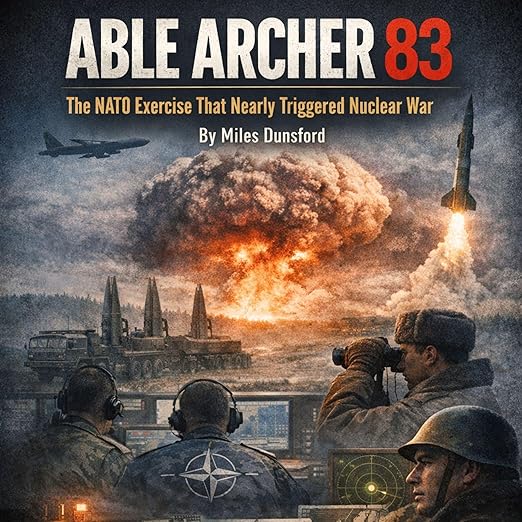
November 1983 sits at the intersection of several destabilizing forces in Cold War history: Soviet paranoia intensified by Reagan's rhetoric and the Pershing II deployments, the intelligence trauma of the KAL 007 shootdown in September of that year, and the broader collapse of any working relationship between Washington and Moscow. Into this volatile context arrived Able Archer 83, a NATO command-post exercise that Soviet intelligence reportedly read as possible cover for a nuclear first strike. This audiobook by Miles Dunsford, narrated by Chris Bentley, reconstructs that week with the care it deserves.
Dunsford's central argument is that the danger of Able Archer 83 was not deliberate. No one in NATO was trying to provoke the Soviet Union. The exercise was a standard rehearsal of command and communication procedures, run in a year like most other years in terms of NATO's internal expectations. But 1983 was not a standard year, and the exercise did not occur in a standard context. The Soviet leadership, already primed by Operation RYAN, the intelligence program tracking Western indicators of an impending nuclear attack, was reading every NATO action through a lens of worst-case assumption. The exercise looked categorically different through that lens.
This is a story about the gap between what is intended and what is perceived, and Dunsford handles it with historical precision. The book traces the year that built the conditions for that misperception, from the Soviet war in Afghanistan draining military and political resources, to Poland's martial law raising fears of both repression and rebellion, to the deployment of Pershing II and ground-launched cruise missiles in Europe that shortened Soviet warning times. Each element narrowed the margin for misinterpretation. Able Archer 83 arrived when that margin had nearly closed entirely.
The intelligence dimension is particularly well developed. Dunsford examines the Soviet intelligence culture that made Operation RYAN possible and examines how the confirmation bias of a system actively searching for evidence of attack can convert ambiguous signals into alarming ones. The lesson is not particular to the Cold War. It applies to any intelligence environment saturated by threat assumptions and under pressure to confirm what its operators already believe.
Chris Bentley Weighs Alarm Without Melodrama
Chris Bentley's narration is well suited to this material. Cold War history of this kind requires a narrator who can maintain calm authority across dense analytical passages without losing the underlying tension of a story whose stakes are nuclear. Bentley does this effectively, and his pacing gives the more alarming conclusions appropriate weight without melodrama. At just under four hours, the audiobook is compact enough to be absorbed in a single long session or across a couple of evenings without losing momentum.
The audio format serves the narrative structure well. Dunsford writes with the measured clarity of someone who has absorbed the primary sources and organized them for an intelligent general audience, and Bentley's delivery honors that clarity without excess embellishment. The book does not require prior knowledge of the Cold War or of nuclear strategy, though familiarity with the period enriches the experience significantly for listeners who have that background.
For listeners who have read the broader literature on Cold War near-misses, including the Petrov incident from September 1983 or the Vasili Arkhipov story from the 1962 Cuban Missile Crisis, Able Archer 83 provides a necessary third case study in the anatomy of accidental nuclear danger. These stories form a pattern that this audiobook helps make visible and legible.
One Reading of an Ambiguous Record
The title's claim that the exercise nearly triggered nuclear war is the most contested element of the book's premise. Historians debate how close the danger actually was. Dunsford is careful to use hedged language when describing Soviet responses, and he acknowledges the uncertainty in the historical record. Some scholars argue the danger was more limited than the worst-case interpretations suggest. This audiobook represents one reading of a genuinely ambiguous historical record rather than a definitive settled account.
The book is part of the Zentara Cold War Operations Revealed series. It functions as a complete standalone, so prior knowledge of the series is not needed. Listeners who enjoy this entry will find the series framework provides a coherent context for related Cold War case studies across other volumes.
At under four hours, the book is relatively short for its subject. Some listeners may find it covers the key events and their context well but leaves the analytical conclusions underdeveloped. More comprehensive accounts of Able Archer 83 exist in longer academic texts for those who want to go deeper into the primary source material and historiographical debates.
An Excellent Introduction to a Forgotten Moment
Ideal for listeners who follow Cold War history and want a focused, well-researched account of one of its least-remembered critical moments. Also recommended for anyone interested in the intelligence and perception failures that create danger in international crises, a subject with contemporary relevance extending well beyond the Cold War period and its specific actors.
Accessible to listeners without specialized Cold War knowledge, though those with some background in the period will get more from the contextual analysis. Chris Bentley's narration makes the relatively short runtime feel substantive and complete. For a first encounter with Able Archer 83, this audiobook is an excellent introduction to a story that deserves considerably more public attention than it currently receives.
Good to Know
How close did Able Archer 83 actually come to triggering nuclear war?
Historians debate this genuinely. The book is careful to note that Soviet responses are 'reportedly' alarming and that the historical record is incomplete. Dunsford presents one reading of an ambiguous record rather than a definitive conclusion, which is the honest approach to the available evidence.
Do I need background knowledge of the Cold War to follow this audiobook?
No, though some familiarity with the period enriches the experience. Dunsford provides enough context about the 1983 political environment that new listeners can follow the argument. Knowledge of the Pershing II deployments or Operation RYAN adds depth but is not prerequisite.
Is this audiobook part of a series?
Yes, it is part of the Zentara Cold War Operations Revealed series. It functions as a complete standalone, so prior knowledge of the series is not needed. Listeners who enjoy this entry will find the series connects related Cold War case studies across other volumes.
How does this audiobook compare to other accounts of Cold War nuclear near-misses?
Able Archer 83 is less well known than the 1962 Cuban Missile Crisis or the Vasili Arkhipov story, and this audiobook helps fill that gap. It is relatively short and aimed at general audiences rather than specialists, making it a good introduction before pursuing more comprehensive academic sources.