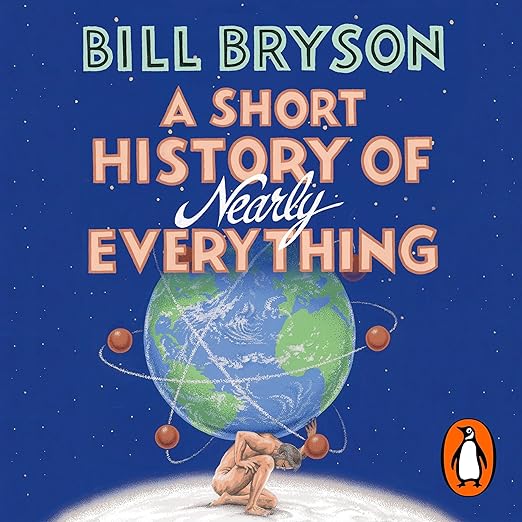
- Performance: William Roberts delivers Bryson's sardonic curiosity with warmth and a pace that never lets the science feel intimidating, though the special introduction read by Bryson himself adds a layer of authenticity Roberts can't quite replicate.
- What it covers: Scientific wonder, human fallibility in discovery, deep time and scale
- Feel: Curious and unhurried, like a long walk through a museum with a knowledgeable friend
- Our call: One of the most genuinely enjoyable popular science audiobooks ever produced, and the format suits it perfectly.
Bill Bryson begins A Short History of Nearly Everything with a question that most science books never dare ask plainly: why does any of this exist? Not the science itself, but us, the improbable creatures who survived long enough to notice. That framing sets the tone for an audiobook that never treats curiosity as a given. Bryson earned it, and he spends just under six hours reminding you how strange it is that you are here at all to press play.
The audiobook edition carries a special introduction written for the format and read by Bryson himself, which matters more than it sounds. His voice establishes the register immediately: rueful, self-deprecating, genuinely awed. Narrator William Roberts then carries the full text with considerable skill, maintaining Bryson's wry cadence without sliding into caricature. The handoff is slightly felt at first, but Roberts earns his place within the first chapter.
Where This One Lands
The structural achievement here is how Bryson handles compression. This audiobook runs under six hours for a book that covers geology, chemistry, particle physics, astronomy, paleontology, and evolutionary biology. Another author would produce a trivia parade. Bryson produces something more like a series of character portraits in which the subject is usually a scientist whose life illuminates the discovery. You learn about the formation of the Earth's crust through the story of the people who figured it out, their obsessions, their blind spots, their sometimes spectacular wrongness. The result is that the science lands with biographical weight rather than textbook inertness.
Reviewer James Marsh, who notes he has built a career around the natural world, calls it a sea of information and means it as praise. What is impressive is that Bryson makes that sea navigable. He consistently anchors abstract scale to human perception. When he explains geological time, he reaches for comparisons that briefly stop you mid-step. The Economist called it possibly the best scientific primer ever published, and it is hard to argue with the logic: if you can make someone genuinely curious about particle physics in forty-five minutes of listening time, you have done something that most textbooks accomplish in none.
Why A Short History of Nearly Everything Works as an Audiobook
The audio format suits this book exceptionally well, and not only because Roberts handles the prose comfortably. Bryson's writing has a spoken quality from the start. His sentences are built to be heard: the rhythm is conversational, the digressions are timed, the punchlines land on clause endings. Listening to it is not a compromise version of reading it; in some passages it feels like the intended experience.
Reviewer Monica Kern suggests this book should replace high school science texts, which is an argument about what science education gets wrong more than a claim about this book specifically. The book works because it treats the audience as intelligent people who have simply never been given a reason to care. That is exactly the problem with most introductory science instruction, and Bryson's instinct to lead with wonder and human stakes rather than definitions and formulas is the corrective.
The Radio 4 Book Club selection badge is worth noting here. Books that translate well to radio tend to translate well to audio, and this one was shaped for that context by its author's sensibility before a producer ever touched it.
What Gives Us Pause
The book was published in 2003, which means some of its science is dated. Cosmological models have shifted, and a handful of the statistics Bryson cites have been revised by subsequent research. For the purposes of this audiobook, that is a minor caveat: the broader arguments about deep time, evolutionary contingency, and the fragility of scientific consensus remain intact and well-supported. Bryson is not writing a textbook; he is writing about how scientific knowledge is made and unmade, and that process has not changed.
Reviewer Daniel Bastian quotes one of the book's most memorable passages: the argument that every ancestor you have ever had survived long enough to reproduce, which means the odds against your specific existence are essentially incalculable. Bryson returns to this note several times throughout the audiobook, and it functions as both a scientific point and a moral argument for paying attention to the world you accidentally inhabit.
First-time listeners to Bryson should know that his books operate on two registers simultaneously: the informational and the comedic. He is genuinely funny about science in a way that does not reduce the science. The humor comes from the absurdity of reality, not from condescension toward it. Roberts captures this double register reliably throughout the recording.
Who Should Listen to A Short History of Nearly Everything
This audiobook is the right fit for anyone who left formal science education with a feeling of mild bewilderment and no particular desire to return to it. Bryson's approach is designed for exactly that listener. It is also worth a listen for people who are already scientifically literate but want a narrative account of how the disciplines developed rather than where they currently stand. Parents looking for an accessible science audiobook to share with teenagers will find it suitable, though younger children will find some of the longer geological and astronomical passages harder to track on audio.
Those expecting practical takeaways or a structured educational program should adjust their expectations. This is a book about wonder and context, not a course. If you want to walk away able to pass a physics exam, this is not your audiobook. If you want to walk away genuinely amazed that rocks exist, it absolutely is.
A Few Questions About A Short History of Nearly Everything
Does the audiobook version of A Short History of Nearly Everything include anything not in the print edition?
Yes. The audiobook edition includes a special introduction written specifically for the audio format, read by Bill Bryson himself. This introduction sets up the listening experience and gives you a few minutes of the author's own voice before narrator William Roberts takes over for the full text.
Is the A Short History of Nearly Everything audiobook good for someone with no science background?
It is specifically designed for that listener. Bryson's stated goal was to make subjects like particle physics and geology comprehensible to people who have never thought they could be interested in science. He consistently prioritizes narrative and human context over technical vocabulary.
How does William Roberts handle the narration compared to Bryson's own voice in the introduction?
Roberts maintains Bryson's wry, conversational tone effectively throughout. The contrast with Bryson's own introduction is noticeable but not jarring. Roberts has a warm, unhurried delivery that suits the material, and most listeners adjust to his voice within the opening chapter.
At under six hours, does this audiobook feel rushed given how much ground it covers?
This is an abridged edition, and compression is real. Some topics receive briefer treatment than readers of the full print edition will expect. The audiobook is best understood as a curated highlight of Bryson's argument rather than the complete work. For deep dives into any specific subject, you would want to follow up with dedicated titles on each discipline.