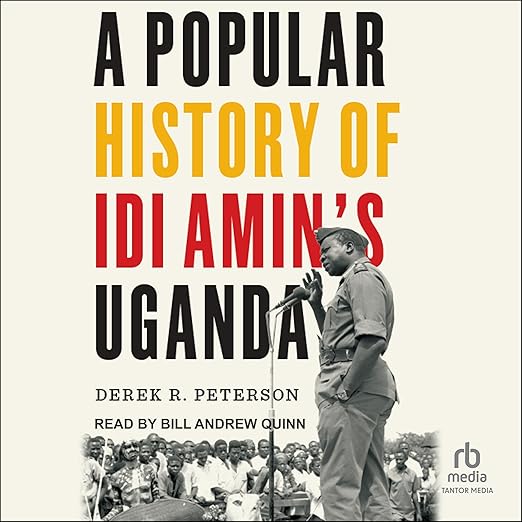
Tyranny needs staff, and that is the uncomfortable subject of this audiobook. Idi Amin ruled Uganda from 1971 to 1979 and inflicted tremendous violence on the country, and the question Derek R. Peterson sets out to answer is not how a tyrant took power but how a regime that calamitous kept running for eight years. The answer, drawn from recently uncovered archives, is that civil servants, curators, artists, businesspeople and self-described patriots turned up and did their jobs. Tantor Media released the file on October 28, 2025 at eleven hours and twenty-eight minutes, read by Bill Andrew Quinn.
Peterson Explains How Clerks Enabled Tyranny
Consent is the mechanism the book reconstructs. Amin, whose dates the copy gives as 1928 to 2003, persuaded ordinary Ugandans to understand themselves as frontline soldiers in a global war against imperialism and colonial oppression, and that framing turned administrative labor into patriotic service. Institutions went on functioning as resources dried up and political violence became pervasive, not because anybody forced clerks to their desks but because the desks had been made to feel like a front line. Peterson's phrase for what follows is sacrifice, and the copy applies it without irony to people who were talented, principled and catastrophically wrong.
Reorganizing the story around the payroll rather than the ruler changes everything downstream. Most accounts of this period take the dictator as the protagonist and the population as the object; this one inverts the arrangement, so the archive being read is administrative rather than atrocity-focused, and the running time is spent among people who were neither victims nor monsters. Curators and artists get treated as political actors, a category that histories of dictatorship routinely skip on the way to the army and the security services.
This Book Claims Lessons for Our Time
Worth registering the publisher's closing claim, since it shapes the final stretch. The description presents all of this as a case study with lessons for our own time, which is a strong editorial position rather than a neutral summary of contents. Listeners who dislike historians reaching forward should know that the reach is advertised on the page. Listeners who want exactly that reach will find it stated before they buy.
New Archives Earn the Groundbreaking Label
February 2026 brought the endorsement on the page, a five-star grading the contribution rather than the entertainment, calling both the research and the perspectives new under the single heading Groundbreaking. Short as it is, that is the right axis for a scholarly work and the right compliment: not that the story moves, but that the material was not available before. Archives opening on a period this contested changes what can be argued, and a general listener gets the benefit of that without having to work through the footnotes.
What the archive actually delivers is texture. A ministry keeping its records straight while the currency collapses, a museum staff arguing about acquisitions, businesspeople calculating what accommodation costs, all of it accumulating into an argument about why systems persist. Nothing in that requires prior knowledge of the region's politics; the reasoning is offered from first principles and the individual cases carry it.
Audio handles this better than the subject suggests. The argument builds cumulatively rather than depending on maps, tables or a chronology you need to keep open beside you, so a listener loses very little compared with a reader. The prose is scholarly without being technical, and the recurring move, taking one person's decisions and asking what they thought they were doing, works particularly well spoken aloud.
Quinn Alone Carries a Decade of Names
The dissenting account on the page is specific and deserves an answer. A two-star filed from the United Kingdom argues that the book loses focus, that too much space goes to side stories and trivial details while the real turning points are brushed over, and that the 1972 expulsion of Asians, which remade Uganda's social and economic fabric, is squeezed into a few pages. Every one of those observations is probably accurate. The disagreement is about design: side stories are the declared subject, and turning points are what this book has deliberately walked away from.
Bill Andrew Quinn carries a decade of Ugandan personal names, place names, ministries and institutional titles alone, along with set pieces from a head of state who was very good at public speech. Keeping all of that distinguishable across the whole file, while a dozen individual careers weave in and out of the account, is harder in audio than it looks, since a reader can flick back a page to check who somebody was. Let the preview settle the pronunciation question before you commit an evening.
Timing on that dissenting entry is worth knowing too. It was filed on October 9, 2025, nineteen days before this edition reached listeners, and it counts pages rather than hours. What it grades is a printed copy that got to readers first, which makes it a useful guide to the argument and no guide whatsoever to the production you would be buying.
It Skips the Battles for the Bureaucracy
Anyone interested in how authoritarian systems recruit consent should hear this, and so should readers of African history who are tired of the same three anecdotes about Amin. It suits students of bureaucracy, of complicity, and of the strange durability of institutions, and it makes an unusually good companion to any account of an ordinary population living inside an extraordinary regime. The people it takes seriously are the ones most histories reduce to background.
Battlefield chronology and atrocity narrative get thin treatment here, so anyone wanting the events of those eight years laid out in order will be frustrated within the first hour. Buyers looking for a biography of Amin are in the wrong place entirely. Readers who need to verify a claim as they go should also weigh what the format costs them, because the archives doing all the work are named in the argument and nowhere else.
Questions Listeners Ask
Is this audiobook a biography of Idi Amin?
No. Amin's dates appear in the copy and the regime frames everything, but the subject is the workforce that kept it upright, from clerks and museum staff to artists and business owners. The argument concerns why they held institutions together through eight years of pervasive violence and vanishing resources, rather than what the ruler personally did.
What period does the audiobook cover?
The regime years, 1971 through 1979, provide the frame, and the file spends a shade under eleven and a half hours inside them. The described source base is recently uncovered archival material, which is what allows the account to work at the level of ministries and individual careers instead of at the level of headline events.
Does the audiobook include a bibliography or notes?
Nothing of the kind is listed. No bibliography, chronology or glossary is named anywhere, and no supporting document travels with the audio. On a work whose authority rests almost entirely on newly opened archives, that costs something real: a listener wanting to trace a claim back to its source has nowhere on this page to begin.