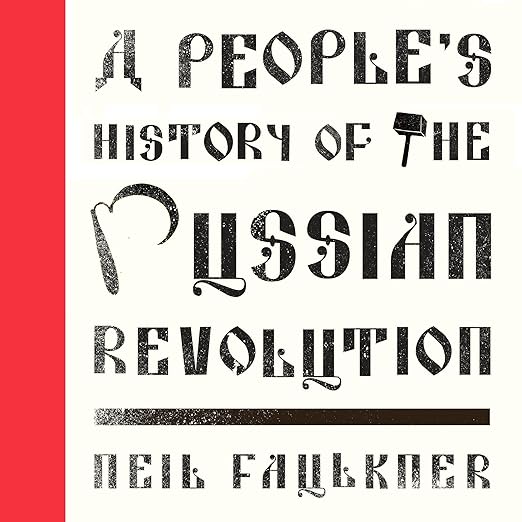
Key Details
- Performance: Douglas Storm holds the reading credit on a compact history that argues far more than it narrates, with a heavy load of transliterated names and party initials
- What it covers: revolution from below, Bolshevik revisionism, state capitalism, contested historical memory
- Feel: Fast, combative, unapologetically partisan
- Our call: A short and forceful counter-history that tells you where it stands; read something hostile to it immediately afterward.
Whoever recorded this audiobook shares a name with whoever wrote its top-listed response. The narrator field reads Douglas Storm; the five-star sitting at the head of the column is filed under Douglas A. Storm. One middle initial separates them, and nothing on the record explains the coincidence in either direction. It may be two people with a common name, which is the likeliest reading, and a buyer weighing a six-and-a-half hour history at 4.0 across thirty-two graders still deserves to notice that the most prominent endorsement on the page is signed almost exactly like the credit for the reading.
Faulkner's case is stated in the first line of the copy and never retreats from it: the Russian Revolution may be the most misunderstood event in modern history, and the misunderstanding is deliberate. What follows is a fast history of a mass movement of millions, organized through democratic assemblies, mobilized for militant action, and directed against a regime the book describes as one of landlords, profiteers and warmongers. This is not neutral framing and never pretends to be. The book is a corrective, written against a settled version of events, and it moves at the speed of an argument.
Defending the Bolsheviks is the book's central act. Faulkner rejects the familiar portraits of Lenin and his party as authoritarian conspirators, as narrow centralists, or as the direct ancestors of Stalinist dictatorship, and instead reads October 1917 as an explosion of democracy and creativity that was short-lived because it was crushed. What replaced it, in this telling, is not socialism at all but a monstrous bureaucratic state-capitalism, and that distinction carries the whole book. Accept it and the argument holds together; reject it and very little else survives.
The most substantial endorsement in the column is candid about the lineage. It notes that the book leans heavily on Trotsky's own history of the revolution and that no apology is offered for doing so, then sets aside the endless argument over who was right and praises instead the sure handling of the material and prose it calls fluid and often powerful. That is the fair assessment. Faulkner is a stylist, the pace never sags, and a reader who knows where the interpretation comes from can take it on those terms.
Storm's Brisk Pace Never Pretends to Be Neutral
Balance is not on offer and the smartest response in the column explains why that is acceptable. A four-star grants outright that the book is written from a Marxist and Trotskyist position, then argues it is no more dogmatic than any other historical interpretation, and calls the search for an impartial account of the Russian Revolution a fool's errand, extending the same point to the Cuban, Chinese and Nicaraguan revolutions. Every account of a revolution is written from somewhere, and this one at least tells you where.
Six and a half hours is the other argument for it. The copy calls this a primer and it means it, which makes it one of the shortest serious routes into 1917 available in audio, laced with first-hand testimony and never summarized from a distance. Douglas Storm is the voice on it, handling Russian names, party acronyms and long passages of quoted witness at a pace that has to stay brisk without turning the polemic into a lecture.
Cliff's Sources Predate the Archives Broue Later Opened
The single one-star in the column is a serious piece of criticism and should be read before purchase. It charges the book with making no pretense of historical objectivity, identifies its principal sources as the works of Tony Cliff, and objects that Cliff died before Soviet archival documents became available. It further argues that Faulkner passes over a Trotskyist historian, Pierre Broue, whose archival findings complicate Trotsky's own accounts. Whatever your politics, that is a specific and checkable objection about sourcing, not a slogan.
A three-star finds an internal problem, and it is the sharpest thing in the column. Early chapters criticize the Mensheviks as reformers and counter-revolutionaries, while the closing analysis attributes the revolution's degeneration to the failure of revolutions elsewhere in Europe during the 1920s and to the impossibility of socialism in a single country. If the second point stands, that entry argues, the first loses much of its force, because the outcome was then structural and not a matter of the wrong faction winning. The book leaves the tension unresolved.
Weigh the badge accordingly. A 4.0 across thirty-two graders looks like mild approval, while the visible column runs from five stars to one, which is a column arguing, not agreeing. Note too that the copy uses British spelling and that the book comes from Pluto Press in partnership with the Left Book Club, a detail the description discloses openly and one that tells you exactly which shelf this was commissioned for. The audio edition itself is recent, dated February 2026, while the debate underneath it plainly predates the recording by some distance.
Newcomers Wanting a Compact Counter-Reading Will Benefit Most
Newcomers to 1917 who want a short, committed account get the clearest deal here, and one five-star describes exactly that experience, having heard the author speak at a book festival in Carlisle and come away persuaded to look further, while recommending Simon Sebag Montefiore's book on the Romanovs as a companion from an entirely different angle. Readers of left history will recognize the tradition immediately. Students needing a compact counter-reading against a standard textbook will find it useful for that purpose alone.
Avoid it if you want the archival consensus, since the one-star's complaint about post-Soviet documents is fair and this book is not built on them. It is also the wrong first purchase for anyone who wants the revolution narrated as a story with characters, because the mode is analytical and the pace is argumentative. Take it as a position paper delivered at speed, read something opposed to it afterward, and six hours will have been well spent.
A Few Questions About A People's History of the Russian Revolution
Is this audiobook an impartial history of the revolution?
No, and it says so. The copy positions the book as a corrective against received versions and argues from a Marxist and Trotskyist tradition throughout. The description also discloses a co-publishing partnership with a book club of the same politics. Treat it as a committed reading with a stated position and never as a survey.
How long is the audiobook and who publishes it?
Six hours and thirty-six minutes, dated February 2026 in audio, from Pluto Press in a co-publishing arrangement the description names openly. That length makes it among the most compact serious routes into 1917 available on headphones, which is a large part of why a newcomer should consider it at all.