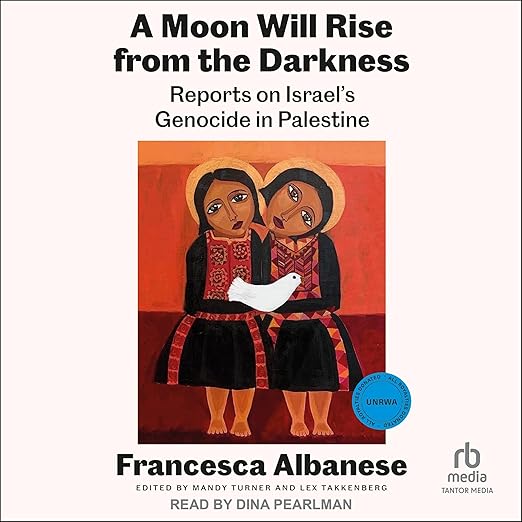
Compiled documents rarely make a comfortable audiobook, and this one does not try to. A Moon Will Rise from the Darkness gathers the reports Francesca Albanese has filed as United Nations special rapporteur since October 2023, adds a reflection of her own, and surrounds them with contributions from people who held the same mandate before her. Five hours and thirty-two minutes is the whole of it. What you are buying is a dossier read aloud, not a narrative history built from one, and knowing that in advance changes how you should approach the listening.
Three Stages, from Genocide Claim to Corporate Audit
Francesca Albanese holds a mandate that reports to the UN rather than to any government, and the publisher's framing puts her at the center of a specific controversy: the sanctions the United States has imposed on lawyers, UN experts and Palestinian officials, which the copy presents as an attempt to force silence. Whatever a listener makes of that framing, it explains the book's existence. This is a working official's case file, published as a book because the reports themselves are hard to read in the form they were filed.
Structurally the volume moves in three stages. It first sets out the argument that the period since October 2023 should be understood as a genocide, then places the violence inside what Albanese describes as a longer history of settler colonialism, then turns to the international corporations she argues have treated the destruction as a commercial opportunity. That third section is the one least covered elsewhere, and it is where the reports read least like commentary and most like an audit.
Former Mandate Holders Add Their Own Accounts
A Moon Will Rise from the Darkness is the one lyrical gesture in an otherwise procedural package, and it tells you who the publisher has in mind. Readers who already share the book's position and want the documentation in one place are the target, not undecided readers hoping to weigh a case. That is a legitimate way to publish primary material, and it does mean the title is doing marketing work the contents never attempt.
Three former holders of the same mandate contribute accounts of their own experiences in the role: Richard Falk, John Dugard and Michael Lynk. Lex Takkenberg, described as a thirty-year veteran of UNRWA, supplies a preface written with the scholar Mandy Turner. That apparatus is the strongest argument for the book as a book rather than a download of documents, because it turns a set of filings into a record of what the office itself has been through across several decades and several rapporteurs.
Six Distinct Voices Under Pearlman's Single Credit
Five hours and thirty-two minutes is short for the subject and exactly right for the form. Reports are dense but finite, and a compilation does not require the connective tissue a narrative history would need. It also means the runtime is doing something unusual: six or more distinct authorial voices, a preface, a reflection and a body of official filings, all delivered through the single reading credit the record gives to Dina Pearlman.
Report prose has a shape most listeners never encounter. It is written to be cited rather than read continuously, it carries its evidence in the sentence rather than in the scene, and it repeats definitions on purpose. Aloud, that register demands patience and rewards attention, in roughly the way a long legal judgment does. Listeners who work with documents for a living will find the rhythm familiar. Listeners who came for narrative history will need to adjust in the first twenty minutes or not at all.
Twenty-Four Ratings, Too Thin for a Verdict
Most of the written column predates this recording. Four of the five visible responses were filed between 12 December 2025 and 1 January 2026, and the audio edition appeared on 20 January 2026, so those reactions belong to a printed book rather than to the file you would be buying. Across the column as a whole, two responses were filed in the United Kingdom and one in India, which means the page pools reactions across markets and editions rather than reporting on one product.
Four five-star responses and one single star, with nothing in between, is the shape of the column, and on this subject that is the expected distribution rather than a useful signal. The 1 January 2026 entry rejects the book outright, comparing it to a Nazi-era propaganda sheet and calling it a waste of paper. Read together, the five entries measure the temperature around the topic and tell you very little about how the reports are constructed, which is the thing a prospective listener actually needs to know.
Twenty-four ratings sit behind the 4.7 badge, which is a very small base on a subject this contested. One additional low grade moves that average visibly, and the five written entries are the only explanation available for any of it. On a title released in January 2026, numbers this thin are an early indicator rather than a verdict, and treating them as consensus would be a mistake in either direction.
Readers expecting a two-sided survey of the conflict should look elsewhere, and the copy is candid about that. This is advocacy in the specific legal sense: a rapporteur documenting findings and arguing they meet a threshold, with recommendations attached. The record files it under history with a Middle East tag, and while the subject is historical, the form belongs to law rather than to history writing. Anyone assigning it as a general introduction to the region will be handing over a document that assumes the debate is already underway.
For Lawyers and Researchers, the Documents Themselves
Human rights lawyers, students of international law and anyone following the UN system's handling of the past two years will find the primary material here in a usable form, which is the book's clearest justification. Listeners who already follow Albanese's work get her reports collected rather than scattered across sessions and sittings. The corporate accountability section is the one that will interest researchers who have read the rest of the coverage and found that part missing.
Approach differently if you want context before conclusions. This volume assumes you have followed events since October 2023 and are ready for the legal argument about what they amount to, and it will feel airless to a listener still assembling the basic chronology. Anyone who finds the framing unacceptable will not be persuaded by the audio edition either, and the one-star already on the page makes that plain. What the recording offers is access to the documents themselves, in the order and the language their author filed them.
Quick Take
- Voice: One reader for a compilation, so the move from a filed report to a personal reflection has to arrive through delivery alone.
- Big ideas: International law and the UN mandate system, corporate accountability, settler colonialism as a historical frame, sanctions against legal experts
- Atmosphere: Documentary and unrelenting, closer to a legal filing than to reportage
- Worth it?: Primary material collected in usable form for listeners who follow international law, and the wrong entry point for anyone new to the subject.
Good to Know
Does this audiobook give a history of the conflict or a set of documents?
A collection. It compiles the reports Albanese filed as UN special rapporteur from October 2023 onward, plus her own reflection, contributions from three predecessors and a preface. The historical material appears inside the legal argument rather than as a standalone narrative, so treat it as primary source rather than survey.
Is the whole volume read by one person?
Yes. Dina Pearlman takes the sole reading credit, and Tantor Media issued the edition on 20 January 2026 at five hours and thirty-two minutes. Compiled reports carry their argument without the connective narration a history would need, which is why the subject fits into so short a runtime.
Does the audiobook cover companies as well as governments?
Yes, and that section is the most distinctive part of it. After the genocide argument and the settler colonialism framing, the final movement turns to international corporations that Albanese argues have profited from the destruction. Researchers who have followed the general coverage will find this the least duplicated material.
What do the reviews tell me about the recording?
Very little, and their register is worth knowing. Most are single sentences of endorsement or rejection, one of them stating simply that everyone who believes in human rights and justice should read the book. They measure feeling about the subject rather than reporting on the edition.