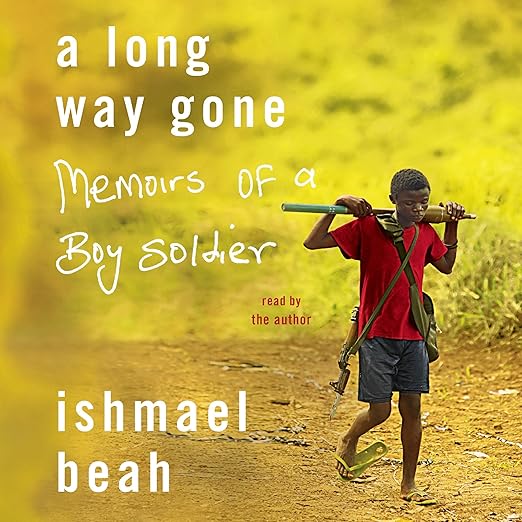
- Read by: Beah narrates his own memoir with quiet gravity. There is no performance to it, and that absence of artifice is what makes the most horrifying passages so difficult to sit with.
- At its heart: Child soldiers, trauma and rehabilitation, the machinery of civil war
- Vibe: Haunting and essential
- Short version: One of the most important memoirs of the last two decades, and Beah reading his own words brings a weight of witness that no other narrator could replicate.
I have assigned or recommended this memoir more times than I can count over twelve years of writing about books. But listening to Ishmael Beah read it himself, in his own voice, with his own cadences shaping sentences he first committed to paper in his early twenties, is a different experience from reading it on the page. The text does not change. The encounter with it does. There is a quality to first-person narration when the first person is genuinely the person that no professional narrator, however skilled, can replicate.
The facts of Beah's life are now well-known in the literary world: he was twelve years old when rebel forces attacked his village in Sierra Leone during the civil war of the 1990s, forcing him to flee across a landscape made unrecognizable by violence. By thirteen, he had been picked up by the government army. What followed was two years as a child soldier, involving drug addiction, automatic weapons, and acts he describes with unsettling precision and no apparent attempt to mitigate their horror.
How A Long Way Gone Holds Up
What distinguishes this memoir from the journalistic accounts of child soldiers that existed before it, and from the fiction writers who had attempted to imagine those lives, is exactly what the original publisher noted: the first-person witness. Beah was there. He did the things he describes. And his account of how an ordinary, gentle, hip-hop-loving boy became capable of those things, and how he was then rehabilitated through UNICEF intervention and eventually the care of a UNICEF worker named Laura Simms, is rendered with the kind of psychological precision that memoir at its best achieves.
The book is also written with real literary force, a phrase from the original jacket copy that has earned its place through the test of time. Beah studied literature at Oberlin College after leaving Sierra Leone, and that education left marks on the writing: in his attention to sensory detail, in his structural control, in his willingness to sit with an image or a moment until it fully develops.
Why A Long Way Gone Works as an Audiobook
Beah narrates with quiet gravity, and quiet is the operative word. He does not perform the horror of what he is describing. He presents it, in the same measured voice that he uses to describe hiding in trees and listening to rap music and remembering his grandmother's stories. That tonal consistency is its own form of testimony. It says: this is what it was. I am not asking you to feel any particular way about it. I am telling you what happened.
One reviewer who heard Beah speak at a high school described the experience of his in-person presence as similarly composed and thoughtful. That quality is present throughout the audio recording. At 7 hours and 43 minutes, it is a single-day listen for dedicated listeners, and the pace is unusual: neither propulsive nor slow, but held at the rhythm of considered memory.
Weak Spots in A Long Way Gone
The memoir covers atrocities committed by a child and witnessed by the same child, and Beah does not obscure them. The violence is specific and some of it is deeply difficult to sit with. This is appropriate and intentional, the book is making the argument that we need to look directly at what happens to children in war, not through a sanitized version, but it is relevant context for listeners who may not be prepared for the degree of specificity.
There have also been questions raised by journalists since the book's publication about certain details, particularly around the timeline of Beah's experiences. Beah and his publisher have maintained the accuracy of the account, and the memoir's core substance has not been effectively disputed. But listeners who follow literary controversy will want to be aware this exists.
The Right Listener for A Long Way Gone
This memoir should be heard by anyone who reads seriously and has not yet encountered it. That is not hyperbole. It is one of the small number of books about what we collectively call conflict that makes the abstraction concrete and personal in ways that policy language and journalism cannot. It belongs alongside The Kite Runner and Half of a Yellow Sun as a text that generates durable understanding of what civil war costs at the human scale.
Listeners should be adults or mature older teens, and should be prepared for difficult material. But the difficulty is the point. Beah survived something most of us cannot imagine, wrote about it with extraordinary care, and then sat down in front of a microphone and gave his voice to it. That effort deserves a listener who is willing to meet it fully.
How does Ishmael Beah's self-narration hold up across the nearly 8-hour runtime?
Beah is not a professional voice actor, but his control and consistency are remarkable throughout. The gravity and composure he brings to the narration does not waver, which is itself an achievement given the nature of the material he is reading aloud.
Are there factual disputes about A Long Way Gone that listeners should know about?
Journalists raised questions about specific timeline details after publication. Beah and his publisher stand behind the account's accuracy. The core substance of his experience as a child soldier in Sierra Leone has not been credibly disputed, and the memoir's literary and moral weight is unaffected by the peripheral controversy.