- Performance: Peter Noble commands fifteen hours of dense archival history with the authority of a senior correspondent, maintaining consistent character differentiation and sustaining Barr's spy-novel narrative momentum.
- What it covers: British-French imperial rivalry, the making of modern Middle Eastern borders, covert political violence.
- Feel: Compulsive and serious, archival depth with narrative drive.
- Our call: A genuinely compelling account of how two European powers spent thirty years dismantling their own agreement and reshaping a region; Noble's narration makes the commitment worthwhile.
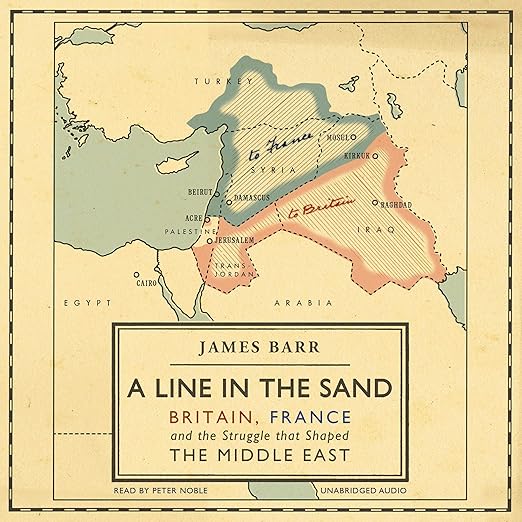
The Sykes-Picot Agreement of 1916 is one of history's more consequential acts of cartographic arrogance, and James Barr's A Line in the Sand is the audiobook that finally puts it into a narrative form that makes the personal politics behind the lines as vivid as the geopolitical consequences. Peter Noble narrates, and I came to this one after spending time with several more recent works on the modern Middle East that kept referencing Sykes-Picot as backstory without ever properly telling its story. Barr tells it, and tells it as compellingly as the subject deserves.
Barr's Sordid Tale of Mutual Undermining
Barr's framing is specific and useful. He is not attempting to write the complete history of either the British or French Middle Eastern mandates. He is telling the story of what he calls the 'sordid tale' of how two European powers spent thirty years undermining each other within the territories they had secretly agreed to divide. The cast of characters is extraordinary: T. E. Lawrence, Winston Churchill, Charles de Gaulle, and a revolving door of diplomats, spies, and soldiers all pursuing national advantage through methods that range from clandestine to openly violent.
What makes the book valuable beyond conventional diplomatic history is the use of declassified papers from both British and French archives. Barr has done genuine archival research, and it shows in the specificity of what he reveals. The Spectator blurb reprinted in the synopsis captures the effect well: 'amazement at the efforts the British and French each put into undermining the other.' That mutual sabotage is both darkly comic and genuinely alarming, because the consequences of this European rivalry played out on populations who had not been consulted about any of it, and whose descendants are still living with the results.
Sir Mark Sykes and Francois Georges-Picot are fascinating subjects for biography in their own right. Barr's characterization of Sykes as a visionary politician and Picot as a diplomat with a grudge gives the original agreement a personality dimension that purely structural diplomatic history tends to flatten. These were human beings making consequential decisions under specific pressures, and Barr recovers enough of that human texture to make the archival material feel alive rather than merely interesting.
Peter Noble Sustains Momentum Across Diplomacy
Peter Noble is an excellent match for this material. He has the quality of a senior correspondent reading aloud from dispatches, authoritative without being pompous, with enough color in his delivery to distinguish personalities while maintaining the credibility the historical subject demands. The fifteen-hour runtime is substantial, but Barr writes with enough narrative momentum that the book does not feel like a survey course. Noble sustains that momentum in the audio version by keeping the pacing taut even through the densest sections of diplomatic maneuvering.
The Independent described the book as 'horribly addictive,' and Noble's narration honors that quality. He treats the spy-novel texture of Barr's reconstruction with appropriate seriousness, neither playing it for thriller effect nor flattening it into dry exposition. The revelation Barr builds toward, the shocking way in which the French finally extracted their revenge against British dominance in the region, lands with the weight it deserves because Noble has maintained the listener's investment through the preceding hours.
French Archives Complicate the Standard Narrative
Reviewer Donna Brown notes that the book 'reads like a novel,' and that is accurate as a description of Barr's method. He reconstructs scenes, attributes motives, and builds dramatic sequences from archival evidence in ways that prioritize narrative coherence alongside historical accuracy. Listeners who prefer academic history with more explicit citation apparatus at every step may occasionally wish for more qualification around specific claims. Listeners who want historical narrative that actually holds their attention will find Barr's approach entirely appropriate.
Reviewer Raymond Parsons, who was familiar enough with the material to buy a second copy for a grandchild, describes it as 'an excellent but complex account.' That complexity is real. Barr is tracking multiple simultaneous threads across multiple countries and decades, and keeping the cast of characters straight requires sustained attention. Noble's consistent characterization helps considerably, but this is not passive listening material.
Barr's use of the French archives in particular yields material that has not been widely available in English-language treatments of this period. The French perspective on their mandate in Lebanon and Syria, and on the British maneuvering that constantly threatened it, is typically filtered through British sources and their inevitable biases. Barr goes to the French records directly, and what he finds complicates the standard narrative in ways that Noble's narration delivers with appropriate weight. The sections that draw on this French archival material are among the most historically original in the book, and they reward the patience the earlier chapters require.
Fifteen Hours Never Feels Merely Academic
Anyone seeking to understand how contemporary Middle Eastern borders came to exist, and why the political structures imposed after the First World War have proven so persistently unstable, will find this audiobook one of the clearest available accounts. The archival depth distinguishes it from more surface-level treatments of the same period.
Peter Noble's narration makes fifteen hours feel appropriate rather than excessive, and the spy-novel quality of the material means the history never becomes merely academic. Listeners who struggle with multi-character political history, or who want a shorter introduction to the period, might begin elsewhere. But for anyone ready to commit to a serious account of how the modern Middle East was made by two powers who barely disguised their contempt for each other, this audiobook is a serious and genuinely compulsive achievement.
Before You Listen
What background knowledge does this audiobook assume about the Middle East?
Barr assumes familiarity with the basic shape of the First World War and the existence of the British and French mandates, but builds the specific history from the ground up. A general sense of the period helps; expert knowledge is not required.
Does the audiobook cover the Sykes-Picot Agreement itself, or primarily what came after?
Both. Barr opens with the secret 1916 negotiation between Sykes and Picot and then spends most of the audiobook tracing the thirty years of rivalry and betrayal that followed as both powers tried to dominate the territories they had divided.
How does Peter Noble handle the large number of historical figures across this audiobook?
With consistent differentiation and appropriate gravity. He does not create theatrical voices for historical figures but builds recognizable character textures through pacing and emphasis, which is the right approach for serious archival history.