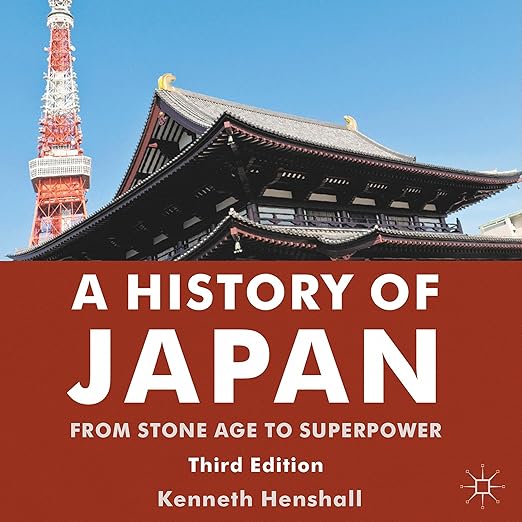
How do you compress an entire national history into one audiobook without reducing it to a chronology of dates and dynasties? Kenneth G. Henshall's answer is to pick an argument and hold it. His survey runs from Japan's earliest periods to its standing as an economic, technological and cultural power, and it keeps returning to a single organizing claim: that a pragmatic determination to succeed shows up again and again across radically different eras. Whether you find that persuasive or reductive will decide how you feel about the whole ten hours and fifty-one minutes.
Pragmatic Determination as the Thread That Holds
Single-volume national histories are a punishing form. Go wide and you produce a list; go deep and you cover three centuries out of twenty. Henshall picks the first risk and manages it with an interpretive thread, which is why the book moves. Periods that usually turn into name-checking get a reason to be included, and the transitions between eras carry more weight than the eras themselves, because the argument is about continuity through rupture rather than about any single golden age.
One 2011 reader puts the positioning exactly right, calling it the first book to read on Japanese history and noting that serious scholars wanting exhaustive detail should look elsewhere. That same response praises the writing as clear and engaging, and credits Henshall with covering the subject in good detail without bogging down in excessive analysis or dreary textbook prose. Both halves of that judgment matter. This is an entry point built with care, and it does not pretend to be a reference work.
The interpretive thread is also the book's most contestable feature. National determination is a satisfying story and a slippery explanation, since it can be fitted retrospectively to almost any outcome, including the disastrous ones. Henshall is more careful than the description's summary suggests, but listeners who have spent time with modern historiography will want to push back at several points, and the format gives them nowhere to check a footnote while they do it.
Bungay's Chronological Spine Through Eleven Hours
Surveys are among the best possible use of audio, and this one benefits from a strong chronological spine. You are being walked forward through time by a single voice with a consistent argument, which is precisely the shape a listener can hold in their head while doing something else. Stephen Bungay reads the edition credited on the listing, and eleven hours is a manageable commitment for a subject most people approach with nothing but film and food as context.
Connective tissue is the real value here. One 2012 response says what it took away was an understanding of Japanese history alongside Japan's ties to other countries, and that relational framing is exactly what a good survey provides. Isolationism, forced opening, empire, defeat, reconstruction and export dominance stop being separate topics and start being one continuous negotiation with the rest of the world, which is far harder to assemble from documentaries or individual period books.
Little-known facts and the latest findings are promised too, and the moments where Henshall drops something genuinely unexpected are among the most enjoyable in the recording. Early history gets the most generous treatment relative to how these surveys usually allocate their pages, which will please anyone who finds the pre-modern periods more interesting than the industrial ones.
Reviews From 2011 Judging a 2021 Recording
Look closely at what the ratings are attached to. This audio edition was published in July 2021, and every visible response dates between January 2011 and April 2017, which puts the entire readable pool four to ten years ahead of the recording. Those responses assess the text, not this reading, and several are transparently about a physical copy. One from 2017 mentions buying this version because the price was right while newer editions were available, which is the sound of multiple print editions collapsed under one rating.
Edition confusion has practical consequences. One four-star entry, titled around the book being a history in 199 pages, praises Henshall for doing a marvelous job in under 200 pages, while the same reader wanted more on the early years and a fuller analysis of economic strategy by decade. Ten hours and fifty-one minutes of audio is a great deal of reading time for a book that short, which suggests the recording follows a later and substantially expanded edition than the one those older responses describe. The listing carries no subtitle, no edition number and no revision date to settle it.
Then the format tax, which is real for history. No maps, no timeline you can glance at, no index, no way to check when a name last appeared. Japanese proper nouns arrive at pace, and if your grounding is thin you will meet clans, eras and reformers faster than you can file them. A rewind button is a poor substitute for a page you can flip back to, so plan on either a second pass or a companion reference.
Newcomers From Film, Food, or a Trip Abroad
Newcomers are the target and should buy accordingly. If your knowledge of Japan comes from cinema, cuisine, business writing or a trip you are about to take, this gives you a coherent frame in a single week of listening. It also suits people who read modern Japanese fiction and keep hitting historical references they cannot place, since the through-line does more for that problem than a period-specific book would.
Specialists should look elsewhere, and the pool contains a warning shot: a two-star response reduces its entire objection to the observation that Henshall is best at describing the words, which reads as frustration with a survey that summarizes where a reader wanted analysis. That is the fair complaint about the form itself. Anyone who wants archival depth, contested interpretation or a scholarly apparatus will find this too smooth, and would be better served by period monographs than by a compression this efficient.
Questions Listeners Ask
Does this audiobook assume any prior knowledge of Japanese history?
No. It is built as a starting point and defines what it needs as it goes. The difficulty is volume rather than assumed background: unfamiliar names and period labels arrive quickly, so listeners with no grounding at all should expect to rewind occasionally or accept a looser grip on the earliest sections.
How much ground does the coverage actually cover?
The full sweep, from the earliest periods through to Japan's modern standing as an economic, technological and cultural power. That breadth is the whole design, so no single era gets monograph treatment. Expect proportionate space rather than a deep dive into any one century or dynasty.
Is the audiobook a fair substitute for reading it in print?
For narrative comprehension, yes. For study, no. Audio strips out the maps, index and glance-back navigation that a history of this density benefits from, and place names are far easier to absorb visually. Listeners planning to retain specifics should pair it with a printed timeline.