In Brief
- Narration: Jack Chekijian handles Wessels's documentary register with steady authority; he does not overdramatize, which suits material this close to primary testimony.
- Themes: bush warfare and combat tracking, winning battles in a losing cause, conservation as post-conflict devotion
- Mood: Documentary and unflinching, with an unexpected meditative quality in the final section
- Verdict: Essential for military history listeners interested in African conflicts and Cold War proxy warfare; approach knowing the perspective is explicitly internal to the Rhodesian SAS.
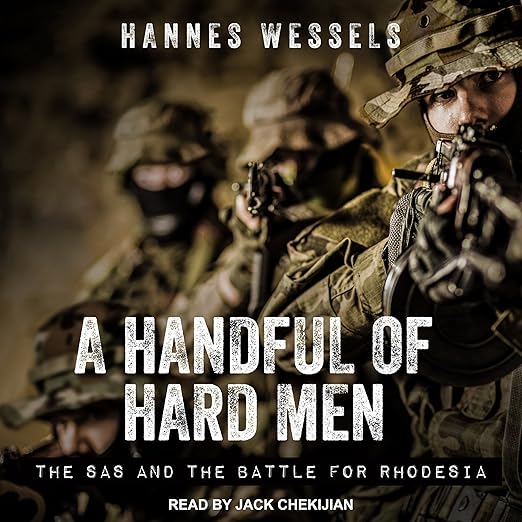
Captain Darrell Watt of the Rhodesian Special Air Service spent twelve years as a combat tracker and bush-warfare specialist in one of the twentieth century's most overlooked conflicts. His unit fought against overwhelming numerical odds, operating with minimal resources against insurgents backed by the Soviet Union, China, and Cuba. By most measurable combat metrics, they outperformed their opposition at every engagement. Rhodesia ceased to exist anyway. Hannes Wessels has written an audiobook biography of a man who won his war and lost his country in the same motion, and that paradox makes for a history that cuts deeper than a standard military chronicle.
Jack Chekijian narrates across twelve hours with a steady command that suits the documentary tone Wessels maintains throughout. For listeners unfamiliar with the Rhodesian Bush War of the 1970s, this audiobook will cover ground that most English-language military history has largely left uncharted. One reviewer accurately observed that if you polled people on their knowledge of Rhodesia, ninety percent have never heard of it. Wessels is filling a specific and real gap in the popular record of Cold War proxy conflicts.
The Best Parts of A Handful of Hard Men
The military history at the core of this audiobook is both specific and genuinely unfamiliar to most listeners. The Rhodesian SAS's operational record is almost entirely absent from popular treatments, and Wessels has done primary-source work that shows: his account of the unit's combat tracking operations, their methods for closing with an enemy in dense bush terrain, and the organizational dynamics of a small force punching dramatically above its weight is grounded in testimony and detail.
The portrait of Watt himself is the audiobook's strongest element. He is not sentimentalized. Wessels is frank that the book is not an unbiased or comprehensive history of the Rhodesian conflict, and that honesty about the book's framing is itself a form of accuracy. Watt's skills as a bush-lore genius and combat tracker, the accounts of which are the centerpiece of the biography, are rendered with enough technical specificity that listeners with special forces or tracking backgrounds will recognize the authenticity. Others will find themselves learning about a warfare discipline they have likely never encountered in this detail.
The final section of the audiobook, in which Watt turns to wildlife conservation in post-independence Zimbabwe, is unexpectedly moving. The pivot from twelve years of combat operations to dedicating his remaining decades to protecting the fauna and people of a country that no longer legally exists in the form he fought for is rendered with a restraint that serves the subject well. It refuses to offer simple resolution to a complex life, which is the appropriate response to a biography like this one.
Chekijian's narration handles the African geographical references and Rhodesian military terminology with appropriate confidence. He does not overdramatize the combat sequences beyond what the prose offers, which is the correct instinct for material this close to testimony. The performance is clean and authoritative throughout.
Before You Commit to A Handful of Hard Men
This is not a politically neutral audiobook, and Wessels does not pretend otherwise. The account is told from inside the perspective of the Rhodesian SAS, which means the view on the geopolitical context of the Bush War reflects the worldview of the men who fought it. Listeners who want counterpoint or historical balance need to supply it themselves. As a primary-source military biography of a specific unit and individual, the book is excellent. As a balanced political history of Rhodesia's transition to Zimbabwe, it is not that, and it does not claim to be.
The density of specific place names, unit designations, and operational terminology can be challenging in the early chapters for listeners new to the subject. Wessels provides enough orientation to follow along, but the learning curve is steeper than a broader military history might require. Patience in the opening chapters pays off as the operational accounts become more immersive.
The biography's treatment of the post-Rhodesia period, which covers Watt's years in what became Zimbabwe and his eventual commitment to wildlife conservation, raises questions about how men of action adapt when the action ends. Wessels does not frame this explicitly as a psychological question, but it is present in the material. Watt's dedication to conservation in the same landscape where he spent twelve years as a combat tracker reads as a form of continued engagement with terrain and living things, a redirection of the same instincts and skills rather than their abandonment. Whether that reading is accurate or projected is a question the audiobook does not answer definitively, and is better for leaving open.
For listeners interested in the specific tradecraft of combat tracking, the chapters describing Watt's methods in the Rhodesian bush are among the most technically detailed accounts of that discipline available in an English-language audiobook. Tracking as a military skill, with its reading of ground sign, spoor interpretation, and the management of a tracking team under fire, receives treatment here that goes far beyond the summary treatment most military histories afford it. Chekijian's narration handles this technical material without flattening it into mere enumeration, which reflects genuine care in the production.
Should You Listen to A Handful of Hard Men?
Military history readers interested in African conflicts, special forces operations, and the lesser-documented theaters of Cold War proxy warfare will find this audiobook essential. Those with existing knowledge of the Rhodesian Bush War will appreciate the operational specificity. General listeners drawn to biography should approach with awareness that the book is explicitly partial in perspective, as the most honest reviewers acknowledge. Chekijian's narration is reliable and does not call attention to itself, which is the right service for documentary material this dense with specific historical and tactical information.
Is this audiobook a comprehensive history of the Rhodesian Bush War?
No, and the book does not claim to be. It is specifically a biography of Captain Darrell Watt and an account of the Rhodesian Special Air Service's operational record. The broader political and historical context is present but secondary. Listeners who want a comprehensive account of the conflict should read this alongside more expansive histories of Rhodesia and Zimbabwe.
Does this audiobook address the political and racial dimensions of the Rhodesian conflict?
They are present in the background, and Wessels does not ignore the context, but the book is written from within the perspective of the Rhodesian SAS and does not attempt political balance. One reviewer explicitly notes this is not an unbiased account. Listeners who want a morally complex engagement with the politics of Rhodesia's white minority government will need to supplement this audiobook with other sources.
Is prior knowledge of the Rhodesian conflict necessary to follow this audiobook?
Some basic familiarity helps, but Wessels provides enough context that listeners new to the subject can follow the narrative. The audiobook is dense with specific place names, unit designations, and operational terminology, so new listeners should expect a steeper learning curve in the early chapters before the operational accounts become more immersive.