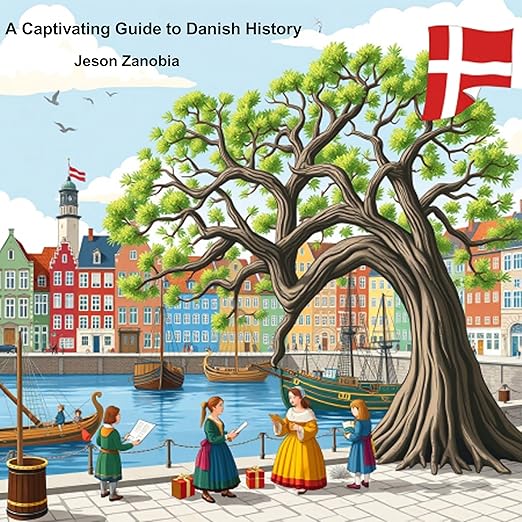
Zanobia Narrates Twelve Centuries in Three Hours
Cnut the Great built an empire that stretched from England to Scandinavia, and yet most listeners could not name him without prompting. That gap between historical significance and popular knowledge is exactly the opening this audiobook steps into. I came to A Captivating Guide to Danish History having spent years teaching modern European literature, where the Scandinavian welfare state is often treated as a fixed background feature rather than a historical achievement. Listening to Jeson Zanobia walk through twelve centuries of Danish power, ambition, and careful reinvention over three hours reminded me how rarely we hear the story of how that background came to be.
Zanobia both writes and narrates here, and the self-narration gives the audiobook an intimate, classroom-seminar quality. This is not a sweeping dramatic production with layered sound design. It is one person, clearly invested in the subject, guiding you through the timeline with the pace of someone who has taught the material before. For a history introduction, that register works surprisingly well.
From the Viking Age to the Welfare State
The synopsis organizes Danish history around a compelling central question: how does a small Nordic nation become, at various points in its history, a dominant force in Northern Europe and then, centuries later, one of the most admired social democracies on earth? The arc Zanobia constructs moves from the Viking Age through the Christianization of Scandinavia, through the reign of Cnut the Great, through the extraordinary Kalmar Union assembled by Queen Margaret I in the 1300s, and eventually toward the welfare state and its WWII experience.
Christianity as Strategy, Cnut as Administrator
What strikes me as genuinely useful in this framing is the attention to strategic context. Zanobia does not present early Danish Christianity as purely a spiritual transformation but as a political calculation, a buffer against the Christian kingdoms pressing from the south and a credential that opened trade routes. That kind of materialist reading of medieval religious history is more interesting than piety-forward alternatives, and it gives listeners a sharper lens for understanding why rulers made the choices they did.
The segment on Cnut the Great is the strongest in the audiobook. Zanobia takes time to map the scope of his empire and to explain why a king ruling England, Denmark, Norway, and parts of Sweden was not simply a military conqueror but an administrator who had to manage disparate legal traditions, church relationships, and political economies simultaneously. For listeners accustomed to thinking of Viking-era Scandinavia as primarily about raiding, this is a useful corrective.
Occasionally Hurried Pacing Through the WWII Section
At three hours and sixteen minutes, this is a survey, not a deep dive. That distinction matters. Zanobia moves quickly, which means that complex events like the Reformation, the Napoleonic-era loss of Norway, or the nuanced politics of Denmark's WWII experience under Nazi occupation receive enough space to be introduced but not enough to be fully examined. Listeners who arrive expecting the depth of a dedicated academic history will feel the compression. Those who arrive seeking an overview to anchor further reading will find the pace appropriate.
The narrator's self-narration is capable but occasionally hurried. Zanobia's delivery suits the expository passages well, but some of the more emotionally charged moments, particularly the WWII section on Denmark's efforts to protect its Jewish population, could benefit from slightly slower pacing. The material deserves more breath than it sometimes gets.
The rating of 3.0 from a single reviewer likely reflects individual expectations rather than any fundamental flaw in the production. History survey audiobooks aimed at general audiences serve a different function than academic texts, and judging them by academic standards produces unfair results. For what this audiobook attempts, it delivers with reasonable consistency.
German Roots Behind Danish and Norwegian Monarchs
One aspect of the synopsis that genuinely caught my attention is the question it poses about Danish royalty: whose roots are not purely Danish? The answer, which Zanobia addresses in the audiobook, involves the house of Glücksburg, a German dynastic line that provided monarchs to Denmark, Norway, and Greece in the nineteenth century. It is the kind of historical detail that sits quietly beneath modern national identity, and Zanobia's willingness to surface it rather than paper over it reflects an honest approach to national historiography. Scandinavia is often mythologized in popular culture as a land of homogeneous values and Viking origins; the reality of its royal and diplomatic history is considerably more entangled with the rest of Europe than that mythology allows.
The audiobook also asks how Denmark built its welfare state and when that happened, questions that Zanobia approaches by tracing the late nineteenth and early twentieth century reform periods when the Social Democratic Party and its coalition partners built the architecture of universal healthcare, generous parental leave, and free higher education. For listeners who have encountered Denmark primarily through happiness surveys or design culture, this historical grounding gives those features a political origin story that context often lacks.
Practical and Honest, Built for Travelers
This audiobook rewards listeners who want a navigable entry point into a national history they know only through Vikings and happiness rankings. If you have read or watched something about the Danish welfare model or Scandinavian design culture and wondered where all of that came from historically, A Captivating Guide to Danish History gives you the thread to follow. It also suits travelers preparing for a trip to Denmark who want geopolitical and historical context before they arrive.
Skip it if you have already read a serious history of medieval Scandinavia or the Hanseatic League, because this audiobook will cover familiar ground without adding much analytical depth. It is also a poor fit for anyone hoping for dedicated coverage of Danish literature, design, or contemporary political life, none of which are covered here.
For students, curious generalists, and listeners who want a three-hour orientation before picking up longer specialist histories of Scandinavia, this is a practical and honest introduction. Zanobia has assembled a coherent narrative out of twelve centuries of history, and that is no small achievement even when the result is necessarily selective.
Quick Take
- Narrator: Jeson Zanobia self-narrates with an engaged, seminar-room warmth that suits the survey format, though some emotionally charged passages could use slower pacing.
- Subjects: National identity through historical reinvention, strategic Christianity in medieval Scandinavia, the arc from imperial power to welfare democracy.
- Tone: Informative and accessible, brisk without feeling rushed.
- Bottom line: A capable three-hour orientation to Danish history that works best as a gateway to deeper reading rather than a standalone study.
Questions Listeners Ask
Is the audiobook suitable for listeners with no prior knowledge of Scandinavian history?
Yes, this is aimed squarely at general audiences coming in without specialist background. The narration assumes no prior knowledge and defines terms and contexts as it goes. That said, the pace is fairly quick, so attentive listening rewards you more than background listening here.
Is Jeson Zanobia's self-narration a strength or a limitation for this audiobook?
It reads as a strength for expository sections, giving the audiobook an intimate, engaged quality. The delivery becomes slightly hurried in the more emotionally weighted segments. Listeners who enjoy author-narrated history will find it appealing; those expecting polished studio narration should adjust expectations.