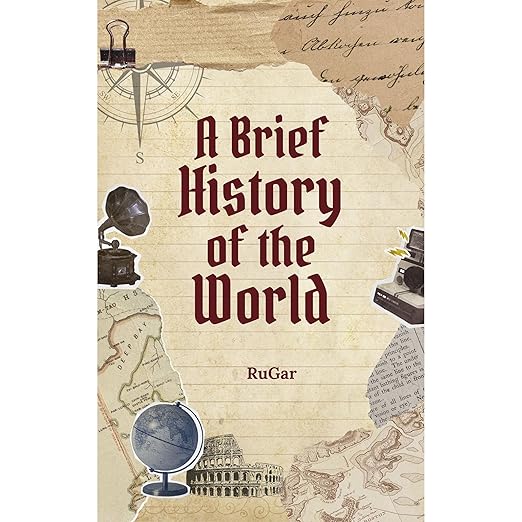
Fifty-Five Hours Undercuts the Book's Brief Title
What does it actually take to compress the entire human story, from early humans walking out of Africa to the entangled global civilization of the present, into a single listenable audiobook? Ruben Garcia's attempt runs to fifty-five hours and forty minutes, which is, despite the title's promise of brevity, one of the longest works in the popular world history genre. Virtual Voice handles the narration, the AI-generated narrator that serves the format's ambitions cleanly if without the warmth of a human performance. For a work of this scope, the consistent pacing actually suits the material: no chapter gets more animation than another, which creates a kind of democratic evenhandedness across ten thousand years of human achievement and catastrophe.
Garcia frames the project as a work for 'curious minds and lifelong learners,' and that framing is honest. This is not a specialist text or a revisionist argument; it is an accessible synthesis of the grand sweep of human history, designed to give readers without prior expertise a coherent map of how the present came to be. That is a genuinely useful thing to have in audio form, particularly at a length that makes it suitable for long commutes, extended travel, or the kind of background listening that accumulates knowledge over weeks rather than sessions.
Pivot Points Replace a Catalog of Facts
The structural approach Garcia takes is to identify pivot points rather than catalog everything. Ancient Mesopotamia and Egypt, the forces of social, political, scientific, and spiritual transformation, the rise and fall of empires, and the connections between civilizations across distances that seem improbable from the vantage point of ancient communication technology: each section builds on the previous one to create a cumulative picture rather than a succession of isolated episodes. That is the appropriate approach for a single-volume treatment of this scope, and it is what prevents the book from collapsing into an inventory.
Virtual Voice Keeps Centuries From Blurring Together
The audio format has specific advantages for a work of this kind. History at scale requires the listener to hold multiple timelines and geographic contexts simultaneously, and a narrated synthesis that moves those transitions explicitly, announcing shifts in geography and era, handles that cognitive work more comfortably than a printed text where readers must track transitions themselves. Even with Virtual Voice narration, the consistent vocal register helps listeners reorient when the book moves from classical Mediterranean civilization to East Asian dynasties or from the rise of Islam to the Reformation.
Garcia writes with the explicit goal of making history 'relevant to today's world,' and the framing choices he makes across the later sections, connecting the economic and political systems of earlier eras to the structures that shape contemporary life, give the audiobook a sense of purpose beyond pure information transfer. Listeners who finish it will not have memorized every date, but they will have a structural understanding of how empires form and dissolve, how ideas spread across cultural barriers, and how the modern world's particular configuration came to be rather than some other arrangement.
No Emphatic Lift for Rome's Fall or Black Death
The Virtual Voice narration is functional rather than expressive. Over fifty-five hours, the absence of human vocal variation can become noticeable, particularly in passages that call for a sense of awe or tragedy that an AI narrator cannot quite render. Listeners who find that delivery style fatiguing over long sessions should plan to break the audiobook across multiple listening periods rather than attempting marathon sessions. The consistent pacing that serves the book's evenhandedness across cultures also means that genuinely momentous events, the fall of Rome, the Black Death, the industrial revolution, do not receive the emphatic uplift a skilled human narrator would provide.
No reviews are available at the time of writing, which makes it harder to calibrate the book's specific strengths and gaps against listener experience. The synopsis presents Garcia's approach as primarily a synthesis aimed at accessibility, and at fifty-five hours the work has room to cover most of the standard grand-narrative checkpoints. Listeners with specific areas of deep interest, medieval Islamic scholarship, Sub-Saharan Africa's pre-colonial history, or Indigenous American civilizations, should supplement this with specialist texts.
At fifty-five hours, A Brief History of the World is less a single audiobook than a curriculum. The most practical approach for most listeners is to treat it as a long-form background project: something to work through in parallel with other listening rather than as the sole focus of a listening period. The format rewards listeners who can hold a long narrative thread across weeks of intermittent sessions, since Garcia's cumulative structure builds understanding across chapters rather than delivering discrete standalone episodes. Virtual Voice's consistent pacing actually assists this kind of distributed listening: the narration does not create a sense of urgency or climax that would make interruption feel jarring. Each chapter functions as a self-contained unit within the larger arc, which suits the sporadic availability that most listeners work with in practice.
Travelers and Lifelong Learners Are Well Served
Listeners who want a single long-form audio introduction to the full sweep of human history will find Garcia's synthesis a practical and ambitious choice. Students building foundational historical knowledge, travelers preparing for destinations with layered historical backgrounds, and lifelong learners who want a coherent narrative frame for the history they already know in fragments will all find value here. Listeners looking for revisionist history, specialist depth, or strong authorial argument should look for more targeted works. Those who find Virtual Voice narration fatiguing over extended listening should plan shorter sessions or consider the print edition for extended sections.
Good to Know
Is A Brief History of the World actually brief, or does the fifty-five-hour runtime contradict the title?
The title is relative: fifty-five hours is brief compared to the actual scope of what it covers. Within the world history genre, a single-volume treatment of the entire human story necessarily involves compression. The 'brief' in the title signals intent toward accessibility and synthesis rather than comprehensive detail.
Is the Virtual Voice narration suitable for a fifty-five-hour audiobook?
It is functional but not ideal for a work of this length. The AI narration maintains consistent pacing, which suits the book's evenhandedness across cultures and eras. However, over fifty-five hours the absence of human vocal warmth and variation becomes more noticeable than it would across a shorter work. Listeners sensitive to AI narration should plan shorter listening sessions.
Does this audiobook cover world history outside the standard Western canon?
Garcia frames the project as covering the 'grand story of humanity' including ancient Mesopotamia, Egypt, and multiple civilizations across millennia. Without available reviews it is difficult to calibrate exactly how proportionate the coverage is across world regions, but the stated scope and the 'Brief History' framing suggest an attempt at global breadth.
Who is the best audience for this audiobook?
Curious generalists and lifelong learners who want a foundational narrative map of human history rather than specialist depth. Garcia writes explicitly for people without prior expertise in the subject. Those with deep background in specific historical periods will find the treatment introductory; those building a first coherent picture of world history from scratch will find it well-suited to that need.