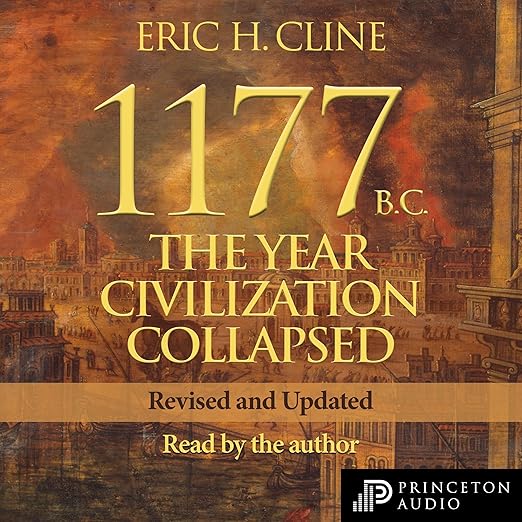
Read the last line of this listing before anything else. It arrives in capitals, and it matters: a PDF accompanies the audiobook. For a book about the collapse of an interconnected Bronze Age world, that file is not a courtesy extra. It is where the maps, the chronologies and the trade routes have gone, and you want to know how to reach it before you press play rather than forty minutes into a discussion of who was shipping tin to whom. Eric H. Cline reads his own work here across ten hours and forty-seven minutes, and the description opens by telling you so.
Winning the War, Then Losing the Peace
Watch what happens in the first paragraph of the summary. It is a genuine reversal. Marauding groups known only as the Sea Peoples invaded Egypt. The pharaoh's army and navy defeated them. And the victory so weakened Egypt that it slid into decline anyway, taking most of the surrounding civilizations with it. Winning the war was the beginning of the end. Any account of collapse that starts there has already refused the simple version.
Everything that follows is explicitly multi-causal, and Cline lists the causes without ranking them: invasion, revolt, earthquakes, drought, famine, and the cutting of international trade routes. The thesis that gives the book its shape is the one about interdependence. These were not isolated kingdoms failing separately. They were a network, and the connections that made them prosperous were the same connections that transmitted the failure. Prosperity and fragility turn out to be the same property, viewed from different ends.
Its closing claim is the one that earns the series placement. The Late Bronze Age collapse cleared ground for classical Greece, which means the disaster is also an origin story. That is a lot of argument to carry in eleven hours, and the structure is what keeps it from becoming a catalogue of ruins.
Cline Reads His Own Uncertainty Aloud
Hearing a working archaeologist read his own research is the format's real selling point, and the description leads with it rather than burying it in a credit field. The difference shows up in the places where scholarship is uncertain, because emphasis is where an author signals confidence. A hired reader delivers every sentence at the same weight. An excavator reading his own conclusions can let you hear which ones he would defend in a seminar and which are the best available reading of thin evidence. On a subject built almost entirely from fragmentary evidence, that distinction is worth a great deal.
Revision has also made this better suited to listening than the original material would have been. One reader, who does network analysis in social and computational research, singles out the chapter on complex systems and the network perspective on the collapse as the part that connected with their own work. Systems argument is prose. It has no tables to squint at, which makes it the most audio-friendly material in the book, and it is precisely what a revised edition adds.
Against that, the visual dependency is real and the PDF is the admission of it. Ancient history runs on maps, king lists and dated sequences. A listener hears place names in a stream, without a coastline to attach them to, and the accompanying file only helps if you are somewhere you can look at a screen. On a walk or a drive, you are holding the geography in your head.
The Subtitle That Never Made the Page
Somewhere along the way the listing lost its subtitle, and the subtitle is the part that explains the book. Two separate readers give the full title as 1177 B.C.: The Year Civilization Collapsed, while the page shows only the date and a parenthetical noting the revision. Anyone searching by the descriptive half of the title will not land here easily, and anyone browsing sees four characters and a note about an update. The series field compounds it: the collection is named on the page, but the volume number is blank.
A vote counter smaller than the evidence beneath it is the second thing to flag. Two votes are recorded, and five written responses are visible. Whatever population produced the badge, it is not the group of people whose reasoning you can actually read, and a two-vote average is far too thin to carry any weight regardless. Read the arguments instead, because they are unusually well qualified.
Expertise is the other notable feature of this column. One reader describes fifteen years of preoccupation with the Bronze Age collapse, having worked through the primary literature and other specialist authors, and arrived expecting to catch errors before concluding that Cline gets nearly everything correct. Another works in network analysis. The shortest entry simply calls it a superb book by an accomplished author and archaeologist of ancient civilisations. Praise from readers who came in prepared to argue is worth more than praise from readers who did not.
Substantive objection arrives just once, from the four-star entry, and it is a terminology dispute: the reviewer argues Cline consistently uses one linguistic label where other scholars prefer another, and reads that choice as evidence of a bias. The same reader wants more interpretation of the source stories, noting that one anecdote about a hippo and a pharaoh is presented without the reading that would make sense of it, forcing you elsewhere. Both are complaints about scholarly posture rather than about accuracy.
Come for the Causes, Skip the Character Drama
Come to it if you like history that argues rather than recounts, and if a multi-causal explanation appeals to you more than a villain. Listen if the idea that connection is itself a vulnerability seems worth eleven hours of ancient evidence. Listen especially if you already know something about the period, since the most enthusiastic responses on this page come from readers who arrived well informed and were not disappointed.
Avoid it if you need a narrative with characters to follow. The Sea Peoples remain, by design, groups known only by that name, and the book's honesty about what the evidence cannot tell us is exactly what makes it unsatisfying as a story. Avoid it too if you listen exclusively while driving or walking, because the geography is doing constant work and the PDF is not available to you there.
My advice for getting the most out of it: open the accompanying file once at the start, look at the map of the eastern Mediterranean, and keep that picture in mind. Everything Cline argues afterward depends on knowing roughly what was next to what.
At a Glance
- Narration: Eric H. Cline reads his own research, which lets you hear where an archaeologist is confident and where the evidence is thin, a distinction a hired reader flattens.
- Themes: Late Bronze Age collapse, systems failure and interdependence, the Sea Peoples, drought and famine, the origins of classical Greece
- Mood: Rigorous, argumentative, quietly ominous
- Verdict: The best kind of collapse history, multi-causal and honest about its gaps; keep the companion PDF within reach.
Frequently Asked Questions
Does this audiobook come with a PDF, and do I need it?
Yes, the description states a PDF is delivered alongside the audio. You will want it. Ancient Mediterranean history depends on maps, chronologies and trade routes, and those materials have been moved out of the narration. Listening without access to a screen means holding the geography entirely in your head.
Does Eric H. Cline narrate this audiobook himself?
Yes. Eric H. Cline reads the recording himself, and the description leads with that fact rather than leaving it in a credit line. On a subject reconstructed from fragmentary evidence, hearing the author's own emphasis tells you which conclusions he considers solid and which are best-available readings.
What does the Revised and Updated edition add?
Most notably a treatment of complex systems and a network perspective on the collapse, which one reviewer working in network analysis singles out as the standout chapter. That material is pure argument rather than tables or figures, which makes it the most listenable section of the whole book.
Why does the listing title leave out the subtitle?
Unclear, but two reviewers independently cite the full title as 1177 B.C.: The Year Civilization Collapsed. The page shows only the date and the revision note, which hides the descriptive half of the title. The series name appears without a volume number, so the metadata is incomplete in both directions.