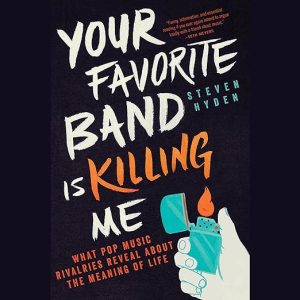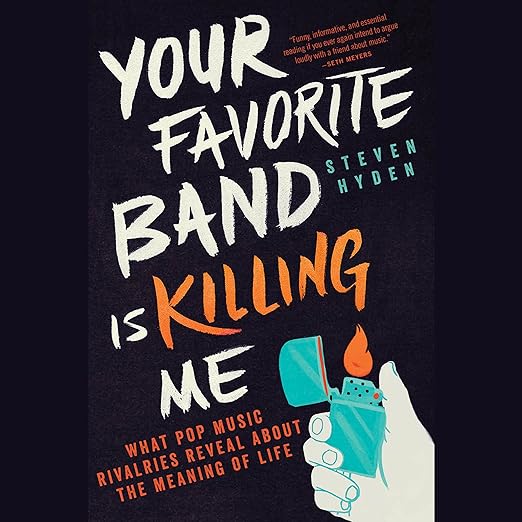
Steven Hyden's premise in Your Favorite Band Is Killing Me is deceptively simple: pop music rivalries are not just arguments about taste but symptom-readings of the culture that produces them. The Beatles versus the Stones tells you something about the 1960s' tension between idealism and hedonism. Biggie versus Tupac tells you something about geography and aspiration and mortality in 1990s hip-hop. Kanye versus Taylor tells you something about race, gender, media, and the way celebrity meltdowns become cultural Rorschach tests. This audiobook, narrated by Ben Sullivan and running seven hours and forty-eight minutes, works through nineteen such rivalries, and Hyden's method is consistently to use the specific musical argument as a lens for examining something larger about the moment that produced it.
Hyden has been writing about music for Grantland and other outlets for long enough to have developed the precise combination of deep knowledge and argumentative energy that this kind of project demands. He is genuinely knowledgeable about the music, but the book is not primarily about the music itself. It's about what choosing sides means, what it says about the listener's relationship to identity and time and belonging, and what the pattern of passionate music partisanship reveals about how culture works. That's a more interesting project than it might initially sound, and Hyden executes it with enough wit and self-awareness to keep even the chapters devoted to rivalries you've never personally cared about feeling worthwhile.
Burning Out Versus Fading Away, Reconsidered
The Hendrix versus Clapton chapter is probably the book's most formally ambitious. Hyden uses it to examine the idea of burning out versus fading away, the cultural value we assign to early death and frozen greatness, and why we often prefer the Hendrix model of luminous brevity over the Clapton model of extended, compromised longevity. That the chapter is also genuinely funny, with Hyden's extended meditation on what exactly Clapton's later career has become, doesn't undercut its seriousness. It's an essay that holds multiple tones simultaneously, and it's the kind of piece that makes you want to argue with it, which is the highest compliment you can pay to cultural criticism.
The Miley versus Sinead chapter covers the clash that played out publicly and messily in 2013, when Sinead O'Connor wrote an open letter warning Miley Cyrus about the music industry, and it functions here as an examination of generational friction and the perpetual battle over what counts as authentic versus commercial in pop music. Hyden doesn't take a clean side in most of these chapters, which is both a strength and an occasional frustration. He's more interested in mapping the terrain of the argument than in winning it, which means the book rewards listeners who enjoy intellectual texture over those who want verdicts.
Sullivan Delivers the Humor at Full Energy
Ben Sullivan's narration handles the tonal register well. Hyden writes in a conversational voice that mixes cultural history, personal anecdote, and comic observation without clear warning of which register is coming next, and Sullivan navigates those transitions cleanly. The humor in particular requires a narrator who doesn't tip it off, and Sullivan delivers the funnier lines at the same energy level as the analytical ones, trusting the content rather than the delivery to land the joke. The seven-hour-plus runtime suits this material well: this is a book you can dip in and out of by chapter, since each rivalry chapter is largely self-contained, or you can listen straight through and let the cumulative argument about music and identity build.
Rolling Stone's description of the book as highly entertaining is accurate but undersells what Hyden is doing. This is cultural criticism that uses entertainment as a delivery mechanism for substantive ideas about why music matters, why partisanship around music matters, and what the long history of pop feuds tells us about the culture that generates and consumes them. Listeners who enjoy Chuck Klosterman's essay collections or Alex Ross's music criticism will find this audiobook immediately in their territory.
No Clean Verdicts, Just Sophisticated Arguments
The book's value is unevenly distributed across chapters in the way that any essay collection is. Listeners who have strong personal investment in some of the featured rivalries, Beatles versus Stones, Nirvana versus Pearl Jam, Oasis versus Blur, will find those chapters more electrically engaging than the chapters devoted to rivalries they've never cared about. Hyden is good enough to make even the latter worthwhile, but the book does benefit from at least passing familiarity with the music being discussed. A listener with no knowledge of the Beatles or the Rolling Stones will understand what Hyden is arguing but won't feel the full force of it.
Some listeners will find Hyden's refusal to deliver clean verdicts frustrating. He consistently complicates the argument rather than resolving it, and while that's intellectually honest, it can feel evasive if what you want from music writing is a strong declaration of the better band. The book is better understood as a series of sophisticated arguments about what music rivalries mean than as a definitive ranking of who won each one.
Validating for Fans, Less Satisfying for Others
Dedicated music fans who also enjoy cultural criticism and who have spent any part of their life arguing passionately about music will find this audiobook both validating and challenging. Listeners who want music writing that operates above the level of biography or simple album review will find Hyden's approach exactly what they're looking for. Non-music-fans who are interested in how cultural partisanship works as a social phenomenon will find enough analytical texture to engage with even without personal investment in the specific rivalries. Listeners who want music history rather than music criticism, or who need the book to deliver clear winners, may find the experience less satisfying than they hoped.
Do you need to know all nineteen featured bands to get value from this audiobook?
No. Hyden is a good enough writer to make even the rivalries you don't personally know worthwhile, because the chapters are ultimately about cultural dynamics rather than the specific music. Familiarity with the major entries, Beatles, Stones, Nirvana, Biggie, Tupac, enriches the experience but isn't required throughout.
How does Ben Sullivan's narration handle the shifts between humor and more serious cultural analysis in this audiobook?
Sullivan handles the tonal shifts well, delivering humor at the same register as the analytical passages rather than telegraphing the jokes. The conversational quality of Hyden's prose comes through clearly, which suits the discursive essay format.
Is there a chapter in this audiobook that works best as a standalone introduction to Hyden's approach?
The Hendrix versus Clapton chapter is frequently cited as the book's strongest single piece. It works both as an argument about burning out versus fading away as cultural values and as a demonstration of Hyden's method: using a specific musical rivalry to excavate a larger idea about fame, longevity, and artistic compromise.