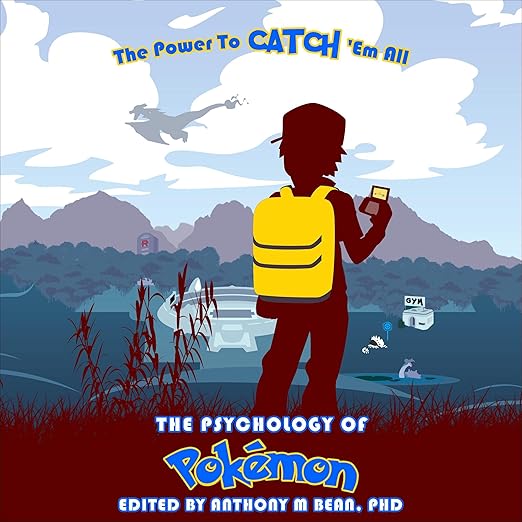
Pokémon and psychology do not sound like obvious companions, but Anthony Bean makes a compelling case that they always belonged together. This audiobook arrived in my rotation at a point when I was thinking about why certain franchises from childhood stay with us while others quietly disappear. The question Bean opens with, drawn from Mewtwo's declaration in the first film, turned out to be precisely the right entry point: not what is this franchise, but what does the gift of life mean, and what do we do with it? Not every pop-culture deep-dive earns that kind of framing. This one does.
Completionism as a Drive Toward Wholeness
Bean has assembled a genuinely eclectic panel of voices: psychologists, clinicians, video game researchers, professors, and long-time enthusiasts. The result is less a single coherent argument than a collection of converging angles, each chapter approaching the franchise from a different disciplinary vantage. What holds it together is a consistent commitment to taking the material seriously without being solemn about it. The question of why we trust a ten-year-old to save the world, for instance, gets a real developmental psychology treatment rather than a dismissive aside. That kind of rigor, wrapped in genuine affection for the source material, is rare in this genre.
The central psychological framing centers on what Bean calls the drive toward emotional wholeness through completionism. The urge to catch them all is not, the book argues, simply a commercial hook. It maps onto documented psychological patterns involving mastery, completion, and the need to categorize and control. These patterns appear across many human activities, but Pokémon's design is unusually sophisticated in how it activates them, and the book takes time to explain why the franchise sustains engagement across decades in a way that most similar properties cannot.
Ash Ketchum's Arc Onto Campbell's Monomyth
The chapter on Twitch Plays Pokémon, which explored collective human behavior at scale through the lens of a chaotic shared playthrough, is one of the more surprising and rewarding passages. It uses the franchise as a window into social psychology that most dedicated studies of online communities would miss entirely. Thousands of strangers attempting to coordinate around a shared game, generating emergent leadership structures and communal mythology in real time, turns out to be an extraordinary case study in group behavior.
The heroic journey chapter, which maps Ash Ketchum's arc onto Joseph Campbell's monomyth, connects the franchise's narrative structure to one of the deepest patterns in human storytelling. Bean does not simply assert the connection; he works through it with sufficient specificity to illuminate both Ash's arc and the broader template it follows. For listeners who have read Campbell or encountered the hero's journey through other media, this section offers a satisfying mapping. For those new to the framework, it serves as a genuinely useful introduction through a subject they already care about.
Lawrence Smooths Out the Multi-Contributor Whiplash
Erik Lawrence narrates with a clean, professional warmth that suits the material well. He does not over-perform the fan enthusiasm, which would quickly become grating, nor does he flatten the academic passages into drone. The seven-hour runtime is comfortable for a book that moves between registers often, and Lawrence maintains a consistent tone that lets the content speak without intrusion. The multi-contributor nature of the book, assembled from various writers and researchers, could easily produce tonal whiplash, but the narration smooths those transitions effectively.
The audiobook format also serves a particular practical function here: because so much of the book is built around cultural memory, recall, and shared experience, listening feels closer to the communal act of discussing a favorite game than reading in isolation. The oral delivery activates something that silent reading might not, and that alignment between format and content is worth noting for listeners deciding which version to choose.
A Factual Slip in the Franchise Count
The one review in the public record flags a factual inaccuracy in the synopsis, specifically the claim about the number of Pokémon games. That kind of error, if it appears in the book itself rather than just the marketing copy, does suggest some inconsistency in the fact-checking process. Listeners with deep franchise knowledge may notice other such discrepancies. This is not a scholarly monograph with footnotes and peer review. It is a hybrid work of fan scholarship and applied psychology, and the standards reflect that.
The book also draws from multiple contributors rather than developing a single sustained argument, which means it can feel uneven in ambition across chapters. Some sections push the psychological frameworks further than others, and the variation in depth is noticeable. Readers who prefer a book with a single voice building one long argument will find the anthology structure somewhat frustrating even as they find individual chapters rewarding.
Straddling Fan Culture and Applied Psychology
Adults who grew up with Pokémon and find themselves wondering why it still matters to them will get the most out of this. The psychological frameworks are accessible without being dumbed down, and the fan affection is genuine without being uncritical. Listeners drawn to cultural analyses of long-running franchises or to applied psychology through popular media will find a comfortable intellectual home here. If you have ever wondered what your attachment to a franchise says about your need for mastery, belonging, or completion, Bean's contributors offer some genuinely useful answers.
Listeners hoping for a rigorous academic text or a comprehensive history of the franchise should look elsewhere. The book straddles fan culture and applied psychology with imperfect results in places, but the attempt itself is worthwhile. Go in with calibrated expectations and a fondness for at least one Pokémon game, and this audiobook delivers genuine insight alongside the nostalgia.