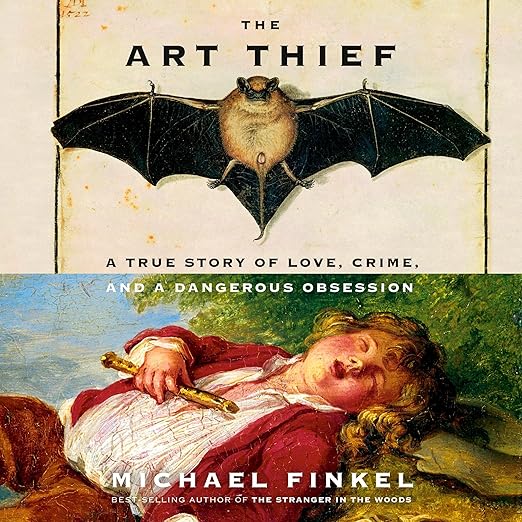
Stephane Breitwieser stole more than three hundred objects from museums and cathedrals across Europe over nearly eight years, carrying out more than two hundred heists with his girlfriend acting as lookout, and he never sold a single thing. All the stolen works went into a pair of secret rooms where he lived among them. That is the premise of The Art Thief, and Michael Finkel has the intelligence to understand that the premise alone raises questions more interesting than the heist narrative itself: What does it mean to possess a work of art? Can genuine love for a beautiful object justify taking it from others? This audiobook, narrated by Edoardo Ballerini, spends five and a half hours with those questions and earns satisfying, complicated answers to most of them.
Ballerini Holds the Irony Without Resolving It
Ballerini is one of the more versatile narrators working in the literary true crime space, and he is very well cast here. Finkel's prose is precise and suggestive, written with the awareness that Breitwieser's story resists easy moral categorization. A thief who steals for love rather than money is a more interesting subject than a thief who steals for money, but he is still a thief, and the physical objects he took from public collections represent real, permanent losses to cultural heritage. Ballerini holds that tension without resolving it artificially, letting the irony accumulate as the heist count rises and the secret rooms fill with stolen centuries.
Finkel's access to Breitwieser is the book's foundational asset. He interviewed the thief extensively, which means the inner life of the obsession is rendered from the source rather than constructed from inference. Breitwieser's logic, that the objects belonged with him because he was the only one who truly appreciated them, is the logic of the classic collector taken to its extreme conclusion. Finkel makes you understand this logic from the inside without endorsing it, which is the hardest thing to do in true crime narrative and the thing he does best. A reviewer who identified as an artist described the book as more emotionally triggering than expected, reacting to the thefts from the perspective of a maker. That response is built into the material: the objects Breitwieser took were made by specific people who placed their work in public spaces precisely so that it could be shared.
Applying the Stranger in the Woods Method Again
The audiobook compresses a story that spans eight years of European art theft into a compact five hours and thirty-nine minutes that never feel rushed. Finkel is economical with scene-setting but generous with psychological detail, and Ballerini's pacing mirrors that balance. The museums and cathedrals across which Breitwieser operated, from Germany to Switzerland to France, acquire presence in the narration without the book becoming a travelogue. Finkel stays close to the thief's experience of these spaces: the specific athleticism he deployed, his innate ability to remain inconspicuous in museum crowds, his gift for circumventing security systems that did not anticipate someone operating purely out of desire rather than profit.
Finkel's previous audiobook, The Stranger in the Woods, built its reputation on a similar method: finding a genuine eccentric and rendering that person's inner world with enough specificity that the eccentricity becomes comprehensible without becoming sympathetic. The Art Thief applies that method to a figure who is more immediately criminal and less sympathetically isolated than Christopher Knight, but the structural approach is consistent. Fans of The Stranger in the Woods will find the quality of observation here at least equal, and the stakes, cultural heritage, obsessive love, the complicity of a romantic partner, are more immediately legible to a general audience.
The Girlfriend Destroys the Collection After the Arrest
The girlfriend's role as lookout and eventual participant in the destruction of the stolen collection after Breitwieser's arrest is one of the most extraordinary elements of the story, and the audiobook gives it the attention it deserves. Her decision to destroy hundreds of stolen objects to eliminate evidence is where the story becomes genuinely shocking, and Ballerini's delivery in these final sections adjusts imperceptibly in tone. Listeners who have been with the story for four hours will feel the shift before they can name it.
Pay close attention to the passages on Breitwieser's physical methods: the specific heist sequences are deployed strategically in Finkel's structure, released when the story needs forward momentum before pulling back to the psychological material that gives the book its real texture. The final act, when hubris tips Breitwieser into a last theft that ends everything, is handled with the narrative compression the moment deserves. This is a true crime story where the ending is known from the beginning, and Finkel makes the inevitability feel like tragedy rather than consequence.
Erik Larson Fans Will Find the Ambition Delivered
Listeners who love narrative nonfiction at the literary end of the true crime spectrum will find this a particularly satisfying entry. The writing demands more from its audience than most true crime does; Finkel is interested in the ideas the case raises, not just the events. Fans of Erik Larson or David Grann, who situate the criminal within a larger cultural and historical canvas, will recognize the ambition here and find it delivered.
Art lovers and museum professionals will have a specific relationship with this material that general listeners will not, but the book does not require specialist knowledge to engage fully with. Listeners who prefer their true crime to move at a thriller pace will find The Art Thief more contemplative than propulsive, which is a deliberate choice on Finkel's part. The story is strange enough to sustain a slower approach, and both Finkel and Ballerini know it.
Is The Art Thief audiobook true crime, or does it lean more toward art history and character study?
It sits at the intersection of all three. Finkel grounds the heist narrative in the specific cultural context of the stolen objects, gives Breitwieser's psychology sustained biographical attention, and uses the true crime framework primarily as structure rather than as the book's primary interest.
How does Edoardo Ballerini's narration suit the European setting and tone of the audiobook?
Very well. Ballerini's measured, precise delivery matches Finkel's prose and the European atmosphere of the story. He does not impose urgency the material does not earn, which gives the psychological depth space to build across the relatively compact runtime.
Is The Art Thief audiobook a good choice for listeners who do not normally enjoy true crime?
Yes, actually. The book is less interested in the mechanics of crime and more interested in obsession, possession, and what beauty does to a certain kind of person. Readers who find conventional true crime exploitative or procedural will find Finkel's approach considerably more literary.