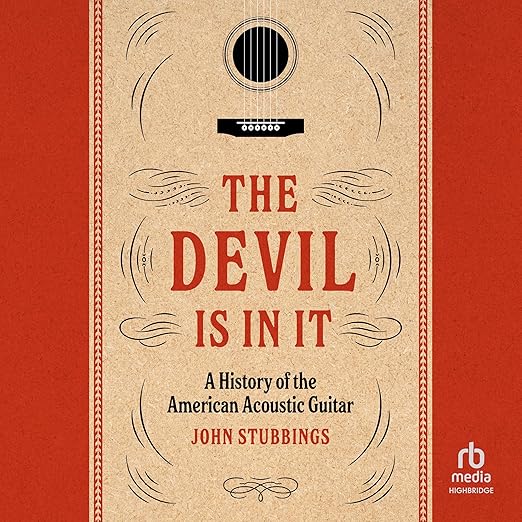
The acoustic guitar is one of those objects that accumulates mythology faster than history, and John Stubbings' The Devil Is in It is, among other things, an attempt to separate the two. This audiobook, expanded from a limited-edition 2020 volume that sold out within days of release, covers fifteen hours of material, and while that runtime will deter casual listeners, it rewards those who come with genuine curiosity about the instrument. Stubbings traveled the country, met guitar makers and historians and collectors and players, and the book he assembled from those encounters is less a conventional history than a long, unhurried portrait of an object and the culture that formed around it.
Taken Into the Story Like a Film
The historical arc begins with the eighteenth-century European classical guitar, which most listeners know only vaguely, and traces the gradual transformation of the instrument through the hands of immigrant luthiers who modified its form to suit new musical demands. C.F. Martin, whose story one reviewer describes as a true immigrant success story, receives significant attention, and the detail on Martin's innovations in flat-top construction is the kind of material you rarely find in general music histories. The transition from a parlor instrument to an icon of American folk, country, blues, and eventually rock is handled with care, and Stubbings shows how deeply intertwined those musical developments were with the instrument's physical evolution over time.
The artist connections are well chosen. From Gillian Welch and Tracy Chapman through to Taylor Swift and Ed Sheeran, the book situates the acoustic guitar across a century of popular music without forcing false continuities. Each artist illuminates something about the instrument's range and adaptability rather than becoming an excuse to summarize a career. The writing across these sections has genuine scene-setting quality. One reviewer describes being taken into the narrative as if it were a film, which is unusually high praise for a history of an object, and it reflects Stubbings' preference for immersive description over encyclopedic list-making.
The cultural dimension of the book is as interesting as the technical one. Stubbings is attentive to the ways the acoustic guitar accumulated social meaning alongside musical significance, how it became associated with authenticity, with folk traditions, with protest music, with intimacy. That cultural biography runs alongside the construction history and enriches both threads. The guitar is not just an instrument being built better over time in this book; it is an object absorbing the meanings of the people and movements that adopted it.
Richards Narrates Fifteen Hours Without Padding
Gareth Richards narrates with the ease of someone comfortable inside long-form nonfiction, maintaining engagement across a runtime that requires real commitment. The fifteen hours do not feel padded; they feel like a book that knew how much space it needed and took it without apology. For listeners who play acoustic guitar, or who have spent time around luthiers or vintage instrument dealers, the level of craft detail will be a genuine pleasure. Stubbings integrates technical knowledge about construction and tone into the narrative rather than presenting it as a separate taxonomy, making it accessible to non-players while remaining substantive for those who know the instrument well.
The audio format suits this material particularly well because Stubbings writes with scene-building rather than purely expository prose. Hearing the book rather than reading it activates the musical imagination in a way that complements the subject, and Richards' warm delivery reinforces the sense of sitting with someone who loves what they are talking about.
Where the Hummingbird Never Shows Up
The Martin-centric perspective is a legitimate limitation worth naming before investing fifteen hours. If your guitar history is primarily rooted in Gibson, Gretsch, or Guild, you may find the coverage of those builders thinner than you hoped. One reviewer specifically notes that Gibson guitars receive less attention than expected, with instruments like the Hummingbird absent from the narrative entirely. The book follows a particular through-line that runs closer to Nazareth, Pennsylvania than Nashville, and that focus is both its strength and its limitation.
The book also does not spend much time on the electric guitar or on the crossover periods when the two instruments competed for cultural primacy. If you want a history that tracks that rivalry in depth, this is not the right source. The Devil Is in It stays close to its acoustic subject with conviction and precision, which rewards listeners who share that specific interest.
One of the book's most interesting passages examines the guitar's relationship to American identity more broadly, how an instrument that arrived as a European import became so thoroughly identified with distinctly American musical forms that its origins are now nearly invisible to most listeners. That process of cultural absorption and transformation, accelerated by the folk revival, the blues explosion, and the singer-songwriter movement of the 1960s and 70s, is the kind of story that Stubbings tells with real historical intelligence.
Impressive Within Its Chosen Frame
Guitar players with an interest in the history of their instrument will find this the most thorough audiobook treatment currently available on the subject. Listeners drawn to American music history, lutherie, or the intersection of craft and culture will also have much to work with. Anyone who has found similar instrument-centered cultural histories compelling, or who has spent time reading about the people who build guitars as much as the people who play them, will feel at home here.
Listeners wanting a broader survey of American popular music that happens to include the guitar, or those hoping for equal coverage across all the major guitar makers, should calibrate their expectations. Within its chosen frame, The Devil Is in It is an impressive piece of work delivered at a runtime that signals the depth of the author's commitment to the subject.
Quick Take
- Performance: Gareth Richards brings a warm, conversational authority to John Stubbings' prose, which suits the balance of historical sweep and close personal encounter.
- What it covers: The acoustic guitar's cultural evolution, American music identity, the relationship between craft and artistic innovation
- Feel: Richly textured and celebratory, with the feel of a long conversation with someone who has handled every instrument they describe
- Our call: A deeply researched and genuinely pleasurable listen for anyone who cares about where the acoustic guitar came from and why it still dominates popular music a century later.