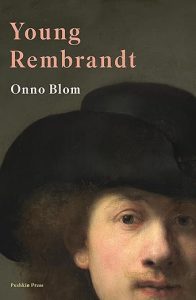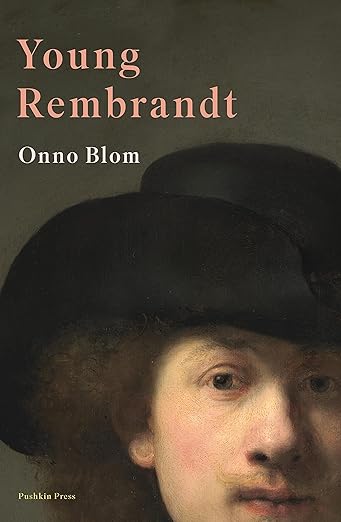
A miller's son from a provincial Dutch town became, on the description's own reckoning, the greatest artist in the world, and almost nothing survives to explain how. That absence is the premise of this audiobook. Onno Blom, a Leiden native, went at the gap sideways: with no documentary record of the young Rembrandt to work from, he reconstructed the country, the city and the house where the painter was born in 1606 and spent his first twenty-five years. What comes back is Leiden during the Dutch Golden Age, a town whose commercial good fortune the book treats as the actual cause, and whose turbulence shows up in the early paintings. Seven and a half hours, and the argument lives in the setting.
A Prize Awarded for a Different Subject
Blom's method is the reason to bother and also its limit. The description states the problem cleanly: the only remaining evidence of Rembrandt's life as a young man is his work. So Blom reads the early paintings as biography and the city as context, and the result is a book about circumstances that happens to have a genius at its center. The prize-winning biographer framing on the listing is real, though it is worth knowing what it points at. The Dutch Biography Prize the description cites was awarded in 2018 for a book about the sculptor and novelist Jan Wolkers, a different subject entirely. It tells you Blom can do this. It tells you nothing about this one.
What lands is the town. The one substantial notice here calls the book a fascinating and informative description of industrious Leiden before and during Rembrandt's growing up there, putting the city ahead of the painter in its own summary and noting that the material on the miller's son himself amounts to such accounts as exist. That is an honest reader response to an honest book. Blom does not fill the silence with invention. He tells you what Leiden was doing while a boy who would become Rembrandt was living in it, and lets the paintings testify to the rest. Note what the description declines to claim. It never says Blom turned up new documents, and it never promises a discovery. What it sells is a reconstruction of conditions, an unusually honest thing for a publisher to advertise, which is why the book holds together as well as it does.
Nick Afka Thomas Must Carry Every Canvas
Nick Afka Thomas has the recording, and the question it raises is genuine rather than ceremonial. This is an art biography whose central evidence is visual, and the recording has to carry every canvas in sentences alone. Blom's descriptive passages were written to sit beside reproductions; stripped of them, those passages work twice as hard and the listener assembles each painting from words. Some people find that the better way to look, because a described picture stays in the head longer than a glanced-at plate ever does. Others will want a screen open beside them. Knowing which one you are is most of the buying decision here.
Dutch is the other argument. Leiden, de Volkskrant, Jan Wolkers, the mill and the town and the family names a book rooted this deeply in one place cannot avoid: these are the words a silent reader slides past without ever settling on a pronunciation. Hearing them said aloud, consistently, across the whole recording removes a low-level friction the page leaves in place, and for a listener with no Dutch it quietly does a job print cannot. Modest benefit, granted. On a book whose subject is one specific town in one specific decade, modest benefits accumulate.
A Print Virtue That Is Simply Gone
Here is the detail that should decide your purchase. The one detailed notice on this listing praises the book as attractive and pleasantly illustrated. That is a print virtue and it is gone. A biography of a painter, in an edition carrying no paintings, is asking something specific of you, and nothing on the page warns you about it. The description does not mention illustrations either way. You find out from a reader who liked them. If the plates are part of why this book appeals to you, buy the printed edition and treat the recording as a companion rather than a replacement.
Two credit-line oddities come from the same source. This listing carries a 420-page count and an ISBN, both of which belong to the printed edition rather than to anything you can hear, and both arrive with a stray invisible character stuck to the publisher line. More consequentially, no translator is credited anywhere. The description supplies an author bio describing a biographer and columnist for a Dutch daily who won a Dutch prize and produced a bestseller in the Netherlands, published here in English under the Pushkin Press imprint. Somebody did that work. The listing does not say who. An English-speaking listener is meeting a Dutch book at one remove, and the person who made the remove possible is nowhere on the page.
And the evidence base is thin enough to be nearly decorative. Fifteen ratings hold up the 4.5, two people wrote anything at all, both filed from the United Kingdom, and the shorter of the two runs to six words about a lovely book the reader could not put down. That leaves exactly one substantive response to a full-length biography. It is a good response, specific and warm and clearly written by somebody who read the thing. It is also, on its own, no basis for a decision. Judge this by Blom's stated method rather than by the social proof, because the social proof has not arrived.
Come for Leiden, Rembrandt Is the Consequence
This is for people who like biography that admits what it cannot know. Blom's whole construction is an argument about how much a city explains about a person, and he sustains it without inventing a single interior monologue for his subject. Readers of Dutch Golden Age history will take more from it than readers hunting the studio years and the famous canvases, because the book stops at twenty-five, before the reputation existed. Anyone who has wondered how provincial prosperity manufactures an artist will find the question taken seriously at length.
Come for the paintings you already know and you will leave disappointed, since the book closes before the career that produced them. Anyone who needs the plates should also stay away, and remember that the one person who wrote at any length here counted the pictures among the charms. What remains is a careful, locally rooted, unusually honest reconstruction of the twenty-five years nobody can document, read straight through by a single voice. Come to it for Leiden. Rembrandt arrives as its consequence.
A Few Questions About Young Rembrandt
Does the Young Rembrandt audiobook include the illustrations from the print edition?
Nothing on the listing suggests a companion file, and the recording itself is prose only. That matters more than usual here, because the one detailed reviewer singled the printed volume out for its pictures. Every painting Blom discusses has to reach you through description alone.
How much of Rembrandt's actual career does this cover?
Only the beginning. Blom deals with the first twenty-five years, from the 1606 birth in Leiden through the period before the painter left the town. The later work, the mature reputation and the famous canvases sit outside the frame entirely.
Is the Young Rembrandt audiobook heavy going for a general listener?
Less than you might fear. Blom builds his case through place, trade and family rather than through art-historical apparatus, and the one substantive review calls it fascinating and informative. Seven and a half hours stays manageable, though the pace is unhurried and the detail is fine-grained throughout.
Who reads it, and is the Dutch material handled clearly?
Nick Afka Thomas is the credited reader, working alone. The book is dense with Leiden place names and Dutch proper nouns, and hearing them spoken consistently removes a small friction that silent reading leaves in place. No translator appears in the credits despite the Dutch original.