Quick Take
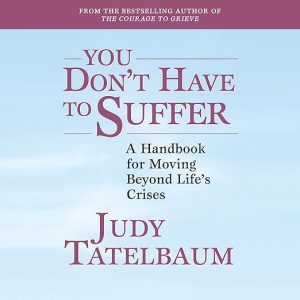
- Narration: Cassandra Campbell brings genuine gravity to Tatelbaum’s material, her measured tone matches the emotional weight without ever tipping into melodrama, making this an easier listen than it has any right to be.
- Themes: Suffering and choice, grief and loss, personal resilience
- Mood: Steady and compassionate, more counsel than consolation
- Verdict: A deceptively quiet book that carries real weight, Tatelbaum’s distinction between inevitable hurt and chosen suffering is one of those ideas that changes how you interpret your own experience.
I listened to this one in fragments over the course of a difficult week, not a dramatic crisis, just one of those weeks when several things go sideways at once and you find yourself watching your own reactions with a mixture of exhaustion and frustration. Judy Tatelbaum’s central premise arrived at exactly the right moment: hurt is inevitable, but suffering is a choice. That is the kind of sentence that can feel either deeply liberating or enormously dismissive depending on where you are and how it is delivered. In this book, it lands as the former.
Tatelbaum has decades of clinical experience as a therapist and teacher, and the book carries that experience in its bones. This is not a self-help title assembled from motivational principles and research citations. It is a handbook built from actual sessions with actual people navigating loss, illness, disappointment, and hardship, and the difference in texture is noticeable from the first chapter. Cassandra Campbell, whose narration work spans a remarkable range of fiction and nonfiction, reads with appropriate gravity, she understands that this material needs space, not performance.
The Distinction That Makes Everything Else Possible
The book’s power rests on one distinction made early and returned to consistently: the difference between the pain that arrives without our consent and the suffering we construct around it. Tatelbaum is not minimizing grief or trauma. She is arguing that our response to difficulty, the stories we tell, the identities we build around our wounds, the choices we make about how long to stay in pain, is genuinely within our agency, even when the original event was not. This is philosophically older than it looks (Stoic thought runs beneath the surface, and Frankl’s influence is detectable) but Tatelbaum makes it feel clinically earned rather than philosophically abstract.
One reviewer described the experience as feeling in the company of a good therapist or counselor through the whole book, and that is an accurate characterization of the register. Tatelbaum writes with the precision of someone who has sat with people in genuine pain and knows what actually helps. She uses case vignettes throughout, anonymized but specific, and Campbell’s narration brings these moments to life without over-interpreting them.
Loss as a Stepping Stone, Not a Stopping Point
The chapters on grief and loss are the book’s strongest. Tatelbaum was also the author of The Courage to Grieve, which addressed loss through a slightly different lens, and that background shows here. Her treatment of grief is unusual in that she insists grief must be fully felt before it can be moved through, there is no bypassing pain in her framework, only the choice not to become permanently organized around it. The phrase powerful experiences as stepping stones to our own growth could sound like toxic positivity in lesser hands. Here it is presented as something harder and more honest: the active work of finding meaning without denying the reality of loss.
Several reviewers noted the book’s particular power during crisis, deaths in the family, health emergencies, relationships fracturing. One describes receiving it from a friend during a period of compounding difficulties and finding it genuinely transformative rather than simply comforting. That practical utility during actual hard times is a better test of a book like this than any review.
Limitations Worth Naming
At seven hours and eight minutes, the book covers considerable ground, but it is a handbook in the older sense, broadly applicable wisdom rather than a step-by-step intervention protocol. Readers dealing with clinical depression or acute trauma will find the framework useful as a complement to professional care rather than a replacement for it. The book does not engage substantially with the neurological dimensions of suffering, which means some readers looking for a biological explanation of why suffering persists will want to supplement it with more clinical titles. But that is not a flaw so much as a scope decision, Tatelbaum is writing about the phenomenology of suffering and the levers we actually have access to, not the neuroscience underneath.
Who Should Listen
Anyone navigating a period of loss, setback, or chronic difficulty will find this book useful. It is particularly valuable for people who feel stuck in suffering they suspect they are partly maintaining but do not know how to release. Cassandra Campbell’s narration is a genuine asset, her voice carries the necessary authority for material this serious without making it feel heavy to the point of inaccessibility. Skip it if you are looking for acute crisis support resources or a clinically structured recovery program; this is philosophical-practical wisdom rather than therapeutic protocol.
Frequently Asked Questions
Does Tatelbaum’s argument that suffering is a choice risk minimizing genuine trauma or grief?
The book addresses this directly. Tatelbaum distinguishes between the initial pain of loss or hardship, which she treats as real, valid, and unavoidable, and the prolonged suffering that can follow, which she argues involves choices about how we relate to that pain. She is not asking people to feel less; she is asking whether they are ready to move through rather than remain in suffering.
Is Cassandra Campbell’s narration well matched to this kind of emotionally serious material?
Campbell is one of the more versatile narrators working in audiobooks, and her performance here is measured and grounded. She does not inflate the emotional content or push the listener toward a particular reaction, she trusts the material, which is the right instinct for a book this thoughtful.
How does this compare to other grief and resilience books like Viktor Frankl’s Man’s Search for Meaning?
The philosophical kinship with Frankl is real, both writers insist on the human capacity to choose our response to circumstances we cannot control. Tatelbaum’s approach is more clinical and practical where Frankl’s is more philosophical and testimony-based. They work well together for a listener who wants both the theoretical foundation and the applied framework.
Is this book suitable to listen to during an active period of grief, or is it better suited to reflection after the fact?
Reviewers have used it in both ways. The book’s gentleness and clinical grounding make it accessible during active difficulty, several readers specifically note receiving it during crises and finding it immediately useful. That said, some chapters may land differently once the acute phase has passed and the work of integration begins.