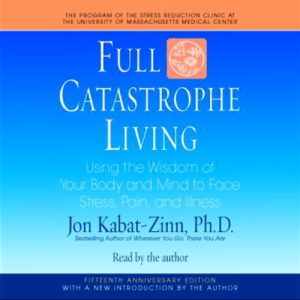
Jon Kabat-Zinn's Full Catastrophe Living is the book that brought Mindfulness-Based Stress Reduction into clinical practice, and this audiobook carries the full weight of that origin. This is not a general audience wellness title; it is the documented curriculum of the MBSR program Kabat-Zinn developed at the University of Massachusetts Medical Center - a program used to treat chronic pain, anxiety, depression, and stress-related illness in clinical settings. Listening to it is a different experience from taking the course, but the audiobook gets closer to that course structure than text on a page alone can manage.
Kabat-Zinn narrates this himself. That choice is meaningful. His voice has the quality of someone who has guided thousands of people through the practices described in this book - measured, patient, without urgency. The nearly six-hour runtime reflects the program's actual depth rather than padding around a simpler concept. Listeners who approach this as background audio will miss most of what it offers; the material requires active engagement, and Kabat-Zinn's pacing assumes a listener who is present to what is being described rather than half-attending while doing something else.
Is Full Catastrophe Living Worth Your Time?
The title comes from Zorba the Greek and captures Kabat-Zinn's fundamental attitude toward the problems this program addresses: the catastrophe of a full human life - illness, pain, loss, anxiety, the ordinary disasters that arrive without warning - is not something to be escaped but to be met with awareness. The program's core practices are mindfulness meditation and mindful yoga, but the book's framework for understanding stress, chronic pain, and the mind-body relationship is what distinguishes it from a meditation manual. Kabat-Zinn draws on medical research throughout, connecting the experiential practices to physiological and psychological evidence that was unusual in mainstream wellness publishing when the book first appeared and remains more rigorous than most current examples of the genre.
The reviewer who described this as "the complete course in Mindfulness-Based Stress Reduction" is accurate. Those with academic and clinical backgrounds who approach this as a comprehensive resource rather than popular self-help consistently give it high marks. The distinction matters because this is not a book that tells you mindfulness is beneficial and then leaves the implementation vague. It describes specific practices, explains the mechanisms by which they work, addresses common obstacles and misconceptions, and provides enough detail that a committed listener could build a genuine personal practice from the audiobook alone.
The Best Parts of Full Catastrophe Living
The self-narration question is worth addressing directly. One reviewer found Kabat-Zinn's delivery adequate but less charismatic than expected for in-car listening. That assessment is fair. This is not a book designed to be heard while driving the way a narrative-driven title is. The material calls for the kind of attention you give a lecture you intend to take notes on. Kabat-Zinn's pacing suits that context - the measured delivery is a feature for listeners using this as a course resource and a friction point for those who want to absorb it passively.
The heart disease chapter is one of the audiobook's more striking passages. Kabat-Zinn's treatment of the roles that anger and tension play in cardiovascular health is medically grounded rather than speculative, and the specific practices he recommends for that context are differentiated from the general anxiety and pain management sections. This is a book that takes the listener's specific health situation seriously enough to provide differentiated tools rather than a single general principle.
The anxiety and panic section of this audiobook - which Kabat-Zinn approaches specifically rather than treating anxiety as a subset of general stress - contains some of the more immediately applicable material for listeners who come to this with that particular challenge. His description of the physiological process of panic, and of mindfulness as a way of observing that process without being consumed by it, is medically informed in ways that distinguish this from reassurance-based approaches to anxiety management. The distinction between noticing anxious thoughts and being driven by them is made with precision, and in audio, with Kabat-Zinn's own measured delivery, this section carries a specific quality of calm authority that print cannot replicate in quite the same way.
Before You Commit to Full Catastrophe Living
The mindful yoga sections are often less engaging in audio than the meditation material, simply because physical practice instructions benefit from visual demonstration in ways that text and audio cannot fully replicate. Listeners who want to integrate the yoga component into a personal practice will want to supplement the audiobook with video instruction. The meditation guidance translates much better to the listening format - there is a genuine argument that guided meditation instruction is more natural in audio than on a page, and Kabat-Zinn's experience as a teacher comes through most clearly in those passages.
Pay attention to the chapters on chronic pain separately from those on stress and anxiety. Kabat-Zinn treats these as related but distinct challenges, and the specific practices he recommends for pain patients are tailored in ways that matter for people living with particular conditions. The full title's reference to facing "stress, pain, and illness" is an honest description of the scope. This audiobook covers more medical territory than most wellness titles and expects listeners to engage with that specificity seriously rather than treating it as academic background.
Should You Listen to Full Catastrophe Living?
People facing chronic pain, anxiety, stress-related illness, or a diagnosis requiring a sustained behavioral response will find this the most rigorous and clinically grounded audiobook available on the subject. Mindfulness practitioners who know introductory material and want the foundational text of the MBSR tradition will find it here. Listeners who have read easier Kabat-Zinn titles and want the complete course are the ideal audience. This is not the right entry point for someone casually curious about meditation - Kabat-Zinn's shorter Mindfulness for Beginners covers that ground more gently. Full Catastrophe Living is the full program, delivered at full depth.
Before You Press Play
- Read by: Jon Kabat-Zinn narrates his own work, which is both an asset and a limitation. His voice carries genuine authority and the measured cadence of a meditation teacher, but some listeners find the delivery low on energy for passive listening.
- At its heart: Mindfulness as clinical intervention, chronic pain and stress reduction, the body-mind relationship
- Vibe: Deliberate and grounded, with the unhurried rhythm of a meditation program
- Short version: Full Catastrophe Living remains the foundational text on Mindfulness-Based Stress Reduction - a rigorous, medically grounded audiobook that functions as a complete course rather than casual listening.