
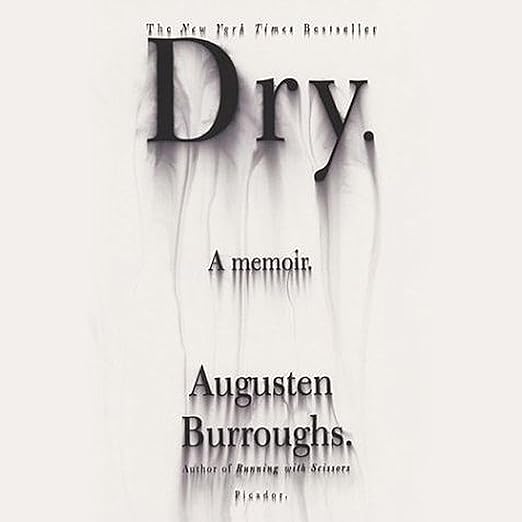
Augusten Burroughs narrates his own memoir the way he writes it: fast, funny, and unwilling to look away from the ugliest details first. This audiobook opens with a riff pulled from Chapter Two, an old bit about Bewitched and Darren Stevens coming home to a stiff drink from his wife Samantha, and it sets the tone for everything that follows: comic, specific, and quietly devastating underneath the jokes. Dry picks up in Burroughs' twentysomething advertising years, the ordinary-looking guy in the nice suit that Grady Harp's review calls one of literature's most convincing portraits of a person nobody suspects is falling apart.
The plot, such as it is, follows Burroughs into rehab at his employer's none-too-subtle request, where his fantasy of celebrity-adjacent group therapy gets replaced by fluorescent lighting and paper hospital slippers. The real subject of the book only starts once his thirty days end and he has to go back to the same drunken Manhattan life and live it sober, a much harder story than the drying-out part. Burroughs sums up the whole arc in one line near the end: Dry is the story of love, loss, and Starbucks as a Higher Power.
The book's references, the Bewitched rerun playing in memory, the fantasy of movie-star-adjacent group therapy, anchor its early-2000s setting with real specificity rather than vague period gesture, giving Dry a time-capsule quality some later addiction memoirs written in a more placeless, generic style lack entirely. That specificity extends to Burroughs' advertising-world details too, the loud ties, the cologne masking last night's drinking, small, exact observations that only someone who actually worked that job and lived that denial could render this precisely.
What Makes Dry Worth Hearing
Self-narration is the strongest argument for choosing this audiobook over the print edition. Burroughs' phrasing has a specific comic rhythm on the page, the catalog of loud ties and cologne on the tongue meant to cover the smell of last night, and hearing him deliver those lines in his own voice removes any interpretive distance a hired narrator would have to work to close. Kaya Hewitt's review calls the book witty, fast, and ironically entertaining even while covering genuinely dark material, and that balance depends on tone as much as text, which is exactly what a self-narrated performance can supply.
Reviewers who already knew Burroughs from Running with Scissors and Wolf at the Table point out that he sustains the same voice across separate memoirs pulled from the same family history, and Dry is where that voice gets tested against material with real clinical weight. One listener describes assigning it for a Master's counseling course alongside Gabor Mate's In the Realm of Hungry Ghosts, reading the two side by side as case studies in addiction told from opposite ends of the recovery spectrum.
The title itself works two ways: Dry describes the sobriety Burroughs is fighting toward, and it describes the arch, deadpan humor he brings to material that could easily tip into melodrama in someone else's hands. The memoir moves in a rough chronology, from the ad agency haze through the mandated stint in rehab through a relapse that runs longer and darker than the setup suggests, and finally into a sobriety that never gets treated as a tidy happy ending. Burroughs resists the recovery-memoir convention of closing on triumph; the final chapters carry as much uncertainty as anything earlier in the book, which is part of why the memoir has stayed in print and in conversation for as long as it has.
Things to Know Before Starting Dry
Listeners expecting the cartoonish family chaos of Running with Scissors should recalibrate. Dry is more claustrophobic and interior, focused on one man's self-deception rather than an eccentric household, and the humor never really softens the descriptions of active drinking. Donna Hill's review flags a longer, heavier stretch covering a later crack cocaine relapse that runs past the point where a tidier memoir would have ended on the rehab graduation, and that section is rougher listening than the ad-executive setup prepares you for.
Burroughs is not a trained voice actor, and his cadence occasionally favors truthfulness over polish, moving briskly through moments where a professional narrator might slow down for effect. No alternate narrated edition exists to weigh against this one, so the choice a listener is actually making is print versus audio, not narrator versus narrator, and the self-narrated version wins that comparison easily given how much of the book's humor lives in delivery.
Burroughs recorded this narration years removed from the events themselves, which raises a genuinely interesting question about reliability: a formerly dishonest narrator describing his own dishonesty, from the vantage point of established sobriety, reads differently than a same-year confessional would. That distance mostly works in the book's favor, giving Burroughs room for the kind of exact, unsparing detail that only comes with hindsight, the specific brand of scotch, the specific lie told to a specific coworker, though listeners who prefer memoir written closer to the events it describes should know upfront that this is not that kind of book.
Who Augusten Burroughs Is Writing For
This suits readers of Running with Scissors who want the next chapter of Burroughs' life, listeners drawn to addiction memoir with a literary and comic sensibility rather than a strictly inspirational one, and anyone who wants to hear a writer read his own account of the gap between how he looked from the outside and what was actually happening.
Skip it if you want a straightforward, uplifting recovery narrative, or if dark comedy layered directly on top of active addiction is a combination you would rather avoid. Dry earns its 4.5 rating from listeners precisely because it refuses the easier, softer version of this story.
Dry predates the current wave of addiction memoir by roughly two decades, and its comic sensibility set it apart from the genre's more clinical or purely inspirational entries even at the time of its original release. Listeners who came to addiction memoir more recently, through a more trauma-forward or self-help-adjacent lens, may find Burroughs' willingness to be genuinely funny about his own worst behavior a useful corrective, proof that the genre does not require constant solemnity to take its subject seriously.
Before You Listen
Do I need to listen to Running with Scissors before this audiobook?
No. Dry stands on its own, though listeners who already know Burroughs' childhood from Running with Scissors will recognize the same voice and catch a few references to that earlier chaos.
Does Augusten Burroughs narrate the Dry audiobook himself?
Yes. Burroughs reads his own memoir, and his self-narration is one of the strongest reasons to pick the audiobook over the print edition.
Is the Dry audiobook heavy enough for academic or counseling course use?
It already has that track record. One listener describes assigning it for a Master's counseling course alongside Gabor Mate's In the Realm of Hungry Ghosts, and its first-person honesty suits that kind of classroom pairing.







