
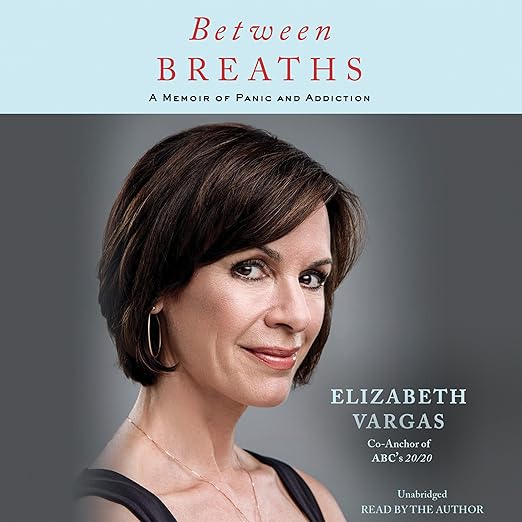
Did alcoholism nearly end Elizabeth Vargas's career on live network television? The audiobook of Between Breaths answers that question directly, in her own voice, tracing the former ABC 20/20 anchor's private struggle with drinking and anxiety from a childhood that started unraveling at age six through the on air admission, delivered to George Stephanopoulos, that finally forced the secret into the open. Vargas narrates her own memoir here, and that choice alone signals how personally she is willing to own this story.
What We Made of It
The book's real subject is not addiction in the abstract, it is the specific mechanics of hiding one. Vargas traces her anxiety back to age six, when her father's deployment to Vietnam left a small child with a fear she was too young to name, and follows that thread forward through a broadcasting career built, almost ironically, on composure under pressure. The gap between her public performance of control and her private unraveling is where the memoir does its most honest work.
What separates this from a standard recovery narrative is how unflinchingly Vargas covers the mechanics of denial itself, not just the drinking but the elaborate effort required to keep a demanding career and a national television profile intact while hiding a dependency. She covers rehab and her first year of sobriety with the same clear eyed instinct she brought to two decades of network journalism, and Diane Sawyer's blurb, calling her a colleague who 'stared straight into the lethal heart of addiction,' captures that same journalistic precision turned on her own life.
The book's reception underscores how much it resonated beyond a typical celebrity memoir readership. Between Breaths won the Books for a Better Life Award in the First Book category, a recognition specifically reserved for works that demonstrate a real capacity to help readers navigate their own struggles, and the Publisher's Weekly review framed it as tracing a genuine arc from professional highs to personal lows and back through recovery. That combination of critical and practical recognition suggests the book succeeds as both craft and testimony.
Vargas's decision to disclose her struggle publicly, on live television rather than through a controlled press release or a written statement, is itself a striking career risk worth sitting with. Television anchors rarely cede that kind of narrative control voluntarily, and the audiobook's opening chapters build toward that admission as a genuine turning point rather than a footnote, giving the memoir real dramatic structure even though every event in it already happened years before Vargas sat down to record it.
What Makes Between Breaths Worth Hearing
Vargas's voice is the book's biggest asset in audio specifically. Listeners who know her from two decades of network news broadcasting will recognize the same measured delivery, except now aimed at material with genuine personal stakes rather than a teleprompter script. That familiarity does real work here, hearing the same composed voice describe losing control of her own life creates a tension print alone cannot fully replicate.
The book also earns its emotional credibility through specificity rather than sentimentality. Reviewer Cheryl notes Vargas grew up in a military family and traces her anxiety back to that childhood directly rather than treating it as a vague backstory footnote, and reviewer KAT frames the book correctly as a full autobiography rather than a narrow addiction narrative. At five hours and thirty five minutes, the audiobook stays tightly focused on this specific arc instead of stretching into a padded, decades spanning memoir.
Vargas is far from the only television journalist to eventually write about addiction, but few do it with her specific combination of access and restraint. She does not use her platform to excuse her behavior or to perform contrition for an audience; she narrates the specific, sometimes unflattering mechanics of how a functioning alcoholic operates inside a demanding career, which gives the book a clinical honesty that elevates it above a simple redemption arc.
What Might Not Land
This is a short listen by memoir standards, and that brevity is a deliberate choice rather than a shortcoming. Vargas is not attempting a comprehensive account of her entire broadcasting career, she is isolating one throughline, anxiety into addiction into recovery, and staying disciplined about it. Listeners expecting a wide ranging media industry memoir in the vein of a longer network news autobiography should recalibrate expectations toward something closer to a focused personal essay expanded to book length.
The material itself is heavy by design: childhood fear, secret keeping, and the guilt of being, in her own words, a working mother who could never find the right balance. Listeners currently navigating their own addiction or anxiety may find real recognition here, but should also know this is not a clinical or distanced account. Vargas writes and narrates from inside the experience, which is the book's strength and also its intensity.
The guilt Vargas describes as a working mother unable to find balance between career and parenting is treated with real specificity rather than generic language about the difficulty of juggling both. She connects that guilt directly to the anxiety and drinking patterns established decades earlier in her childhood, which means listeners get a genuinely integrated psychological account rather than several loosely connected personal essays stitched into one memoir.
Should You Listen to Between Breaths?
Readers of addiction memoirs in the tradition of Mary Karr or Augusten Burroughs, anyone following Vargas's broadcasting career, and listeners drawn to concise, self narrated personal accounts are the natural audience here.
Skip it if you want a full career retrospective of her twenty years in network news rather than a focused recovery memoir, or if addiction and childhood anxiety are subjects you need distance from right now. For anyone ready to hear a familiar public voice speak with unfamiliar candor, Between Breaths delivers that specific, fairly rare combination.
Before You Listen
Does Elizabeth Vargas narrate the Between Breaths audiobook herself?
Yes, and her own measured broadcasting voice applied to deeply personal material is a large part of the audiobook's impact.
How long is the Between Breaths audiobook?
Five hours and thirty five minutes, a tightly focused listen centered on one specific arc rather than a full career memoir.
Does Between Breaths cover Elizabeth Vargas's full career at ABC and A&E?
Not comprehensively. The book stays focused on her anxiety, addiction, and recovery rather than functioning as a broad media career retrospective.







