Quick Take
- Narration: Virtual Voice (AI-generated) narrates throughout, a significant limitation for nuanced health science content that depends on precise tonal calibration.
- Themes: peptide biology, GLP-1 distinctions, evidence evaluation vs. wellness hype
- Mood: Deliberate and cautious, the book actively resists overselling, which gives it an unusual tone for this genre
- Verdict: The framework is sound and the anti-hype positioning is welcome, but the Virtual Voice narration is a real obstacle for material this dense and detail-oriented.
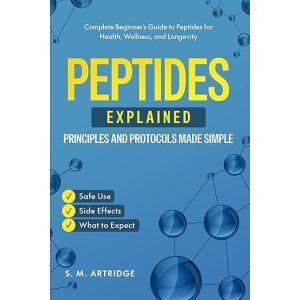
Peptides have had a strange trajectory through health culture. Five years ago they were a niche topic in bodybuilding communities and anti-aging clinics. Now they’re in mainstream wellness conversations, driven largely by the GLP-1 explosion and a wave of online enthusiasm that far outpaces the clinical evidence. I’d been looking for something that would help me understand what’s actually known versus what’s being projected onto compounds that haven’t been thoroughly studied in most of the ways they’re being used. Peptides Explained arrived at exactly that moment.
The author, S. M. Artridge, works within the Brain and Body Longevity Library series, and the positioning here is deliberate and unusual: this book explicitly does not provide dosing instructions or medical advice. That disclaimer appears in the synopsis itself, which is almost unheard of in health and wellness publishing. The choice is intentional, and the book earns it by being rigorous about distinguishing what is clinically established, what is emerging from research, and where genuine gaps exist in the evidence.
The GLP-1 Distinction That Most Peptide Books Miss
One of the more valuable things this audiobook does is clarify why GLP-1-based therapies are structurally different from most other peptides being discussed in wellness contexts. GLP-1 receptor agonists have extensive clinical trial data, regulatory approval, and decades of research behind their specific mechanisms. Most other peptides in popular use do not. Artridge draws this distinction carefully and doesn’t let the legitimacy of GLP-1 research lend credibility to the broader peptide space by association, which is exactly the rhetorical move that most wellness content performs, either consciously or not.
Reviewer Vincenzo D. notes that the book respects the reader’s intelligence and resists drifting into biohacker fantasy. That’s accurate. The sections covering how peptides work in the body, the amino acid building blocks, the signaling mechanisms, the difference between peptide types, are explained in plain language without being condescending, which is a difficult balance to strike in science writing.
What the Cautious Framing Does and Doesn’t Do
The explicit refusal to provide dosing protocols or one-size-fits-all guidance is both the book’s greatest intellectual honesty and its practical limitation. Listeners coming to this with a specific question, should I be taking BPC-157 for tendon recovery? what does the research actually say about TB-500?, will find themselves understanding the epistemological landscape without getting specific answers. That’s appropriate given the genuine state of the evidence, but it means the audiobook functions more as orientation than as reference.
The framing works best for someone trying to evaluate claims they’ve encountered online or in fitness communities, or someone considering a conversation with a prescribing physician about peptide therapy. For those purposes, having a clear framework for what questions to ask and what evidence to demand is genuinely useful. For someone who already knows the landscape and wants clinical depth, this book doesn’t go far enough.
The Virtual Voice Problem with Dense Health Science
This is where I have to be direct. Virtual Voice narration, Audible’s AI-generated audio, presents a specific problem for health science content that requires precise tonal calibration. When Artridge makes a distinction between evidence that is robust and evidence that is preliminary, the weight given to that distinction matters. Virtual Voice delivers text without the inflection and pacing cues a human narrator uses to signal hierarchy, what’s important, what’s a qualification, what’s a firm statement versus a tentative one. For casual wellness content, this is merely unfortunate. For a book explicitly built around evaluating evidence quality, it undercuts the primary purpose.
The four-hour runtime is appropriate for the scope being covered, and at 4.9 stars across 42 ratings, the response to the content itself is genuinely positive. The book’s anti-hype positioning clearly resonates with listeners navigating an information environment full of enthusiastic overclaiming. The material deserves better production.
Who Should Listen and Who Should Look Elsewhere
Listen if you want a grounded, skeptical introduction to what peptides are and how to think about claims made for them, particularly if you’ve been encountering GLP-1 adjacent conversations and want to understand the broader landscape without being sold on it. This works well as pre-consultation reading before talking to a physician.
Look elsewhere if you want protocols, specific compound guidance, or clinical depth beyond the introductory. Also be aware of the Virtual Voice limitation before committing; the material deserves a human narrator capable of carrying the nuances of evidence-level distinctions.
Frequently Asked Questions
Why doesn’t this book include dosing information like most peptide guides?
The omission is intentional and the book explains why: peptide use is highly individualized and should be guided by a qualified medical provider. Artridge argues that any book claiming to provide universal dosing protocols deserves skepticism given how variable individual health contexts are. This is an ethical choice, not a gap.
Is the Virtual Voice narration tolerable for this kind of scientific material?
It’s a genuine limitation. Dense health science benefits from a human narrator who can signal the relative weight of different claims through pacing and inflection. Virtual Voice delivers text evenly without those cues, which is a problem for a book specifically focused on distinguishing strong evidence from weak evidence.
How does this book handle the GLP-1 boom specifically, is it a GLP-1 guide?
No. GLP-1 appears as an important reference point specifically because it represents the subset of peptides with robust clinical backing, Artridge uses it to clarify why other peptides shouldn’t inherit that credibility by association. The book is about the broader peptide landscape, not a GLP-1 guide.
Is S. M. Artridge a medical professional, and does the book cite clinical sources?
The author’s credentials are not detailed in the available metadata. The book positions itself as educational context-setting rather than clinical guidance, and the explicit disclaimers about not providing medical advice suggest awareness of the professional boundary. Listeners wanting author credentials should investigate independently before treating any content as clinical authority.