Quick Take
- Narration: Bob Souer delivers Sandison’s faith-integrated narrative with steadiness and warmth, handling both the personal testimony passages and the expert interview summaries without losing the devotional register the material requires.
- Themes: Autism and Christian faith, family advocacy, neurodivergent potential
- Mood: Hopeful, devotional, and narrative-driven
- Verdict: A distinctive and genuinely moving collection for Christian families navigating autism, though its faith-forward framing means it speaks most directly to a specific audience.
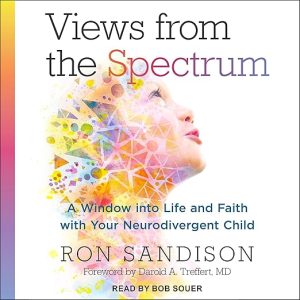
I came to Views from the Spectrum during a stretch when I had been reading a lot of clinical autism literature, the brain scans and behavioral frameworks and intervention matrices, and what struck me immediately about Ron Sandison’s book was how completely it refuses that register. This is not a book about deficit management. It is a book about what families on the spectrum have actually accomplished, and it tells those stories through a lens that the clinical literature almost never provides: faith.
Sandison himself is on the autism spectrum, and his presence throughout the book as narrator and guide rather than distant observer gives Views from the Spectrum an authority that a neurotypical author could not replicate. He is writing from inside the experience, and that shapes everything from the stories he chooses to the questions he asks his interview subjects. The twenty profiles are not assembled from the outside. They are gathered by someone who knows the territory.
Twenty Portraits That Do Not Flatten
The structural choice here is twenty profiles of young adults with autism, each illustrating a different dimension of what the synopsis describes as what was thought impossible. These are not inspirational sketches, they are substantive portraits. Tyler Gianchetta’s account of pulling his mother from a burning vehicle. Kimberly Dixon, a nonverbal poet and artist, whose work challenges every assumption about what communication requires. Armani Williams, competing as a NASCAR driver, for whom motorsport became a channel for the kind of focus and pattern recognition that the neurotypical world had not known how to value.
What Sandison does well is resist the flattening that afflicts so many inspiring autism story collections. He does not present these individuals as props for a neurotypical audience. He gives them complexity, allows for difficulty, and lets the faith dimension emerge from their own testimony rather than imposing it from above. One reviewer flags the use of an outdated diagnostic term as problematic, a fair observation that reflects the ongoing vocabulary evolution in this space. Listeners who find that term uncomfortable should factor it in, though it does not define the book’s overall approach.
Where Scripture Meets Lived Experience
Each chapter ends with a prayer and devotion, and this is where Views from the Spectrum commits fully to its identity as a Christian book rather than a general-audience parenting resource. Sandison weaves Scripture throughout the narrative, not as decoration but as structural load-bearing material. The framework is not autism is a challenge to overcome but rather God’s design includes neurodivergent minds and bodies. That theological position has real practical consequences for how Sandison presents everything from early intervention to social skill development.
One reviewer describes the book as carrying some internalized ableism alongside its encouragement, worth noting for readers who approach autism advocacy from a neurodiversity-first perspective. The faith integration and the ableism concern are worth holding simultaneously rather than dismissing either. This is a book with a genuine perspective, not a neutral survey. It does not pretend to be otherwise, and that honesty is actually part of its value.
Bob Souer Holding the Balance
Bob Souer is a reliable presence in Christian nonfiction audio, and he brings appropriate gravity and warmth to Sandison’s text. The material includes both narrative sections and more instructional how-to passages, and Souer handles the tonal shifts smoothly. He does not push the emotional content, he lets the stories do that work themselves, which is the right call for material this specific and personal. The 42 ratings averaging 4.8 reflect a readership that found what it was looking for, and the high score across a reasonably sized sample suggests Souer’s performance is serving the book well.
The Expert Voice Alongside the Personal
Sandison does not rely solely on the twenty personal narratives to carry the book’s argument. He has also interviewed top experts in the autism field and incorporates their insights alongside the individual stories. This dual structure, anecdote and expertise, testimony and research, prevents the book from becoming either a purely inspirational collection or a dry professional reference. The balance is what earns the 4.8 average across 42 ratings, a score that reflects readers finding genuine utility alongside genuine emotional resonance.
Who Should Listen and Who Should Skip
The ideal listener is a parent of a child with autism who has a Christian faith and has felt alienated by clinical literature that never acknowledges their spiritual life. For secular families or those approaching autism primarily from a neurodiversity-as-identity framework, the devotional content will feel like a barrier rather than an asset. The expert interviews and parenting guidance have standalone value, but they are embedded within a faith narrative that is not easily separated out. This is a book for a specific community, and within that community it speaks with genuine authority.
Frequently Asked Questions
Is this book appropriate for non-Christian families of children with autism?
The devotional content, prayers, Scripture, and faith-based framing, is central to the book’s structure rather than incidental. Non-Christian readers may find the personal stories and expert interviews valuable, but the overall experience is shaped by a Christian worldview throughout.
Does the book address practical parenting strategies or is it primarily inspirational?
Both. Sandison includes parenting tips and insights from autism field experts alongside the personal narratives. The book functions as a hybrid of story collection, how-to guide, and devotional resource rather than any single one of those things.
The synopsis mentions nonverbal individuals. Does the book address communication for non-speaking autistics?
Yes, through Kimberly Dixon’s profile as a nonverbal poet and artist, the book engages with the question of what communication and contribution look like beyond speech. However, it does not provide AAC guidance or clinical communication strategies.
Is Sandison’s own autism experience woven throughout, or is it background context?
It is genuinely woven throughout. Sandison narrates his own journey with autism alongside the twenty stories of others, making his personal experience a through-line rather than a briefly mentioned credential.