
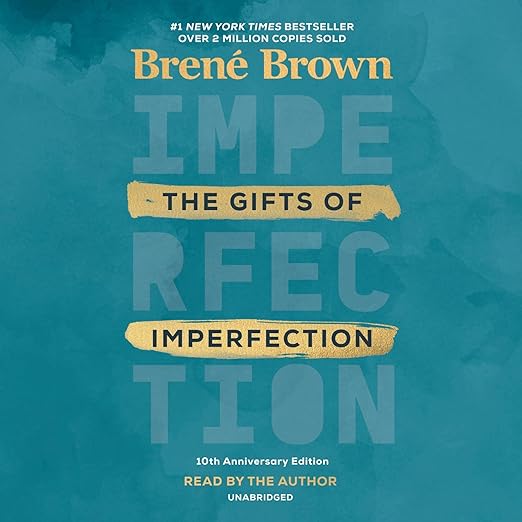
A new foreword is what separates this audiobook from the edition that arrived ten years before it, and nothing in the review pool mentions the foreword at all. That is a strange gap on a page whose entire justification is an anniversary. What sits underneath is unchanged: four and a half hours on ten guideposts to what Brené Brown calls wholehearted living, built from research into people who have decided their own worth is not up for negotiation. The material is durable. The packaging is where the questions start.
Ten Guideposts Paired With Their Own Saboteurs
Ten guideposts organize everything, and they are the reason the book has outlasted a decade of similar titles. Each one pairs a practice worth cultivating with the expectation that sabotages it: authenticity against the need for approval, self-kindness against perfectionism, play and rest against exhaustion as a status symbol. Naming the saboteur alongside the practice is what stops the list from becoming another set of instructions nobody follows.
Brief is the word a January 2013 five-star chooses, and the same response identifies the book's real method: plenty of observation and data, very little prescriptive advice, with the findings laid out for a reader to apply as they see fit. That is an accurate description and a warning. Anybody who wants a program with numbered steps and a checklist will find the research handed over and the application left entirely to them.
Two million copies in thirty-five languages is the claim the anniversary copy leads with, alongside a description of the author as a mapmaker and a fellow traveler. Marketing of that kind usually oversells. Here it mostly accounts for the texture of the writing, which moves between social science and the register of somebody talking across a kitchen table, and which is far more comfortable citing shame research than issuing instructions.
Kitchen-Table Narration From the Woman Who Wrote It
Shame is the engine, and treating it as a subject rather than a symptom is what separates this from the wider self-help shelf. The argument holds that shame survives on silence and loses its grip when it is named out loud, which reframes the entire project: not a program for becoming better, but a practice of becoming visible. Everything about courage, compassion and connection in the later chapters follows from that single move.
Germany supplied the most recent account on the page, a January 2026 five-star that summarizes the book accurately and generously: the focus falls not on eliminating imperfections but on facing them, with shame confronted so it loses its power, and self-compassion, resilience, intuition, creativity and calm cultivated in its place. That reader also notes that the ideas have been discussed elsewhere before, which is a fair and unusually balanced thing to say in a five-star.
Kitchen-table intimacy is what the copy promises, and the author reading her own work is therefore not a bonus feature but the delivery mechanism. Brené Brown wrote a book whose authority comes from sounding like a person rather than a podium, quotes her own lines inside it, and then speaks those lines herself. The runtime is short enough that the voice never has to strain to keep the confessional register going.
Repetition Even Loyal Readers Will Recognize
Repetition is the complaint an August 2016 five-star from the Italian storefront raises, and it deserves attention despite the generous grade. That response arrived after watching a widely shared talk on vulnerability perhaps a hundred times, found the book worthwhile, and still reported that the same ideas turn up everywhere the author appears, online, in magazines and across the books. Anybody who has absorbed the talks should expect recognition rather than revelation.
Four of the five accounts gathered here predate this edition entirely, arriving between 2012 and 2016, and one of them mentions buying its copy in May 2011. Exactly one of them postdates the September 2020 release. What that means in practice is that this page pools a decade of opinion about a text and presents it as a verdict on a recording, which no one who wrote here has necessarily heard.
Advice is the thing this book declines to give, and for a substantial share of buyers that is the disappointment. The guideposts describe a direction rather than a route. Nobody is told how many minutes of play to schedule or what to say when the shame arrives. That restraint is principled and it is genuinely useful for some listeners, while others will finish the runtime moved, persuaded and no clearer on what to do tomorrow.
Perfectionists Suspecting the Cost of Perfection
Perfectionists who have started to suspect the cost are the core audience, and the book was built for exactly that moment of suspicion. Anyone in a period of transition, professional or personal, will find the framing useful. Listeners who like their psychology sourced but not clinical get a genuine middle path, since the material comes from qualitative research rather than from anecdote, without ever sounding like a literature review.
Self-esteem was what a March 2012 five-star went looking for, describing a purchase made the previous May by somebody who then found that the title resonated because perfectionism was the real problem underneath. That is the arc this book keeps producing in its readers, and it is worth noting that the response was still being written about years after the fact. Books that get returned to are a different category from books that get finished.
Nobody in acute crisis should start here, since the subject is how to live rather than how to get through the next week, and it offers no clinical guidance whatsoever. Anybody who has already worked through the author's later titles is reading backwards here, since this is the foundation those were built on. Anybody else gets a compact book that respects its listener's intelligence.
Before You Listen
How dense is the audiobook at four and a half hours?
Ten guideposts spread across roughly 271 minutes leaves under half an hour for each, which is exactly the pace the writing wants. Nothing is padded and nothing is rushed. The compression works because the book states a finding, illustrates it briefly and moves on, rather than expanding each idea into a chapter of examples.
How does this audiobook differ from the original edition?
The distinguishing feature is a new foreword written for the tenth anniversary; the ten guideposts and the research behind them are the same text that sold two million copies. Nobody buying this should expect revised findings or new chapters. What you are paying for is the original argument plus a decade of hindsight at the front.
Should you bother with this audiobook if you already know the author's later books?
It depends on your appetite for origins. The description is explicit that the movement started here, so the vocabulary of vulnerability, shame and wholeheartedness that fills the later titles is being assembled in front of you. Expect recognition rather than surprise, and a shorter, plainer version of arguments you already know.







