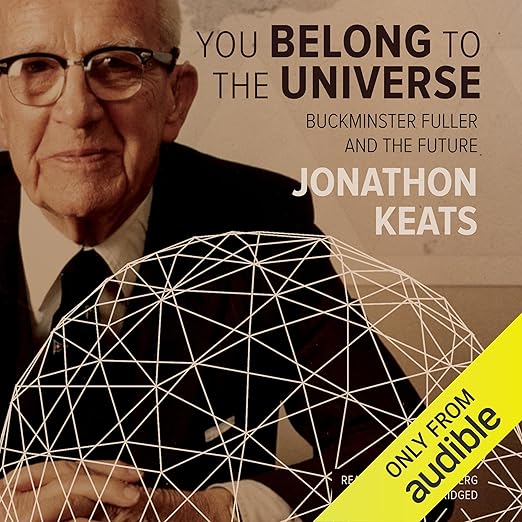
Buckminster Fuller invented the geodesic dome, a three-wheeled car, and a bathroom that needed neither plumbing nor sewage, and this audiobook's whole argument is that we let his best ideas fade from memory at exactly the wrong moment. You Belong to the Universe is critic and experimental philosopher Jonathon Keats' study of Fuller's six-decade quest to "make the world work for 100 percent of humanity," and it treats its subject as urgently relevant rather than a nostalgic curiosity, a bolder claim than most biographies of unfashionable geniuses attempt to make, since Keats is not just documenting Fuller's legacy but actively campaigning for its revival.
Half Intellectual History, Half Present-Day Application
Keats is not writing a conventional cradle-to-grave biography here. He is reviving Fuller's own practice, what Fuller called comprehensive anticipatory design science, and applying it directly to transportation, climate change, urban design, and education, arguing these methods are not just historically interesting but practically necessary right now. That structure, half intellectual history and half present-day application, gives the book real momentum instead of settling into a standard great-man narrative. Keats also works to dispel some of the mythology that has grown up around Fuller since his death, treating him as a serious, flawed thinker rather than a purely eccentric visionary to be admired from a safe distance.
Fuller described himself, in his own words, as a "comprehensive anticipatory design scientist," a title that sounds almost like a joke until Keats walks through what Fuller actually meant by it, someone trained to anticipate problems society has not yet fully recognized and design solutions before crisis forces a reaction. That refusal to simply lionize Fuller is part of what keeps the book from sliding into hagiography. Keats is explicit that Fuller's ideas were often dismissed during his own lifetime, and rather than treating that dismissal as simple shortsightedness on everyone else's part, the book takes seriously why certain proposals, like a bathroom requiring neither plumbing nor sewage, struck contemporaries as impractical even when the underlying thinking behind them held up. The book treats inventions like the geodesic dome and the Dymaxion car less as museum pieces than as proof of concept, evidence that Fuller's underlying method, doing the most with the least, produced workable results decades before anyone had the political will to adopt them at real scale.
A Reviewer Who Waited Since a 1982 Lecture
One reviewer, who says they spent two days in 1982 at a one-on-one Fuller lecture, put the book's arrival in deeply personal terms: "I have been waiting for this book since 1982, when I spent the better part of two days listening to a one-on-one Bucky lecture entitled 'Urgent Warnings for Humanity.' I promised Bucky I would write the book that Jonathon Keats has at long last written. Thank you, Mr. Keats." That is about as strong an endorsement as a biography of a specific, once-personal subject can earn, coming from someone who had a direct, personal stake in seeing Fuller's ideas properly documented decades before Keats ever took on the project.
Bloomberg's Tonal Shift From History to Argument
Josh Bloomberg's narration handles the shift between historical analysis and contemporary argument with real skill, keeping Keats' philosophical reasoning legible without artificially simplifying it for the sake of pace. His energy rises appropriately in the book's more speculative, applied chapters, exactly where Keats pivots from explaining what Fuller believed to arguing why it should matter to listeners today, which is a meaningful tonal shift for a narrator to track cleanly across a single project, especially one moving between geodesic domes and Dymaxion cars in its historical chapters and climate policy and urban planning in its applied ones.
Another reviewer captured the book's dual appeal directly: "Overall, You Belong to the Universe is an excellent read. It's both educational and entertaining," adding that it "provokes even more curiosity in readers for ways to apply some of Bucky's most famous ideas to problems (still) facing the world today." A third, shorter review called it simply "an easy to read review of Bucky's way of seeing the world," which fairly describes the book's accessible, application-first approach.
Doing the Most With the Least, Applied
At five hours and twenty minutes, this is a compact treatment of a genuinely complex, six-decade body of work, and listeners wanting exhaustive biographical detail on Fuller's personal life and engineering career specifically, rather than the application of his ideas to present-day problems, may find the pace moves faster than a full-scale biography would allow. Keats is selective by design, choosing depth of argument over completeness of the historical record, which suits listeners more interested in what Fuller's ideas can do today than in a definitive account of every invention he ever patented. Transportation, climate change, urban design, and education each get their own applied argument, and the throughline across all four is Fuller's own preference for doing the most with the least, a principle that reads as more urgent now, given the resource constraints Keats highlights, than it may have seemed even a few decades ago.
Keats Writes With Advocacy, Not Dispassion
Taken together, the three reviewer reactions quoted above cover an unusually wide range for a five-hour audiobook, a personal connection to Fuller himself, a more general appreciation for the book's educational and entertainment value, and a shorter but no less enthusiastic nod to its readability. That spread suggests the book succeeds with both readers who arrive already devoted to Fuller and readers meeting his ideas for the first time through Keats' framing.
Keats' own background as a critic and experimental philosopher, not an engineer or professional historian, shapes the whole project. This reads as an argument for Fuller's continued relevance, built and defended with real conviction, rather than a dispassionate technical account of how his inventions actually worked, and listeners should adjust their expectations to that advocacy-driven register from the start.
A Conventional Biography This Is Not
Rediscovering Fuller's ideas rewards listeners already curious about design, systems thinking, or the history of twentieth-century invention, especially anyone who has encountered the geodesic dome or Dymaxion car as trivia and never learned the philosophy that produced them. Longtime Fuller devotees and total newcomers both have real reasons to press play, since Keats builds the case from the ground up rather than assuming prior familiarity.
A conventional cradle-to-grave biography this is not, and listeners who specifically want a comprehensive, chronological account of Fuller's personal life alongside his professional one should know this book prioritizes his ideas and their present-day application well above his day-to-day biography.
The Short Version
- Read by: Josh Bloomberg's energetic, clear delivery handles Fuller's dense philosophical argument without flattening it, shifting up in energy naturally when the book turns from history to present-day application.
- At its heart: Underappreciated genius, applying old ideas to new crises, design as a tool for problem-solving
- Vibe: Urgent and admiring, closer to advocacy than neutral biography
- Short version: A smart, compact case for taking Buckminster Fuller seriously again, best for listeners already curious about design and systems thinking.
Do I need any background in architecture or design to follow this audiobook?
No. Keats explains Fuller's key concepts, like comprehensive anticipatory design science, from the ground up, and reviewers specifically praise how the book stays accessible without oversimplifying.
Does Josh Bloomberg's narration suit both the historical and argumentative sections of this audiobook?
Yes, reviewers and the book's own structure suggest his energy shifts naturally between Fuller's history and Keats' present-day application chapters without losing clarity in either register.