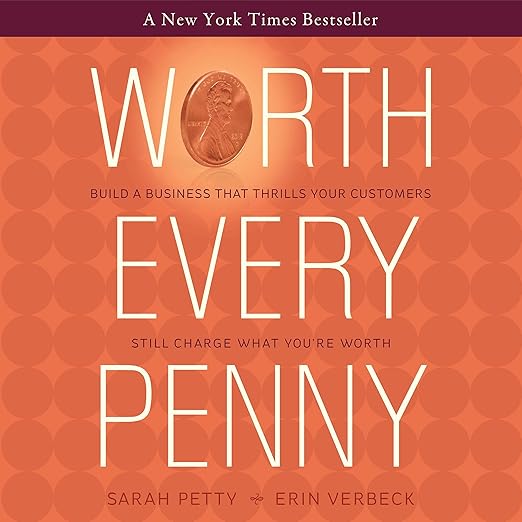
Sarah Petty and Erin Verbeck open their case against discounting with a blunt premise: photographers and small business owners who compete on price are fighting a war they can't actually win. This audiobook credits only Verbeck in its author field, but the synopsis names both women as co-authors throughout, and the argument itself, built around what they call the 'boutique' business model, clearly belongs to both.
Reframing 'Boutique' as a Business Philosophy
The boutique model Petty and Verbeck describe isn't a euphemism for 'expensive'; reviewer Janette Fuller gets at the real distinction when she explains that 'being boutique' is 'a model of doing business, a filter for your business decisions, and a mind-set,' not a product category or price point. That reframing, treating boutique as an operating philosophy rather than a marketing label, is the book's most useful move, and it's why the advice generalizes past photography into any small business built on personal service.
Structurally, the book moves from brand-building through pricing strategy to the relationship-based sales skills needed to close a boutique sale without feeling pushy, and it draws on real anecdotes from restaurateurs, contractors, and professional service providers alongside photographers specifically. That range of examples is doing real work: a listener convinced this advice only applies to wedding photographers would be missing the book's actual ambition, which is a general theory of pricing power for any owner-operated service business.
Petty's specific reputation comes from years spent coaching photography studio owners directly on pricing and positioning, which explains why the book's anecdotes read as drawn from real client consultations rather than invented composite examples. That coaching background also explains the book's occasionally repetitive structure Robin Spencer flags: consultants who spend years repeating the same core lesson to different clients often build books around reinforcement and repetition by design, since the goal is behavior change in a reader, not simply information transfer.
Listeners who work through the book's relationship-based sales training specifically will notice it draws a clear line between manipulation and genuine persuasion, insisting the boutique approach only works when the underlying product or service is actually excellent. That distinction matters for how the advice ages: pure sales tactics decoupled from real quality tend to stop working once a market catches on, while positioning built on genuinely earning premium prices through better service has a longer practical shelf life.
The book's title itself functions as a small piece of the argument: 'worth every penny' reframes price resistance as a value-perception problem rather than an actual affordability problem, the exact cognitive shift the boutique model depends on a business owner making before any specific tactic in the book can work. Getting a client to believe they're paying for genuine value, not simply a higher number, is the persuasion challenge underneath every chapter that follows.
Curt Alexander's Direct, Confident Register
Curt Alexander narrates with the direct, confident register a business how-to audiobook needs; this is prescriptive content built around concrete action steps rather than reflective memoir, and a narrator who keeps momentum moving forward without over-dramatizing routine business advice is the correct fit. Listeners following along at a desk or during a commute can absorb the strategy chapters without needing to rewind for tone or emphasis, since Alexander's delivery prioritizes clarity over performance.
The audio format suits a book built around real anecdotes and dialogue-style client examples better than a dry strategy manual would translate; hearing the 'over-the-top customer experience' philosophy described in a confident, direct voice reinforces the book's own argument that presentation and delivery matter as much as substance. Reviewer Emily Potts calls the book 'full of awesome strategies' built around 'action steps' rather than pure theory, and that action-oriented structure holds up well when narrated at a brisk, forward-moving pace.
The race-to-the-bottom pricing dynamic Worth Every Penny argues against is a well-documented problem across freelance and creative-service industries broadly, not unique to photography; a crowded market with low barriers to entry consistently pushes new entrants toward competing on price before they've built enough of a reputation to compete on anything else. Framing the book's specific advice against that wider economic pattern helps explain why its lessons have traveled well beyond photography into other service-based small business communities since its original publication.
Robin Spencer's Fair Warning About Repeated Ideas
Reviewer Robin Spencer's four-star review is the most useful counterweight here, praising the 'very inspiring' opening chapters while cautioning that the book 'seems to go on and on' at points and that readers already familiar with other marketing books 'will not find anything new.' That's a fair caveat for anyone who has already read extensively in the small-business marketing space; the boutique framing is genuinely useful, but some of the underlying pricing-strategy and branding advice overlaps with ideas available elsewhere under different names.
The book's origin in photography-industry coaching means some anecdotes and examples lean toward that industry more heavily than a listener from an unrelated field might expect, even though the core boutique argument is explicitly built to generalize. Listeners entirely outside creative-services businesses, retail or manufacturing, for instance, may need to do more translation work to map the advice onto their own business model than a photographer or event-based service provider would.
A New York Times and Wall Street Journal bestseller credential, as the synopsis claims for this book, carries real weight but is also worth understanding in context: business and how-to bestseller lists typically operate on a smaller sales threshold than general fiction lists, which doesn't diminish the book's actual usefulness but does mean the label signals strong performance within its specific category rather than mass-market crossover sales.
Listeners running businesses with thinner margins or more commoditized offerings than photography, where genuine differentiation is harder to manufacture, may find some of the boutique positioning advice requires more creative adaptation than the book's confident tone suggests, since not every product category offers the same room for the kind of premium storytelling this approach depends on.
For Owners Deciding Whether to Compete on Price
Worth Every Penny suits photographers, event-based service providers, and any small business owner who feels pressure to discount against lower-priced competitors and wants a structured argument for why that pressure is worth resisting. Owners early in building a brand identity, still deciding whether to compete on price or on experience, get the most direct strategic value from the pricing and positioning chapters specifically.
Business owners who have already read deeply in boutique-positioning and premium-pricing strategy elsewhere may find portions familiar rather than revelatory, and listeners seeking a fast, compressed summary should know the four-and-a-half-hour runtime moves through real depth rather than a quick highlight reel.
Does this Worth Every Penny audiobook credit both Sarah Petty and Erin Verbeck as authors?
The catalog's author field lists only Erin Verbeck, but the synopsis explicitly names both Sarah Petty and Erin Verbeck as co-authors throughout, so both should be credited for the actual argument.
How does Curt Alexander's narration suit a business strategy audiobook like this one?
Alexander delivers the material with direct, confident, forward-moving clarity that keeps prescriptive strategy content easy to follow without unnecessary dramatization.
Does this audiobook cover pricing strategy in general or specifically for creative businesses?
It covers general pricing and brand-positioning strategy, illustrated with anecdotes from restaurateurs, contractors, and service providers, not just creative or photography-specific examples.