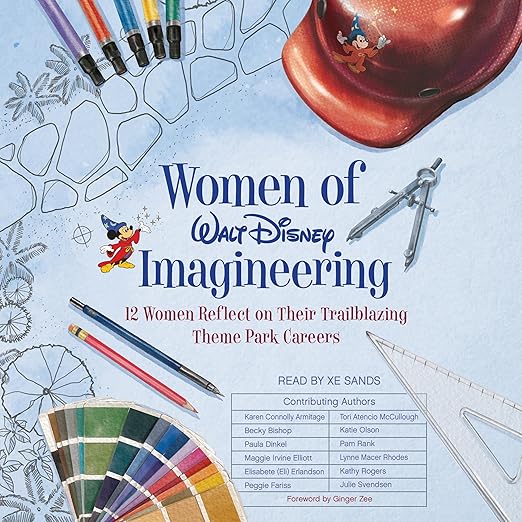
At a Glance
- Narrator: Xe Sands favors warm, unified cohesion over sharply differentiated voices, the right call for a twelve-contributor essay collection.
- Subjects: Women breaking into a male-dominated creative field, hands-on theme park design craft, legacy and mentorship
- Tone: Inspirational but grounded in genuine technical detail
- Bottom line: A rewarding sampler of twelve distinct Imagineering careers that trades depth on any one story for breadth across an entire underrepresented history.
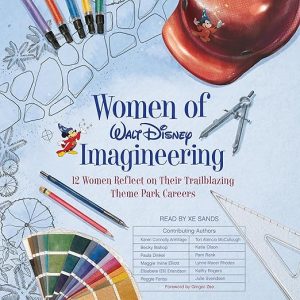
Walt Disney Imagineering employed astonishingly few women in creative leadership for decades, so what actually changed, and what did it cost the women who pushed through first? This audiobook answers both questions a dozen different ways, since Women of Walt Disney Imagineering collects first-person essays rather than one continuous narrative, each Imagineer describing her own path through set design, engineering, or creative direction on the theme parks that make up Disney's built empire. Julie Svendsen assembles voices spanning multiple creative disciplines during what the book calls an era of unprecedented expansion, and the throughline across all twelve contributors is less about any single project than about what it meant to be visibly, increasingly present in rooms that hadn't made much space for them before.
Twelve Careers, Under Seven Hours, By Design
The essay-collection format is both the book's structural strength and its natural limitation: because each Imagineer writes about her own specific projects and decades, the book trades a single sustained narrative for range, glimpses of Disney legends working alongside these women, behind-the-scenes process for how a theme park attraction actually gets designed and built, and the particular friction of navigating a visibly male-dominated workplace while doing it. Reviewer Sheena captured both sides of that tradeoff honestly, calling it 'a great read and inspirational' while also wishing individual chapters 'went into more detail,' a natural consequence of fitting a dozen full careers into under seven hours.
Expansion and Friction, Happening Simultaneously
What comes through consistently despite the format's breadth is craft pride, specific, hands-on descriptions of building three-dimensional storytelling for millions of park guests rather than vague reminiscence. These are women describing the actual mechanics of Imagineering work, not just their feelings about being present in the field, and that specificity is what keeps a dozen different first-person voices from blurring into a single generic trailblazing-woman narrative, each contributor's particular discipline, architecture, show design, engineering, giving her chapter a genuinely distinct texture.
The book's timing is worth noting on its own terms: Imagineering as a formal division dates back to Walt Disney's own lifetime, but the specific era these contributors describe, the decades of what the synopsis calls unprecedented expansion, largely covers the theme park industry's growth from the 1980s onward, as Disney moved from a single American company into a worldwide entertainment operation with parks on multiple continents. That expansion created both opportunity, genuinely new roles and disciplines that didn't previously exist, and the specific friction the essays describe, since scaling a creative department globally while also slowly diversifying it happened simultaneously rather than sequentially.
Cohesion Over Twelve Competing Personalities
Narrator Xe Sands has real, specific experience with exactly this kind of multi-contributor nonfiction, and her approach here favors cohesion over character-style differentiation between the twelve essayists, a deliberate choice that keeps the listening experience unified rather than turning into twelve distinct vocal performances competing for attention. For a book whose value is the accumulated weight of many individual stories forming one larger picture, that steady, warm consistency across contributors serves the material better than an attempt at twelve wildly different voices would.
A Gift for a Budding Animator, Well Received
The behind-the-scenes specificity is the other real draw: reviewer T.S. bought this as a gift for 'a budding animator and artist' and reported it was well received, which speaks to how much genuine craft detail sits inside the personal storytelling. Listeners with any interest in themed entertainment design, architecture, or the practical mechanics of building experiences at Disney's scale will find real substance here, not just inspirational framing around gender representation, though that framing matters too and never gets buried under the technical detail.
Sands' choice to prioritize unity over differentiation also serves a practical function across format: with twelve distinct authorial voices already creating natural variation in vocabulary, sentence rhythm, and personal anecdote style on the page, adding heavy vocal differentiation on top could risk turning a coherent oral history into something closer to a series of disconnected monologues. Her steadier approach keeps the listener anchored in the collective project the book is actually making, one shared professional culture described from a dozen vantage points, rather than fragmenting it into twelve competing personalities.
More a Sampler Than a Complete Portrait
Reviewer Sheena's wish for 'more detail' in individual chapters is the most useful expectation-setter here: because twelve contributors share under seven hours of runtime, no single Imagineer's story gets the kind of deep, sustained treatment a dedicated single-subject memoir would offer. If you're hoping for one particular Imagineer's full career story in granular depth, this format will feel more like a sampler than a complete portrait of any one path.
Bought the Wrong Book, Enjoyed It Anyway
Reviewer Willi's note that she 'bought the wrong book' but still found it 'a nice book highlighting women imagineers' is worth flagging for anyone searching Disney's catalog of Imagineering titles specifically: this is easy to confuse with other behind-the-scenes Disney books given how many exist, so listeners should confirm this is the essay-collection format they want before starting, rather than a single-author history of the department.
This is also worth situating honestly against Disney's own broader publishing catalog: unlike a corporate-sanctioned official history, these are personal essays written by the contributors themselves, closer in spirit to an alumni oral history project than an authorized institutional account. That distinction matters for tone, expect candor about workplace friction and personal struggle rather than polished corporate messaging, but it also means the book doesn't claim to be a comprehensive institutional history of Imagineering as a department, just twelve individual, honestly rendered slices of one.
Aspiring Young Women in Design and Engineering
This suits Disney parks enthusiasts who want the design and engineering side of the story rather than just ride history, and anyone interested in women's history within a specific, unusually visible creative-technical field. Aspiring designers, architects, or engineers, especially young women in those fields, will likely get the most direct value, per reviewer T.S.'s gift-giving experience with a young artist.
Listeners who enjoy oral-history-format nonfiction generally, the kind built from multiple first-person accounts rather than a single authorial voice, will recognize the format's specific pleasures here: the accumulation of small, telling details across many careers that no single memoir could gather, even if no individual detail gets the sustained attention a solo memoir would give it. That format has real precedent in respected nonfiction, and this collection uses it capably, letting twelve distinct professional journeys accumulate into something larger than any one of them could tell alone.
No Table of Contents to Orient a Listener
Those wanting a single continuous narrative arc, rather than twelve overlapping but distinct first-person accounts, may find the essay structure disorienting in audio specifically, since no visual chapter list exists to orient a listener between contributors the way a printed table of contents would. Listeners craving forensic detail on any one Imagineer's full career are better served treating this as an introduction to twelve names worth researching further, not a final word on any of them.
Questions Listeners Ask
Is the Women of Walt Disney Imagineering audiobook narrated by the Imagineers themselves?
No. All twelve essays are voiced by a single narrator, Xe Sands, who maintains a consistent, warm tone across contributors rather than performing each as a distinct character.
Do I need Disney theme park expertise to enjoy this audiobook?
No. The essays explain the design and engineering work in accessible terms, though listeners with existing interest in themed entertainment will get extra context from the specifics.