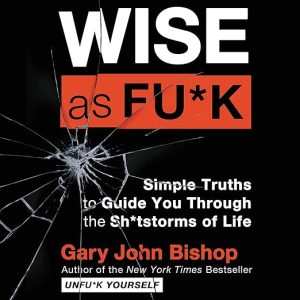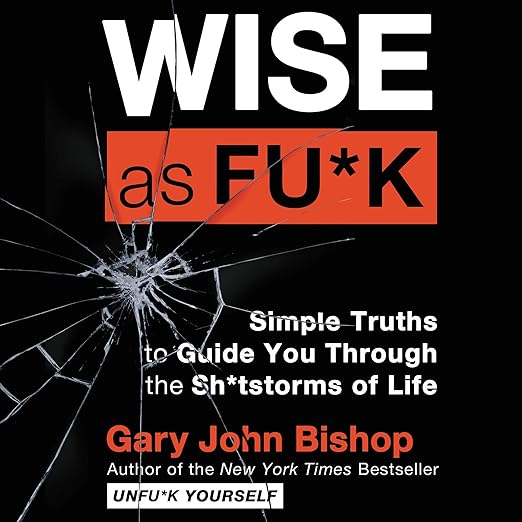
Gary John Bishop built an entire publishing career on saying the blunt thing a therapist will not, and this audiobook sequel to Unfu*k Yourself hands him four hours and five minutes to apply that same voice to love, loss, fear, and success. Bishop narrates his own material, as he does across the whole Unfu*k Yourself franchise, and his Scottish cadence has become as much a part of the brand's identity at this point as the profanity in the titles; the craft question for Wise as Fu*k specifically is whether that same blunt energy can sustain a book about wisdom rather than just self-sabotage.
Why Each Section Reads Like a Coaching Session
Bishop's pitch here is a redefinition project: wisdom is not accumulated knowledge or clever internet advice, it is the specific, practical skill of acting well inside the four areas life reliably tests everyone on. His self-narration is doing real interpretive work throughout, since the book's whole appeal depends on hearing the profanity and directness land as earned bluntness rather than shock value, a tone that a hired narrator, however skilled, would have a harder time replicating without Bishop's own lived conviction behind it.
Bishop trained and worked as a professional coach before his writing career took off, and that coaching background shows in the book's structure: each of the four sections functions less like an essay making an argument and more like a coaching session pushing a specific behavioral shift, consistent with how he says he actually works with clients one on one.
'Totally Recommend' and a Breakup Reframed
Reviewer Deborah OKC describes using the book to get through a breakup, specifically crediting it with reframing the story she was telling herself about what the breakup meant rather than the breakup itself: 'unlovable, a failure, a bad picker.' That is the book's method in miniature: less comfort, more direct confrontation with the internal narrative causing the pain, and Bishop's delivery keeps that confrontation from tipping into either cruelty or empty toughness.
Reviewer Alicia Leal's brief but enthusiastic response, just two words, 'totally recommend,' is worth pausing on in its own right: short, unqualified endorsements like this show up often among the reviews this book has drawn, since the whole selling point here is getting to the point quickly, a fitting echo of Bishop's own style even in how readers choose to describe it.
Wise as Fu*k arrives inside a self-help subgenre that boomed over the last decade, blunt, profanity-forward titles positioned explicitly against softer, more traditional self-help language, with Mark Manson's The Subtle Art of Not Giving a F*ck as the most famous comparison point. Bishop's own Unfu*k Yourself predates and helped establish that same wave, and Wise as Fu*k reads as a mature, confident continuation of a lane he helped define rather than a late entry chasing a trend.
The word choice in the title itself, wise rather than smart or successful, is a deliberate departure from more achievement-oriented self-help branding. Bishop is explicitly not promising listeners more accomplishments or more money; he is promising a different relationship to the hard parts of life that accomplishment alone does not fix, a narrower and arguably more honest promise than a lot of self-help marketing makes.
Bishop frames wisdom explicitly against seemingly good advice available for free online that he argues does not actually change behavior, a direct swipe at exactly the kind of content-marketing self-help ecosystem his own book competes inside. That self-aware positioning, acknowledging the crowded, noisy market for this kind of advice while arguing his own approach cuts through it, gives Wise as Fu*k a slightly different rhetorical stance than a book that pretends no competition exists.
Bishop's Voice Is the Product, Not the Delivery
Self-narration matters more for this specific author than almost any other in the tough-love self-help category, because Bishop's entire voice, the profanity, the directness, the refusal to soften hard truths, is the product as much as the advice itself. A different narrator reading these exact words would fundamentally change what the book is; Bishop reading his own book preserves the specific relationship he has built with an audience across Unfu*k Yourself and its sequels.
At just over four hours, this sits on the shorter end for self-help audio, and that brevity works in the book's favor given its four-part structure: love, loss, fear, and success each get focused, direct treatment rather than diluted across a longer runtime padded with repetition. Reviewer aJc describes the book sitting unread on a shelf for a while before finally engaging with it and immediately appreciating its tone and edge, a listening arc audio arguably shortens by lowering the barrier to actually starting.
At just over four hours, Wise as Fu*k also works well as a re-listen, the kind of audiobook someone might return to for a single relevant section, the fear chapter before a big decision, the loss chapter after a hard year, rather than only ever experiencing it start to finish once.
A Scottish Accent This Genre Rarely Offers
The profanity in both the title and the prose itself is not incidental marketing, it is structural to Bishop's whole approach, and listeners sensitive to that language throughout a full audiobook, not just in the title, should know it continues consistently rather than being front-loaded for shock value alone.
This functions explicitly as a sequel, building on ideas introduced in Unfu*k Yourself rather than starting entirely fresh. Listeners unfamiliar with Bishop's earlier work can still follow Wise as Fu*k on its own terms, since it applies rather than assumes the earlier book's core framework, but longtime readers of the first book will likely get more resonance from the callbacks.
Bishop's Scottish accent and background are worth mentioning specifically for listeners deciding between audio and print: his delivery carries a directness that reads as culturally distinct from the more neutral American self-help narrator voice most listeners in this genre are used to, part of what reviewers describe as his book's edge, and that regional specificity is something only the audio edition can actually deliver.
A Good Fit Unless Profanity Is the Dealbreaker
Listeners who responded to Unfu*k Yourself's blunt, profanity-forward style, or anyone who wants tough-love self-help without therapeutic softening, will find Bishop's self-narration exactly as direct and effective here as in his earlier work.
Listeners who found The Subtle Art of Not Giving a F*ck's tone appealing but wanted more direct, actionable structure underneath the irreverence will likely find Bishop's more clinical four-part framework a good match for that same taste.
Skip it if profanity throughout a self-help audiobook is a dealbreaker regardless of the underlying advice, or if you prefer a gentler, more clinical approach to processing love, loss, fear, and success. Bishop's whole method depends on a bluntness that will not work for every listener.
Quick Take
- Read by: Gary John Bishop narrates his own blunt, profanity-forward material with the same conviction that built his earlier bestsellers.
- At its heart: tough-love self-help, wisdom as practice, love, loss, fear, and success
- Vibe: Blunt, direct, and unsentimental
- Short version: A short, sharp sequel to Unfu*k Yourself, best for listeners who want tough love without the therapeutic softening.
Do I need to have read Unfu*k Yourself before this audiobook?
No, Wise as Fu*k applies rather than assumes the earlier book's framework, though longtime readers will likely catch more of the callbacks.
Does Gary John Bishop narrate this audiobook himself?
Yes, as he does across the whole Unfu*k Yourself franchise, and his self-narration is central to how the book's blunt tone actually lands.
What four areas does this audiobook focus on?
Love, loss, fear, and success, each given dedicated, direct treatment across the book's four-hour runtime.