Before You Press Play
- Voice: Robert Frederick is credited, reading an English text whose translator the listing never names.
- Big ideas: Classical myth read as philosophy, knowing versus acting, early modern interpretation.
- Atmosphere: Compact, aphoristic and faintly archaic, in short self-contained pieces.
- Worth it?: A strange and worthwhile three hours, on a page that contradicts itself four separate ways.
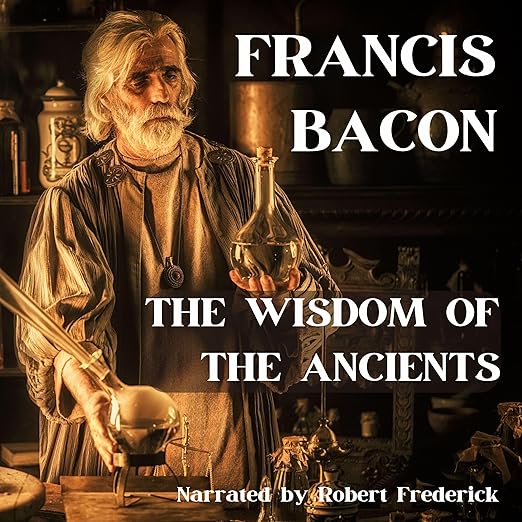
Somebody has attached the wrong name to this audiobook. The author line reads Neil Oliver, while the description directly beneath it opens by telling you that Bacon published this interesting little work in 1609, and all three written responses discuss Francis Bacon at length and nobody else. Before you decide whether a short collection of classical fables belongs on your list, you should know that this page cannot agree with itself about who wrote the thing, and that disagreement is not a small clerical matter.
Thirty-One Fables, One Argument Restated
Francis Bacon's book gathers thirty-one fables drawn from Greek and Roman myth, each retold briefly and then read for whatever Bacon takes it to mean. The description characterizes them as combining deep thought with poetic beauty, and identifies the recurring argument underneath: that knowing and acting are commonly, and wrongly, treated as convertible terms, meaning that understanding a thing and doing it are assumed to follow one from the other. Most of the fables exist to press that single distinction from a slightly different angle each time. Repetition is the method rather than an accident of it.
Thirty-one interpretations inside a short book means each one is very short indeed. Michel, five stars from Canada in July 2013, put numbers on it: roughly a hundred pages in the print edition, and about one sentence of interpretation per myth. That response is warm about the whole thing, recommending it to anyone drawn to mythology and reporting that many readings are genuinely insightful once you bring the background, while conceding that a fair number of them are obvious. Both observations can be true of a collection this size.
That same response flagged the practical obstacle too, which is a handful of Latin quotations arriving with no explanation and no translation attached. On a page you can at least look at them, copy them down, or check them afterward. Read aloud, an unexplained Latin phrase is three seconds of sound that has already gone past, and no listener is realistically going to stop a recording to transcribe something phonetically for later. A glossary would have solved it, and none exists.
A Three-Hour Read in Self-Contained Pieces
Compression is the genuine selling point. Three hours and twenty-three minutes is short enough to finish across two sittings, and the form cooperates: thirty-one self-contained pieces, none depending on the one before, each a myth followed immediately by a reading of the myth. You can stop anywhere without losing your place. Very little early modern philosophy is structured this forgivingly for a listener with an ordinary attention span, which is a real argument for the recorded edition.
Nobody Names the Text Frederick Is Reading
Robert Frederick holds the reading credit. What the page does not tell you, and what matters considerably more than the credit does, is which English text he is reading. The work was composed in Latin, so every English version in existence is somebody's translation, and no translator is named anywhere on this listing, in the description, or in the publisher information sitting beside it.
Fables are close to the ideal shape for this format. Each entry opens with a narrative, which is the mode a listener follows most easily, and then turns to commentary, which is the mode a listener follows least easily. Putting the story first buys the argument a hearing it would otherwise struggle to get. Bacon is doing philosophy through storytelling four centuries before anybody thought to call that a technique. The stories carry the ideas past a listener's defenses.
Two Responses Converge on One Translation
Translation is the problem two of the three responses converge on, and it is a serious one. G.H.Smith, two stars filed in the United Kingdom in June 2011, set the reasoning out carefully: Bacon published this work in Latin as De Sapientia Veterum in 1609, and by that account never produced an English version himself. What is offered under his name is therefore a translation, which an unwary buyer might reasonably mistake for Bacon's own prose. Nothing on the page corrects that impression.
Northern Ariadne, one star from the United States in December 2011, went further and named the consequence: an ornate, faulty, out-of-print translation that leaves the text ambiguous and hard to follow, with no scholarly material attached to help. That response steers readers toward the Spedding and Ellis edition instead, noting it can be found openly. Whether this recording uses the translation both accounts objected to is stated nowhere on the page. A buyer has no way to check before listening, and the sample will not settle it either.
Every Written Verdict Predates This Recording
Nine ratings produce the 3.0 shown at the top, and three carry written responses: a one, a two and a five, filed from three different countries between June 2011 and July 2013. This recording carries an August 2024 date. Every written verdict available to you therefore predates it by more than a decade and describes a text edition, one of them explicitly an e-reader version whose navigation that reviewer praised in passing. Navigation on an e-reader tells you nothing about a recording.
Four Things on This Page Disagree
Readers who already know their classical myth will take the most from this, because Bacon assumes the stories and spends his sentences entirely on what they mean. If the myths themselves need introducing, the interpretations arrive with nothing to attach themselves to, and commentary on narratives you cannot picture is a hard listen at any length. Some prior grounding is closer to a requirement here than to a recommendation, and the listing never mentions it.
Buyers looking for a scholarly edition should stop at this paragraph. No translator, no introduction, no notes and no textual apparatus appear anywhere on the record, and nothing in the description suggests any of it exists. Anyone studying Bacon seriously needs an edition with a named translator and an editor's hand visibly behind it. What this listing offers instead is an unattributed English rendering of a Latin original, read aloud. For a first encounter that may be enough; for anything beyond one, it is not.
Four separate things on this page disagree with one another: the byline, the description, the category tag and the written record. The author line says Neil Oliver. The description says Bacon. The tag says Architecture. The responses discuss a work written in Latin about Greek and Roman myth. Whatever is actually on the recording is worth hearing, being short, strange and genuinely old, but everything printed around it should be treated with care.