At a Glance
- Narration: Rudy Sanda keeps the pacing crisp across eight hours, finding the right register for Algeo's blend of urban history and entrepreneurial biography, the result is a listening experience that moves like the train Beach never got to run at scale.
- Themes: innovation versus political corruption, the Gilded Age's grip on infrastructure, the long cost of delayed public investment
- Mood: Energetic and novelistic, with a satisfying villain and a sympathetic inventor
- Verdict: Algeo has found a story almost too good to be true and told it with the pace of a thriller, a genuine discovery for listeners who love urban history done with narrative ambition.
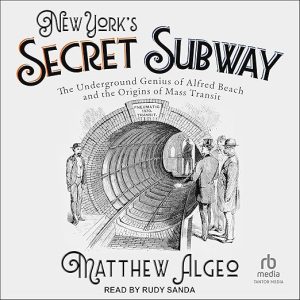
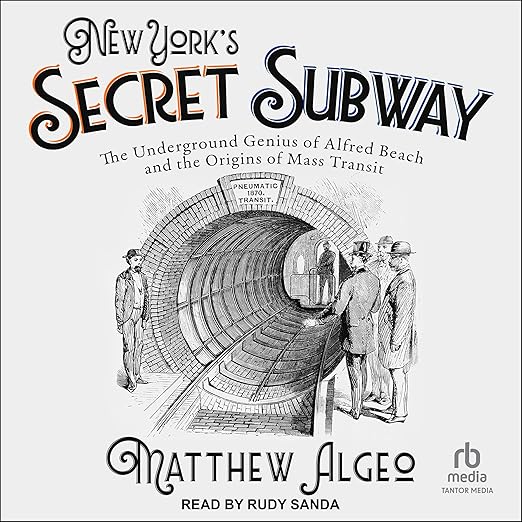
Alfred Beach built a working underground railway beneath Broadway in secret, hauling construction debris out of the tunnel at night and disguising the project as a pneumatic mail-delivery system to avoid tipping off his enemy. His enemy was William M. Tweed, "Boss" Tweed of Tammany Hall, the most spectacular political criminal New York had yet produced. This audiobook, New York's Secret Subway, narrated by Rudy Sanda, tells that story with the kind of momentum that makes eight hours feel considerably shorter.
Matthew Algeo has found the ideal subject for narrative nonfiction: a clear protagonist with a genuine vision, a compelling antagonist with real power, a remarkable engineering feat accomplished under genuinely dramatic circumstances, and a payoff that contains both triumph and tragedy. The pneumatic passenger railway Beach built beneath Broadway in 1869 was operational. It worked. It demonstrated conclusively that underground rapid transit was feasible in Manhattan. And then political opposition, financial crisis, and the accumulated inertia of a city in Tweed's grip conspired to deny New Yorkers a subway system for another thirty years after Beach proved it could exist.
Beach's Bet to Ask Forgiveness, Not Permission
What Algeo does particularly well is resist the temptation to flatten Beach into a pure hero and Tweed into a pure villain, even though their roles in the story are essentially those of the mild-mannered inventor versus the oafish tyrant. The nuance is in the details: Beach's obsessive secrecy, his decision to build without permits and ask for forgiveness rather than permission, was a calculated bet that only worked in the short term. Tweed's corruption was spectacular but also representative of how Gilded Age cities actually operated. The story is morally clear without being morally simple, which is a harder feat than it sounds.
Reviewer jopet called it "thoroughly researched and highly entertaining" and noted that Beach's original cover story, the pneumatic delivery system for mail between Manhattan post offices, was itself an extraordinary piece of misdirection. Reviewer Sharon Carmack highlighted Algeo's care in covering earlier attempts to solve New York's congestion problems, which gives the Beach story its proper context within a longer struggle to move people through a city that was growing faster than its infrastructure could manage.
Sanda's Restraint Keeps Tweed From Becoming Parody
Rudy Sanda's narration keeps the energy consistent across the full eight hours. Algeo's prose is economical and well-paced, and Sanda doesn't overplay the dramatic moments. The Tweed sections benefit from this restraint, a narrator who leaned hard into the villainy would tip the balance toward parody, and the story is better served by the understated approach. The engineering passages, which in a lesser audiobook could become dense and tedious, move cleanly in Sanda's hands.
Street Chaos and Tammany Politics, Not a Lecture
Manhattan's infrastructure story is one of the great recurring subjects of American urban history, and Algeo positions Beach's pneumatic subway within it accurately. The street-level chaos of mid-nineteenth century New York, pedestrians, horses, streetcars, vendors, all competing for the same narrow streets, with a trip from City Hall to Central Park taking hours, is rendered with enough specific detail to feel genuinely oppressive. The case for underground transit isn't just stated; it's built from the lived experience of a city that desperately needed it.
The Gilded Age political context is handled with a light touch rather than a lecture. Algeo doesn't need to explain what Tammany Hall represented or why Tweed's power was so difficult to dislodge; he dramatizes it through the specific interactions between Beach, the horse-car operators, the politicians they owned, and the tortuous legislative processes that blocked Beach's patent application at every turn. That narrative approach makes the political history feel immediate rather than archival.
A Delay Pattern That Still Sounds Familiar
The book's structure follows Beach from invention through the secret construction through the public revelation and then through the long, demoralizing aftermath, the thirty-year gap between proof of concept and actual subway construction. That final section is the one that carries the most weight for contemporary listeners, because the pattern Algeo describes, a good solution delayed by political self-interest and capital inertia until the window of opportunity closes, is not a pattern confined to nineteenth-century New York.
Algeo notes explicitly in the synopsis that although this story took place more than a century ago, it will at times sound surprisingly familiar. He's right, and the audiobook is better for not laboring that point. The parallels present themselves without prompting.
Pressure Differentials and Beach's Beautiful Waiting Room
The engineering detail is genuine but accessible. Algeo was clearly fascinated by the technical specifics of Beach's pneumatic system, the pressure differentials, the cylindrical passenger car, the beautifully appointed waiting room Beach built beneath Broadway to demonstrate that underground transit could be both functional and civilized, and that enthusiasm carries over into the narration without becoming specialized to the point of exclusion.
Great for Narrative Fans, Thin on Argument
Listeners who enjoy narrative nonfiction in the tradition of big American urban history will find this audiobook particularly satisfying. It has the pacing and character clarity of well-constructed popular history, and the subject is unusual enough that even listeners with a solid background in New York history will likely be encountering significant portions of the story for the first time.
Listeners who prefer their history delivered as analysis rather than narrative may find Algeo's novelistic approach a touch thin on structural argument. The book is an account of what happened and why, not a broad economic or sociological argument about Gilded Age urban development. That's a choice, not a deficiency, but it's worth knowing before you begin.
How much prior knowledge of New York history does this audiobook assume?
Very little. Algeo builds the context for both Tweed's political machine and the urban infrastructure crisis from the ground up. Listeners without existing knowledge of Tammany Hall or Gilded Age New York will find everything they need in the narrative itself.
Does the audiobook cover the eventual construction of New York's subway system, or does it end with Beach's project?
Algeo carries the story through to the eventual subway construction, making clear how Beach's pneumatic demonstration paved the way for the system that opened thirty years later. That longer arc gives the book its sense of historical consequence rather than just engineering curiosity.
Is this audiobook primarily about Alfred Beach as an individual, or does it range broadly across Gilded Age New York?
Beach and his direct antagonist Tweed are the central figures, but Algeo uses their conflict as a way into the broader story of Gilded Age infrastructure politics, street-level urban chaos, and the systemic obstacles facing innovation in a politically controlled city. The personal and the historical are genuinely interwoven.