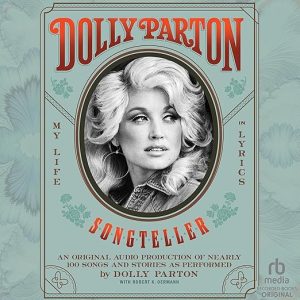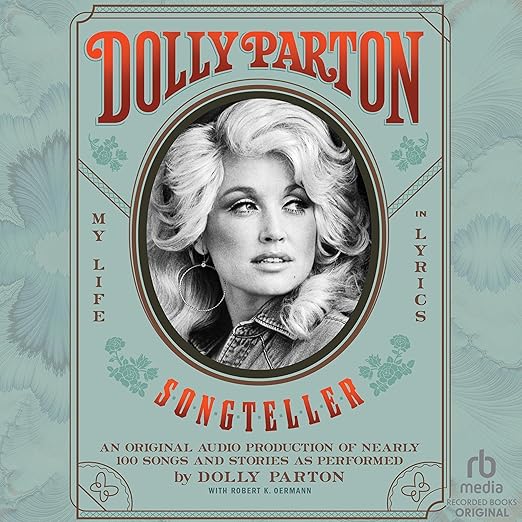
An audio original built around a songwriter's own catalog is a different animal from a memoir read aloud, and Recorded Books made that distinction the entire point of this audiobook. Dolly Parton works through nearly a hundred of her songs across five hours and eighteen minutes, singing into the stories rather than around them. The accounts posted underneath are almost entirely about a coffee-table book, which is the oddest fact attached to this listing and the first thing any buyer needs to understand.
An Exclusive Performance, Not a Memoir Read Aloud
Publisher copy is unusually precise about what was actually made here: a production of songs and stories performed by Dolly herself, an exclusive audio performance in which she weaves her words together with music and memories. That is not narration of a memoir. With something like three thousand songs to her credit and ten Grammy Awards behind her, the selection alone amounts to an act of editing, and the ones she keeps, Jolene, I Will Always Love You, 9 to 5, Coat of Many Colors, are the ones people actually ask about.
A Catalog Walked at Conversational Pace
The organizing principle is curiosity rather than chronology, and that choice pays off. A conventional celebrity memoir marches through decades whether or not anything happened in them. This one moves from song to song, which means each segment arrives with its own reason to exist and its own natural ending. The trade is that nothing accumulates into an arc, so the book works in fragments and rewards being picked up rather than being finished.
One expectation needs adjusting before you press play. Nearly a hundred songs inside a little over five hours works out to a few minutes each with the stories included. This is not an album and it is not a concert; it is a catalog walked at conversational pace, with the music used as illustration. Once you hear it that way the pacing makes complete sense, and the alternative, a straight memoir with the songs described rather than sounded, would have been far worse.
Phrasing a Hired Reader Cannot Supply
Author and reader are one person here, and that is more than a convenience. A songwriter explaining her own lyrics is doing something a hired reader structurally cannot, because the explanation and the performance issue from the same source. Recorded Books built the production around exactly that, and the description calls the result an exclusive audio performance rather than a recording of an existing book.
That distinction carries the whole case for choosing the audio. A printed Songteller can reproduce a lyric and a photograph of the room it was written in; it cannot supply the phrasing, the key, or the particular way a line lands when delivered by the person who wrote it. Lyrics on a page are famously inert things. Heard in the voice that made them, with the circumstance attached, they do something no book can arrange.
Catalog range is the other argument. Ten Grammy Awards and roughly three thousand songs is a body of work with real range inside it, and the selection here reaches across the famous titles and the ones standing behind them. The description promises the stories behind the stories, and connecting a lyric to the circumstance that produced it remains the single most reliable pleasure this whole format offers.
Four Reviews About a Coffee-Table Book
Now the trouble with the reviews. Four of the five accounts on this listing are not about the recording at all. Captain Grouper's five-star post is a transaction review, satisfied with the purchase and noting that the book looks nice. K.T.'s reports buying it as a gift for a sister who loved it. Amazon Customer describes a big, heavy coffee-table book packed with photographs, currently occupying the writer's actual coffee table, and praises the packaging it arrived in. Jordan's says it is good for the kids. Not one of those describes anything you can listen to.
Only the fifth account does real critical work and is explicitly about a third edition again. Aanel Victoria bought the digital text, says so plainly, and regrets missing the color photographs of the large-format version. It is still the most useful writing on the page: it reports learning a good deal about Parton's upbringing, her family's poverty and her musical relatives, and describes the book as a series of short vignettes introduced by lyrics. That same account quotes the subtitle as My Life in Song Lyrics.
Three Titles, and the Displayed One Is Wrong
Which brings up the titles, three of which are currently in play. The listing displays Dolly Parton, Songteller. The description calls it Dolly Parton, Songteller: My Life in Lyrics. A reader quotes a third variant. The displayed version is the one that matters commercially and it is the one missing its subtitle, which is the single phrase telling a browser that this book is organized around the writing rather than being one more celebrity life story.
A pair of smaller cautions remains. The vignette structure accumulates rather than builds, so anyone expecting a shaped life story with a beginning and an end should adjust the expectation now. And a 4.9 average drawn from ten ratings measures very little: ten people, nine of whom must have left five stars for that figure to appear, standing in for an audience that runs into the millions.
Answers Where a Song Like Jolene Came From
Fans of the catalog are the obvious audience, and specifically the ones who have wondered where a particular song came from. If you have ever wanted to know who Jolene was, this is the only place the person who wrote her is going to answer, and the answer arrives in the same voice that made the question worth asking in the first place.
Songwriters and anyone interested in craft make up the second group. A working writer talking through the origins of a hundred pieces of her own work, in her own voice, is a primary source, and primary sources about songwriting are considerably rarer than they ought to be. The format also suits family listening better than most memoirs, since the segments are short, the songs are familiar and nothing requires prior knowledge.
Listeners who came for the pictures are on the wrong edition, which is the clearest single lesson of the reviews gathered here; the large-format book and this recording are different products answering different appetites. Anyone wanting a conventional cradle-to-present memoir should look elsewhere too, because the songbook is the organizing device rather than the calendar. What remains is precisely what the description claims, in the only edition where the songs actually sound.
Questions Listeners Ask
Does the audiobook include actual singing?
Yes, and that is the point of the format. The description promises the songs themselves alongside the memories attached to them, delivered by Parton rather than read out by anybody else. Expect passages and excerpts rather than full studio recordings across a hundred titles; the music illustrates the stories rather than replacing them.
Is the audiobook the same content as the coffee-table book?
No, and the gap between them is the whole reason to choose one over the other. The print edition carries large-format color photographs and a presentation the recording obviously cannot reproduce. The recording carries the voice, the phrasing and the music, none of which a page delivers. They overlap in text and diverge in everything else.
What questions does it actually answer?
The description names three outright: how close I Will Always Love You came to being recorded as a duet with Elvis, how Parton became an actress, and exactly who Jolene was. Those are the questions fans have circled for decades, and building a book around them is a better idea than another chronological march.