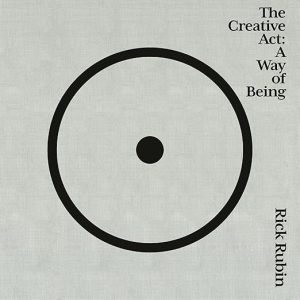
Coffee table book is a phrase that turns up in the written record for this one, and it is offered there as praise. It is also about the most awkward thing anybody could say about an audiobook. Rick Rubin's book was built to be opened at random, held for a page and set down again, and the audio edition asks you to receive it as a continuous sequence instead. That tension runs through everything else worth saying here.
Rubin's Book on How to Be, Not Do
Rubin's proposition is stated in his own words inside the description: he set out to write a book about what to do to make a great work of art, and it revealed itself instead as a book on how to be. That distinction governs the whole thing, and it separates a book you work through from one you simply live alongside. The chapters are short, aphoristic and cumulative rather than sequential, and what the book promises is a way of relating to the world rather than a method to follow. Anybody arriving for a process will spend an hour waiting for one to begin.
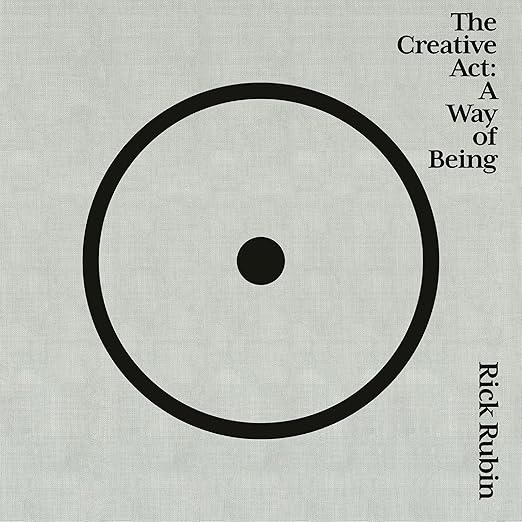
Tony, writing five stars in January 2026, describes it from the working end. "This isn't a how-to book or a guide filled with tactics. It's more about mindset and awareness, and how to create space for ideas to show up." That account also gives the book its full name, The Creative Act: A Way of Being, which is the subtitle this listing leaves off, and which happens to be the clearest possible warning a buyer could get about what the book is not.
Aphorisms That Survive on Cadence
Rubin has the reading credit on this one, and for a book of aphorisms that is close to necessary. Short declarative paragraphs with white space around them survive on cadence, and a text this dependent on pauses puts an unusual amount of weight on whoever decides where they fall. The page carries no further production detail beyond that credit and the publisher, so one name is doing all the work here.
Nothing Depends on Thirty Minutes Earlier
Whatever makes this awkward in audio also makes it worth replaying. Nothing depends on what came thirty minutes earlier, which means any section stands on its own and the whole recording tolerates being played in fragments. One March 2026 response reports learning things and, more to the point, feeling new things, and describes the book helping to reframe parts of a life that had never been counted as creative expression at all.
Better on a Third Pass
Audience is genuinely broader than the author's day job would suggest. Rubin is a music producer and the tag on this page says music, yet the copy says plainly that the subject is artists of all genres and traditions, and the written record bears that out. A graphic designer and marketer, a lifelong musician and composer, and a reader who had never thought of themselves as creative have all posted here, and none of the three writes about records or studios.
Five hours and forty-five minutes is short for a book carrying this reputation, and the brevity is structural rather than a shortfall. Aphorism does not pad, and there was never a chapter here that needed filling out to length. What you get is a compressed sequence of small pieces instead of a sustained argument, which is why the thing works as something to return to rather than to complete, and why finishing it once tells you very little about what it will eventually be worth to you. Books of this shape get better on a third pass.
A Pause the Listener Must Manufacture
The coffee-table objection is the real one. Justin Morrison, in a four-star account from November 2024, describes the book as easy to pick up, put down and resume later, with short chapters full of quiet advice to carry through the day. Every one of those verbs describes handling a physical object rather than following a recording. Audio gives you a play button and a timeline, and the reflective pause the book was designed around has to be manufactured by the listener rather than supplied by the object.
Eleven Ratings, One Written in Spanish
Numbers here are smaller than they look. Eleven ratings sit beneath a book the description calls the number one New York Times bestseller, and five written notices sit under them. One of those five is written in Spanish and posted from Mexico in February 2026, which leaves four English-language accounts of an English recording. None of the eleven votes is explained by anything beyond those four, which is a remarkably thin public record for a title carrying that billing.
Losing the subtitle compounds the mismatch. A Way of Being is not decoration, it is the correction the book keeps making about itself. Without it, the listing's title reads as a manual, and a buyer expecting exercises and tactics will spend the first hour waiting for them to start. Nothing else on the listing corrects that impression, and the description's talk of a generous course of study actively reinforces it.
For the Stuck, Not the Untrained
Anyone inside a creative practice who is stuck rather than untrained is the audience. The book assumes you can already do the thing and addresses the conditions around doing it, which is why it lands with working designers, musicians and writers and tends to frustrate people looking for a first lesson. James Monday's account describes anecdotes and exercises sitting alongside the reflection, which is a fair summary of the mix on offer, though the reflection outweighs the rest by some distance.
Listeners who want something to return to rather than to finish are the other group. Treated as a rotation, a few pieces at a time, the recording behaves the way the printed book does on a table, and the short chapters make that easy to organize around a week. Treated as a single sitting, it flattens into repetition, which is a fault of the listening plan rather than of the writing. Nobody reads a book of aphorisms cover to cover in one go either.
Skip it if you want tactics, tools or a process to follow, since the book refuses all three on principle and says so within its first few minutes. Skip it too if aphorism without argument irritates you, because that is the entire mode from beginning to end. Past those two objections sits a short, unusually generous book about the conditions creativity needs, read by the person who spent a career arranging them for other people.
Frequently Asked Questions
Is The Creative Act audiobook read by Rick Rubin?
Yes, and on a book of short aphoristic chapters the choice carries real weight. The whole text depends on cadence and on the pauses between paragraphs, so whoever sets them shapes the experience. No producer, director or second voice is credited anywhere, making the author's name the entire production record.
Does this audiobook work if you are not a musician?
It does. Rubin is a music producer and the page tags this music, but the description addresses artists of all genres and traditions, and the examples are not drawn narrowly from the recording studio. Designers, writers and people with no formal practice at all sit comfortably inside the intended audience.