Quick Take
- Performance: Christa Lewis is exceptionally well-matched to this material, warm and precise without sentimentality
- What it covers: Women's economic history, material culture as evidence, continuity across centuries, recovery of erased lives
- Feel: Measured and revelatory, building quietly to genuine emotional resonance
- Our call: Richly rewarding for listeners who bring patience and prior interest in decorative arts or women's history
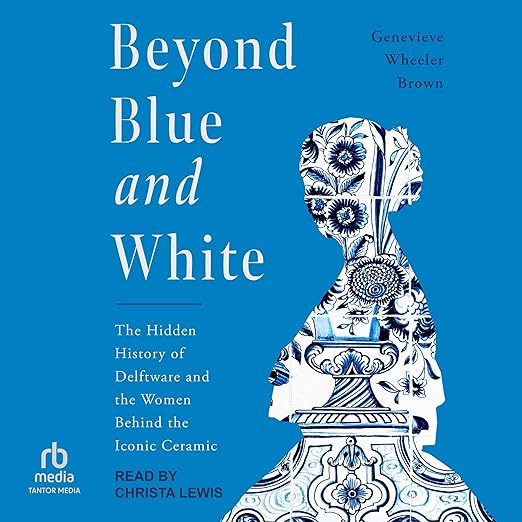
Decorative arts history rarely generates the kind of intimate drama that Genevieve Wheeler Brown finds in seventy-five pieces of Delftware discovered in a historic Manhattan townhouse, but this audiobook, narrated by Christa Lewis, builds a compelling case that these cobalt-glazed ceramics are nothing less than a record of women's lives across three centuries. Beyond Blue and White is a curatorial investigation that becomes cultural history by degrees, and it rewards patient listening with genuine revelations about who owned, made, and traded these objects across the early modern world.
Delftware as a Record of Undercounted Women
Wheeler Brown's position as a decorative art advisor gives her a specific professional lens through which to read these objects, and she uses it with real skill. The discovery of 75-plus pieces of 17th- and 18th-century Delftware in a single Manhattan location is unusual enough to warrant serious attention on its own terms. Wheeler Brown's insight is that the collection is not merely interesting as an aesthetic artifact but as a social document, and specifically as a document of women whose role in the economic and cultural life of their time was systematically undercounted by the historical record.
Christa Lewis Matches a Measured, Specific Prose
The prose is measured and specific without becoming dry. Wheeler Brown moves between close description of individual pieces, the painted scenes, the maker's marks, the wear patterns that suggest decades of actual use rather than display, and expansive historical context with a fluency that suggests someone who has spent years thinking about how objects carry meaning across time. Christa Lewis's narration matches this register precisely: unhurried, attentive, and confident in material that requires both scholarly authority and genuine warmth.
At 4.7 stars across 8 hours and 22 minutes, this is an audiobook that found its audience and delivered precisely what that audience hoped for. The rating reflects not just subject matter appeal but execution: Wheeler Brown has written something that earns the discovery premise fully.
Merchant Widows and Workshop Painters as Evidence
The book's strongest sections are those where Wheeler Brown reconstructs specific women from the historical record that these ceramics point toward. A piece that was owned by a particular merchant's widow, a tile that traces to a workshop where women worked as painters, a service that passed through four generations of female inheritance: each of these threads opens into a micro-history that collectively builds the book's central argument about women's active participation in the Delftware trade and the culture of collecting and display that surrounded it.
For listeners interested in material culture as a historical methodology, the audiobook offers a compelling model of how to read objects as evidence rather than merely as aesthetic products. Wheeler Brown is rigorous about what the ceramics can and cannot tell us, which makes her reconstructions feel trustworthy rather than speculative. When she moves into imaginative recovery of historical scenes, she signals clearly that she is doing so, and Christa Lewis's narration sustains a tone that is warm without being sentimental, keeping these passages from drifting into historical fiction while preserving their emotional resonance.
The book also works as an argument about the archival work that remains to be done on women's economic history in the early modern period. Wheeler Brown is not simply recovering individual women from obscurity; she is demonstrating that the objects they left behind constitute a form of evidence that conventional textual archives have not always captured, and that the curatorial investigation of these objects is itself a form of historical recovery.
Christa Lewis's performance across the full 8 hours and 22 minutes is consistent and well-calibrated. She navigates the book's shifts between close object description and broader historical argument without losing either the precision the former requires or the momentum the latter needs to sustain a listener's engagement over this length.
No Accessibility Hook for the Casually Curious
Listeners without prior interest in decorative arts or early modern European history may find the opening chapters require some adjustment. Wheeler Brown assumes an audience that finds the specific details of ceramic production, glaze chemistry, trade routes, and provenance research inherently interesting, and she does not front-load the book with the kind of broad accessibility hook that popular history often relies on to secure initial engagement.
The Manhattan discovery that frames the book functions more as an organizing device than as a sustained narrative thread. Listeners expecting regular returns to the present-day discovery story and its investigation will find the book spends most of its time in the historical record rather than in the contemporary curatorial process. The discovery is a starting point rather than a story the book is actively telling throughout.
Some of the connective tissue between individual women's stories and the broader argument about gender and economic life in the period moves more quickly than the richest sections of the book allow. The argument is convincing overall, but these transitional passages can feel slightly compressed relative to the careful development that characterizes the book's best material.
Museum Professionals Will Find This Directly Relevant
This audiobook is built for listeners who enjoy narrative history focused on recovered or undervalued perspectives, with a specific appetite for material culture and the history of decorative arts. Art historians, museum professionals, curators, and anyone with interest in early modern European women's economic history will find it directly relevant and genuinely enriching.
Genevieve Wheeler Brown has written something that justifies its discovery premise fully, turning what could have been a narrow curatorial essay into a genuinely moving account of the women these objects outlasted. Christa Lewis's narration makes the audio format the right choice for this material, and the 4.7 rating reflects an audience that arrived with the right expectations and found them exceeded.
Do I need a background in art history to appreciate this audiobook?
No formal background is required, but listeners who find the specific details of ceramic production and provenance research inherently interesting will engage more deeply with Wheeler Brown's core method.
Is Beyond Blue and White a general women's history audiobook or is it primarily about ceramics?
It is deliberately both. The Delftware functions as the lens through which Wheeler Brown recovers the lives of the women who owned, made, and traded these objects across three centuries.