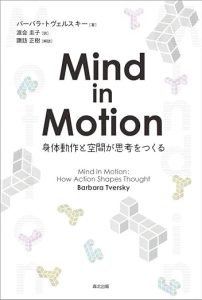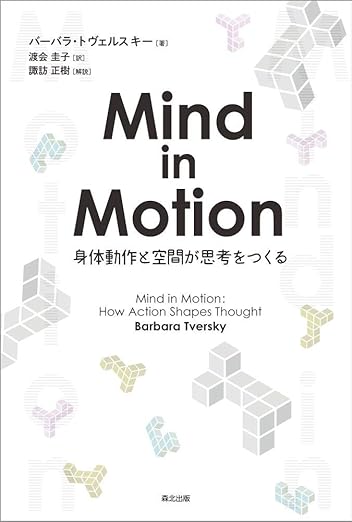
In Brief
- Voice: Cassandra Campbell's steady delivery holds together prose that moves associatively rather than linearly
- Big ideas: Spatial cognition, embodied thought, gesture as thinking, how bodies shape abstract reasoning
- Atmosphere: Contemplative and intellectually restless
- Worth it?: Rewarding for patient listeners who embrace essayistic argument; challenging for those who need tight structure
Cognitive science has spent decades asking how language shapes thought, but Barbara Tversky's audiobook Mind in Motion reframes the question entirely: what if the body came first? This is a book about spatial reasoning, gesture, and the way physical action in the world scaffolds everything from mathematics to architecture to the stories we tell each other. Cassandra Campbell narrates across 11 hours and 17 minutes in a production that suits the material's contemplative pace, and the result is an extended encounter with one of the most original thinkers currently working in cognitive psychology.
We Think in Action Before Words
Tversky's central argument is both provocative and carefully supported: language is not the foundation of thought. Bodily movement and spatial reasoning are. We think in action before we think in words, and the abstractions we build, diagrams, maps, gestures, metaphors rooted in up and down and near and far, all trace back to how our bodies move through and interact with physical space. This is a thesis with significant implications for how we understand learning, communication, design, and cognition across cultures.
A 3.6 Average Reflects a Genuine Division
Tversky has the research to back the argument. She draws on studies of how people sketch maps, how architects think about space, how children learn number concepts through physical manipulation, and how gesture reveals thought that speech alone cannot carry. The intellectual range is genuinely impressive. The problem, and it is worth naming honestly, is that the prose advances associatively rather than linearly. Arguments emerge through accumulation and juxtaposition more than through explicit logical scaffolding. Reader reviews split predictably on this feature, and the 3.6 average rating reflects a genuine division between listeners who find the style generative and listeners who find it frustrating.
This is not a book that summarizes neatly. It is a book that changes how you notice things, and that effect depends on a willingness to follow an argument that does not always announce where it is headed.
Campbell Gives Fragmentary Prose Room to Breathe
Cassandra Campbell's narration is one of the strongest arguments for choosing the audio format for this particular book. Her steady, unhurried delivery gives Tversky's fragmentary prose room to breathe, and she navigates the tonal shifts between research summary, personal anecdote, and philosophical observation without the text feeling choppy or disconnected. At 11 hours and 17 minutes, this is a substantial commitment, but Campbell keeps the experience from becoming exhausting by maintaining a pace that invites attention rather than demanding it.
Gesture Is a Parallel Cognitive Channel
The book's best sections are its most concrete. Tversky on wayfinding and how different cultures encode spatial directions reveals how deeply culturally variable our cognitive habits are. Some languages require constant awareness of cardinal directions, forcing speakers to maintain a continuous mental orientation that English speakers never develop. This section alone is worth the runtime for anyone interested in the relationship between language, environment, and mind.
Her analysis of gesture as thought made visible is equally revelatory, particularly for anyone who has ever caught themselves waving their hands while trying to explain something on the phone. Tversky shows that gesture is not decoration for speech but a parallel cognitive channel, and the research she draws on to demonstrate this is fascinating. The chapter connecting spatial reasoning to mathematical abstraction is among the most original contributions in the book, tracing a continuous line from the way we orient ourselves in physical space to the way we navigate abstract problem-solving.
For listeners willing to engage with a text that does not hand them conclusions in a tidy sequence, the payoff across these 11 hours is substantial. Tversky is thinking through her ideas in front of you, and even when that process produces less-finished passages, the intellectual company is worth it.
This Won't Suit Every Cognitive Style
The associative structure is a real challenge, and it is the primary reason for the book's mixed reception. Tversky moves between anecdote and research finding and philosophical claim in a way that assumes an engaged reader willing to do some of the connective work. Listeners who prefer tightly argued nonfiction with clear chapter-by-chapter takeaways may find this disorienting. The 3.6 average rating honestly signals that this book will not suit every listener's cognitive style.
The book occasionally gestures toward conclusions it does not fully develop before moving on, which produces a nagging sense of incompletion in certain sections. Some of the research citations are handled lightly enough that curious listeners will want to pursue the underlying sources independently. This is more a feature of the book's essayistic mode than a correctable flaw, but it is worth knowing before committing eleven hours to the project.
A handful of sections aimed at connecting spatial cognition to social behavior feel less rigorously developed than the perceptual and motor cognition chapters that form the book's core. These passages read more like promising sketches than finished arguments, and they represent the most significant gap between the book's ambition and its execution.
Thought Isn't Linear, and Neither Is This
This audiobook is best suited to listeners with existing interest in cognitive science, linguistics, design, philosophy of mind, or education who are comfortable with scholarly prose that does not hold your hand through every transition. Architects, product designers, educators, mathematicians, and anyone who works with spatial or visual thinking professionally will find directly applicable insights throughout.
It is not the right entry point for someone new to cognitive science who wants a structured introduction to the field. For that audience, a more conventionally organized book would serve better. But for the listener who wants to sit with a genuinely original thinker working through ideas in real time, even when that process is messier than a polished lecture, Mind in Motion offers something rare: a book that actually practices what it argues. Thought, for Tversky, is not linear. Neither is this, and that is both its limitation and its point.